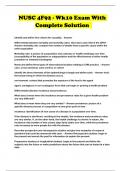
NUSC 4F92 - Wk10 Exam With
Complete Solution
Identify and define five criteria for causality. - Answer
Differentiate between mortality and morbidity rates. How does each inform the CHN? -
Answer mortality rate: compare the number of deaths from a specific cause within the
entire population
Morbidity rate: a picture of a population and a disease or health challenge over time
(susceptibility of the population or subpopulation and the effectiveness of either health
promotion or treatment strategies)
Name and define three types of observational studies relating to CHN practice. - Answer
case, cross-sectional, case-control, or cohort
identify the three elements of the epidemiologic triangle and define each. - Answer host:
the human being in which the disease occurs.
environment: context that promotes the exposure of the host to the agent
agent: contagious or non-contagious force that can begin or prolong a health problem
Differentiate between incidence and prevalence.
What does it mean when the incidence and prevalence rates for a given health problem
are very different?
What does it mean when they are very similar? - Answer prevalence: picture of a
specific disease process in a population at one given point in time.
incidence: identification of new cases of a disease in a population over time.
If the disease is shortlived, resulting in few deaths, the incidence and prevalence rates
are very similar. If, on the other hand, the health challenge is chronic in nature, the
incidence rate (number of new cases) stays fairly static over time, while the prevalence
rate increases as more people live with the disease.
Describe prospective and retrospective studies and give two examples of research
questions that could be answered with each. - Answer Retrospective studies: begin in
the present and search the past for information to explain the present.
Prospective studies (or longitudinal studies): begin in the present and follow the
subjects into the future or make predictions about the future that can be tested at a later
date.
Complete Solution
Identify and define five criteria for causality. - Answer
Differentiate between mortality and morbidity rates. How does each inform the CHN? -
Answer mortality rate: compare the number of deaths from a specific cause within the
entire population
Morbidity rate: a picture of a population and a disease or health challenge over time
(susceptibility of the population or subpopulation and the effectiveness of either health
promotion or treatment strategies)
Name and define three types of observational studies relating to CHN practice. - Answer
case, cross-sectional, case-control, or cohort
identify the three elements of the epidemiologic triangle and define each. - Answer host:
the human being in which the disease occurs.
environment: context that promotes the exposure of the host to the agent
agent: contagious or non-contagious force that can begin or prolong a health problem
Differentiate between incidence and prevalence.
What does it mean when the incidence and prevalence rates for a given health problem
are very different?
What does it mean when they are very similar? - Answer prevalence: picture of a
specific disease process in a population at one given point in time.
incidence: identification of new cases of a disease in a population over time.
If the disease is shortlived, resulting in few deaths, the incidence and prevalence rates
are very similar. If, on the other hand, the health challenge is chronic in nature, the
incidence rate (number of new cases) stays fairly static over time, while the prevalence
rate increases as more people live with the disease.
Describe prospective and retrospective studies and give two examples of research
questions that could be answered with each. - Answer Retrospective studies: begin in
the present and search the past for information to explain the present.
Prospective studies (or longitudinal studies): begin in the present and follow the
subjects into the future or make predictions about the future that can be tested at a later
date.