3.5 Electricity
3.5.1 Current Electricity
Basics of Electricity:
Current = The rate of flow of charge.
Charge (C) = Current (A) x Time, Q = It
Coulomb (Unit of Charge) = The charge that flows when 1A of current flows for 1 second.
--> We can find out how many electrons are needed to deliver charge using the charge of an electron
(found in data book).
-In a charge-time graph, current is the gradient (using a tangent)
-In a current-time graph, charge is the area under the graph (i.e. integrating I dt = Q)
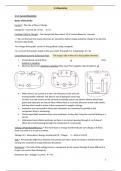
Conventional Current & Electron Flow: The longer side of the cell is the positive terminal
Conventional current flows from
positive to negative
Electrons flow from negative to positive (they repel from negative side of battery)
When there’s no current in a wire, the electrons in the wire are
moving totally randomly, but they’re not all going the same way
so there’s no net current as the currents essentially cancel out (atoms vibrate about fixed
points but electrons are free to flow). When there is a current, electrons travel really slowly
but they don’t need to arrive at the component to supply it charge.
Ammeters are connected in series and voltmeters are connected in parallel to the
component they’re measuring.
(Unless specified) ammeters have zero resistance, so they don’t stop the current flowing in a
circuit.
Voltmeters have infinite resistance so there is no current passing through it, so it doesn’t
affect the current passing through the component it’s measuring.
Voltage (/Potential Difference) = The work done or energy transferred) per unit charge as it flows
from one point in a circuit to another.
Voltage (V) = Work done (/Energy transferred) (J) / Charge, V = W/Q or V=E/Q
Volt = The potential difference between two points such that 1 joule of energy is transferred when
moving one coulomb of charge between the points.
Resistance = The ratio of the voltage across a component to the current through it (how difficult it is
to get a current to flow through it).
Resistance (Ω) = Voltage / Current, R = V/I
1
, Ohm = The resistance such that a potential difference of 1 volt causes a current of 1 amp to flow.
Current-Voltage Characteristics:
-When calculating resistance from an I-V characteristic, read off the values for I and V, the find R,
don’t use the gradient!
-It’s better to calculate resistance using larger values so the uncertainty is smaller.
Ohmic Conductor: (e.g. a resistor)
The graph is a straight line which passes through the origin (therefore it
obeys Ohm’s law). Therefore, resistance is constant, and the current is
directly proportional to the potential difference across it. (Usually
resistance has no relation to the gradient, but in this case, resistance =
1/gradient (where y = I, x = V)).
Filament Lamp:
Resistance is not constant. As the current flows through the filament,
it gets hot, so the resistance increases, causing the current to still
increase as voltage increases, but at a slower rate. There’s less current
per volt applied so the line curves away from proportionality.
Semiconductor Diode:
A diode is designed to let current flow in only one direction. Forward
bias is the direction in which the current can flow, in reverse bias (left
hand side), the resistance is very high so the current that flows is almost
zero. At around 0.65V (threshold voltage) the diode will conduct and
then the current will increase a large rate.
Ohm’s Law = The current flowing through a conductor is proportional to the voltage across it,
provided the physical conditions remain constant.
I ∝ V, as long as physical conditions are constant, such as temperature and light level.
Resistivity:
Resistivity describes how well particular materials resist the flow of current. (Resistance is about
particular components).
Resistivity = The resistance of a material of unit length
and unit cross-sectional area. It’s measured in Ωm.
2
3.5.1 Current Electricity
Basics of Electricity:
Current = The rate of flow of charge.
Charge (C) = Current (A) x Time, Q = It
Coulomb (Unit of Charge) = The charge that flows when 1A of current flows for 1 second.
--> We can find out how many electrons are needed to deliver charge using the charge of an electron
(found in data book).
-In a charge-time graph, current is the gradient (using a tangent)
-In a current-time graph, charge is the area under the graph (i.e. integrating I dt = Q)
Conventional Current & Electron Flow: The longer side of the cell is the positive terminal
Conventional current flows from
positive to negative
Electrons flow from negative to positive (they repel from negative side of battery)
When there’s no current in a wire, the electrons in the wire are
moving totally randomly, but they’re not all going the same way
so there’s no net current as the currents essentially cancel out (atoms vibrate about fixed
points but electrons are free to flow). When there is a current, electrons travel really slowly
but they don’t need to arrive at the component to supply it charge.
Ammeters are connected in series and voltmeters are connected in parallel to the
component they’re measuring.
(Unless specified) ammeters have zero resistance, so they don’t stop the current flowing in a
circuit.
Voltmeters have infinite resistance so there is no current passing through it, so it doesn’t
affect the current passing through the component it’s measuring.
Voltage (/Potential Difference) = The work done or energy transferred) per unit charge as it flows
from one point in a circuit to another.
Voltage (V) = Work done (/Energy transferred) (J) / Charge, V = W/Q or V=E/Q
Volt = The potential difference between two points such that 1 joule of energy is transferred when
moving one coulomb of charge between the points.
Resistance = The ratio of the voltage across a component to the current through it (how difficult it is
to get a current to flow through it).
Resistance (Ω) = Voltage / Current, R = V/I
1
, Ohm = The resistance such that a potential difference of 1 volt causes a current of 1 amp to flow.
Current-Voltage Characteristics:
-When calculating resistance from an I-V characteristic, read off the values for I and V, the find R,
don’t use the gradient!
-It’s better to calculate resistance using larger values so the uncertainty is smaller.
Ohmic Conductor: (e.g. a resistor)
The graph is a straight line which passes through the origin (therefore it
obeys Ohm’s law). Therefore, resistance is constant, and the current is
directly proportional to the potential difference across it. (Usually
resistance has no relation to the gradient, but in this case, resistance =
1/gradient (where y = I, x = V)).
Filament Lamp:
Resistance is not constant. As the current flows through the filament,
it gets hot, so the resistance increases, causing the current to still
increase as voltage increases, but at a slower rate. There’s less current
per volt applied so the line curves away from proportionality.
Semiconductor Diode:
A diode is designed to let current flow in only one direction. Forward
bias is the direction in which the current can flow, in reverse bias (left
hand side), the resistance is very high so the current that flows is almost
zero. At around 0.65V (threshold voltage) the diode will conduct and
then the current will increase a large rate.
Ohm’s Law = The current flowing through a conductor is proportional to the voltage across it,
provided the physical conditions remain constant.
I ∝ V, as long as physical conditions are constant, such as temperature and light level.
Resistivity:
Resistivity describes how well particular materials resist the flow of current. (Resistance is about
particular components).
Resistivity = The resistance of a material of unit length
and unit cross-sectional area. It’s measured in Ωm.
2