1. Globalizing Business
§1. What Is Global Business
This book focuses on both the I and B of International business. To cover both it
defines global business as business around the globe, and in stead of focusing
only on the foreign part (I), as the previous generation of text books do. Many
previously domestic markets are now globalized. It becomes difficult to tell, in the
competition of winning costumers, what is international and what is ‘domestic’.
Thus ‘global’ seems to be a better word to capture the essence of the
competition.
This book also devotes extensive space to the competition in emerging
economies/markets unlike others. This is important because the emerging
markets contribute approximately 50% of the global gross domestic product
(adjusted for PPP).
A great deal of institutional development and infrastructure and factor market
development has taken place in emerging economies. Such wide-ranging
development has resulted in the emergence of a class of mid-range emerging
economies, that differ from traditional emerging and developed economies, Some
economies graduated from ‘emerging’ and became ‘newly developed countries’.
Led by BRIC, emerging economies accomplished “the biggest economic
transformation (Great Transformation) in modern economy.
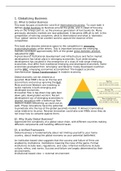
Global economy can be viewed as a
pyramid. Most MNE’s focus on the top and
second tiers and end up ignoring the BoP.
More and more Western are investing to
tackle markets in both emerging and
developed economies.
Innovation flow is top-down (top gets best
down gets downgraded version). Recent
development out of emerging economies is
reverse innovation with a bottom-up flow
(bottom makes something up could use as
well). These innovations have the potential
to penetrate into the top of the global pyramids market. It delivers tremendous
value relative to its price. Reverse innovation could take over MNEs since they do
not know how to compete against them.
§2. Why Study Global Business?
Appreciate the complexity of a global value chain, with different countries making
different components and handling different tasks.
§3. A Unified Framework.
Global business is fundamentally about not limiting yourself to your home
country, about treating the global economy as your potential battlefield.
An institution-based view suggests that the success and failure of firms are
enabled by institutions. Institutions meaning the rules of the game. Formal
institutions include laws, regulations, and rules. Informal institutions include
culture, ethics, and norms. Success and failure are largely determined by their
environments.
Institutional-based view -> external environment
§1. What Is Global Business
This book focuses on both the I and B of International business. To cover both it
defines global business as business around the globe, and in stead of focusing
only on the foreign part (I), as the previous generation of text books do. Many
previously domestic markets are now globalized. It becomes difficult to tell, in the
competition of winning costumers, what is international and what is ‘domestic’.
Thus ‘global’ seems to be a better word to capture the essence of the
competition.
This book also devotes extensive space to the competition in emerging
economies/markets unlike others. This is important because the emerging
markets contribute approximately 50% of the global gross domestic product
(adjusted for PPP).
A great deal of institutional development and infrastructure and factor market
development has taken place in emerging economies. Such wide-ranging
development has resulted in the emergence of a class of mid-range emerging
economies, that differ from traditional emerging and developed economies, Some
economies graduated from ‘emerging’ and became ‘newly developed countries’.
Led by BRIC, emerging economies accomplished “the biggest economic
transformation (Great Transformation) in modern economy.
Global economy can be viewed as a
pyramid. Most MNE’s focus on the top and
second tiers and end up ignoring the BoP.
More and more Western are investing to
tackle markets in both emerging and
developed economies.
Innovation flow is top-down (top gets best
down gets downgraded version). Recent
development out of emerging economies is
reverse innovation with a bottom-up flow
(bottom makes something up could use as
well). These innovations have the potential
to penetrate into the top of the global pyramids market. It delivers tremendous
value relative to its price. Reverse innovation could take over MNEs since they do
not know how to compete against them.
§2. Why Study Global Business?
Appreciate the complexity of a global value chain, with different countries making
different components and handling different tasks.
§3. A Unified Framework.
Global business is fundamentally about not limiting yourself to your home
country, about treating the global economy as your potential battlefield.
An institution-based view suggests that the success and failure of firms are
enabled by institutions. Institutions meaning the rules of the game. Formal
institutions include laws, regulations, and rules. Informal institutions include
culture, ethics, and norms. Success and failure are largely determined by their
environments.
Institutional-based view -> external environment