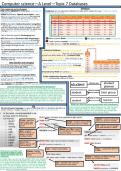
Computer science—A Level—Topic 7 Databases
Data capturing and exchanging Databases
Data can be captured in many ways, manually or Databases are an organised collection of data which allows for easy: modifying, adding,
automatically: deletion and searching.
•OMR (Automatic): Optical mark reader– used
to detect presence of pencil marks by receiving
reflected light from the pencil marks, it then
recognises the pattern and sends it to the com-
puter for analysing and reporting.
•OCR (Automatic): Optical character recognition
– consist of scanner and special software—scans
text on a document or piece of paper into com-
puter then the software examines the paper and
changes letters into form it can be edited.
This is also the same for Exchanging data:
•EDI (Automatic): Electronic data interchange— Table contains fields—columns/attributes. The data is stored in a table—entity/file.
a computer-to-computer exchange of business
documents in a standard electronic format be- Table contains records—rows/tuples.
tween business partners. EDI documents can The table above is a flat file database as it allows users to specify data attributes for only
flow straight through to the appropriate applica- one table at a time storing those attributes independently.
tion.
•A comma-separated values file (CSV) is A Relational database allows the user to specify
another popular format for exchanging information about multiple tables and the rela-
data—each record is on a separate line and tionship between them. Here we can extract tutor
each field is separated by commas. group from both tables as it’s a common field.
Manual methods could include: paper, There must be at least one field in each record
memory stick etc. that is uniquely identifiable—this is known as the
primary key (Student ID etc).
Data Selection and managing The primary key in the Tutor table has become
One of the best ways of selecting data is the foreign key in the Student table. A Foreign
structured query language (SQL) - it allows key is the linking field in the foreign table formed
for fast and efficient retrieval, deletion and when a relationship is made.
manipulation of data using simple com-
mands. Secondary key fields are used as a search criteria, it
is often meant to be me more memorable than a primary key hence used as a search criteria.
A database manipulation language (DML)
can be used to modify a database by adding Entity-relationship diagrams (ERD) are used to sketch the relationships between database
new data or deleting data by using com- tables, relationships come in 3 forms:
mands such as: UPDATE, DELETE, INSERT.
You could also use database management sy- One to one
stem (DBMS) as it provides a layer of abstraction for the user and programmer.
How can data be captured and exchanged for databases?
Data needs to be captured, then it needs to be managed, then selected and
finally exchanged. An OCR could be used for taking in paperwork and inputting One to many
the information into a computer, it can be managed using a DML which can be
used for modifying a database and data can be selected using structured query
language to select certain data for example it can select a certain field only.
Data can be exchanged manually using storage mediums or by using an EDI Many to many
which is an computer-to-computer automatic exchange for example when
stock is low in a shop, the computer will exchange data to a supplier with the
items that are low in stock.
What are the key terms associated with databases?
SQL The key terms associated with databases are: Flat line data-
Structured query language is a way of selecting data in a database based on a base, relational database, fields, columns, records, table,
certain criteria—makes it easy to modify, add, remove and view data. entity, attributes, primary key, secondary key, foreign key,
entity-relationship diagrams and common fields.
Update—used to select the
From—specifies table you want to modify.
what table you Select—used to choose the
are getting this fields you want to modify.
from. Set—allows you to change
the data stored in a field.
Where, and, Like—used
And—used to for conditions or creating
have multiple con- search criteria
ditions or select
multiple fields.
Insert into—
Allows you to add
data to fields.
Join— Used to join tables. Drop— Completely deletes
How do you use the main Values—Assign a table.
keywords in SQL to create, the values to the
return and delete data in a fields.
database? Delete— deletes any fields that fall
To create data, we can use the INSERT INTO and VALUES under the conditions below.
commands by selecting the fields we want to add values
to, to return data we just SELECT data FROM a table and On— specifies the common
use a WHERE command to create a criteria for what data field between two tables.
you want. Finally to delete data we can use the DELETE
command and use a WHERE command to create a condi-
tion for which should get deleted.
Data capturing and exchanging Databases
Data can be captured in many ways, manually or Databases are an organised collection of data which allows for easy: modifying, adding,
automatically: deletion and searching.
•OMR (Automatic): Optical mark reader– used
to detect presence of pencil marks by receiving
reflected light from the pencil marks, it then
recognises the pattern and sends it to the com-
puter for analysing and reporting.
•OCR (Automatic): Optical character recognition
– consist of scanner and special software—scans
text on a document or piece of paper into com-
puter then the software examines the paper and
changes letters into form it can be edited.
This is also the same for Exchanging data:
•EDI (Automatic): Electronic data interchange— Table contains fields—columns/attributes. The data is stored in a table—entity/file.
a computer-to-computer exchange of business
documents in a standard electronic format be- Table contains records—rows/tuples.
tween business partners. EDI documents can The table above is a flat file database as it allows users to specify data attributes for only
flow straight through to the appropriate applica- one table at a time storing those attributes independently.
tion.
•A comma-separated values file (CSV) is A Relational database allows the user to specify
another popular format for exchanging information about multiple tables and the rela-
data—each record is on a separate line and tionship between them. Here we can extract tutor
each field is separated by commas. group from both tables as it’s a common field.
Manual methods could include: paper, There must be at least one field in each record
memory stick etc. that is uniquely identifiable—this is known as the
primary key (Student ID etc).
Data Selection and managing The primary key in the Tutor table has become
One of the best ways of selecting data is the foreign key in the Student table. A Foreign
structured query language (SQL) - it allows key is the linking field in the foreign table formed
for fast and efficient retrieval, deletion and when a relationship is made.
manipulation of data using simple com-
mands. Secondary key fields are used as a search criteria, it
is often meant to be me more memorable than a primary key hence used as a search criteria.
A database manipulation language (DML)
can be used to modify a database by adding Entity-relationship diagrams (ERD) are used to sketch the relationships between database
new data or deleting data by using com- tables, relationships come in 3 forms:
mands such as: UPDATE, DELETE, INSERT.
You could also use database management sy- One to one
stem (DBMS) as it provides a layer of abstraction for the user and programmer.
How can data be captured and exchanged for databases?
Data needs to be captured, then it needs to be managed, then selected and
finally exchanged. An OCR could be used for taking in paperwork and inputting One to many
the information into a computer, it can be managed using a DML which can be
used for modifying a database and data can be selected using structured query
language to select certain data for example it can select a certain field only.
Data can be exchanged manually using storage mediums or by using an EDI Many to many
which is an computer-to-computer automatic exchange for example when
stock is low in a shop, the computer will exchange data to a supplier with the
items that are low in stock.
What are the key terms associated with databases?
SQL The key terms associated with databases are: Flat line data-
Structured query language is a way of selecting data in a database based on a base, relational database, fields, columns, records, table,
certain criteria—makes it easy to modify, add, remove and view data. entity, attributes, primary key, secondary key, foreign key,
entity-relationship diagrams and common fields.
Update—used to select the
From—specifies table you want to modify.
what table you Select—used to choose the
are getting this fields you want to modify.
from. Set—allows you to change
the data stored in a field.
Where, and, Like—used
And—used to for conditions or creating
have multiple con- search criteria
ditions or select
multiple fields.
Insert into—
Allows you to add
data to fields.
Join— Used to join tables. Drop— Completely deletes
How do you use the main Values—Assign a table.
keywords in SQL to create, the values to the
return and delete data in a fields.
database? Delete— deletes any fields that fall
To create data, we can use the INSERT INTO and VALUES under the conditions below.
commands by selecting the fields we want to add values
to, to return data we just SELECT data FROM a table and On— specifies the common
use a WHERE command to create a criteria for what data field between two tables.
you want. Finally to delete data we can use the DELETE
command and use a WHERE command to create a condi-
tion for which should get deleted.