NBRC KETTERING SEMINARS - THERAPEUTIC PROCEDURES | LATEST VERSION | 2024/2025 | ALREADY PASSED
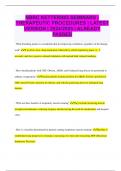
NBRC KETTERING SEMINARS - THERAPEUTIC PROCEDURES | LATEST VERSION | 2024/2025 | ALREADY PASSED - What breathing pattern is considered ideal for improving ventilation, regardless of the therapy used? It involves slow, deep inspiration, followed by a brief inspiratory pause (1 - 3 seconds), and slow, passive, relaxed exhalation with normal tidal volume breathing. - How should patients with CHF, Obesity, ARDS, and Unilateral lung disease be positioned to enhance oxygenation? Position patients in prone position for ARDS, Fowler's position for CHF, lateral Fowler's position for obesity, and with the good lung down for unilateral lung disease. - What are three benefits of inspiratory muscle training? They include increasing muscle strength and endurance, reducing dyspnea, and decreasing the need for medications and hospital visits. - How is a baseline determined for patients starting inspiratory muscle training? Baseline is established using progressive resistance, increasing over time after measuring MIP (Maximum Inspiratory Pressure). - What is the primary indication for Incentive Spirometry (IS) or Sustained Maximal Inspiration (SMI)? It's primarily used for preventing or treating atelectasis in patients who can take deep breaths voluntarily. - What methods does Incentive Spirometry (IS) use to encourage deep breathing? It utilizes visual motivation and feedback to encourage patients to take deep breaths. - How often should IS or SMI therapy be performed, and under what conditions? Therapy should be performed hourly while the patient is awake, aiming for approximately 10 breaths per session. - When is the optimal time to instruct a surgical patient on IS techniques? Before surgery, to ensure understanding and establish post-operative volume goals. - After surgery, what fraction of a patient's pre-operative inspiratory capacity should they aim to achieve post-operatively? Approximately half. - If a patient cannot achieve the targeted volume during IS or SMI therapy, what should the respiratory therapist check first? Check connections and ensure a proper mouth seal before adjusting the volume target. - What are five indications for IPPB (Intermittent Positive Pressure Breathing) therapy? These include preventing or correcting atelectasis in patients unable or unwilling to take deep breaths, reducing pulmonary edema, decreasing work of breathing, improving aerosol distribution, and enhancing the cough mechanism. - What are four contraindications for IPPB therapy? They include unskilled practitioners, hypotension, untreated pneumothorax, and elevated intracranial pressure (ICP). - What are the effects of hyperventilation during IPPB therapy? Patients may experience dizziness, tingling in the fingers, and a slower breathing pattern. - What does impending venous return lead to during IPPB therapy? It results in decreased cardiac output and increased intracranial pressure (ICP). Describe how a Bird Mark
Geschreven voor
- Instelling
- NBRC KETTERING SEMINARS - THERAPEUTIC PROCEDURES |
- Vak
- NBRC KETTERING SEMINARS - THERAPEUTIC PROCEDURES |
Documentinformatie
- Geüpload op
- 6 juli 2024
- Aantal pagina's
- 25
- Geschreven in
- 2023/2024
- Type
- Tentamen (uitwerkingen)
- Bevat
- Vragen en antwoorden
Onderwerpen
-
nbrc kettering seminars therapeutic procedures

Ook beschikbaar in voordeelbundel