
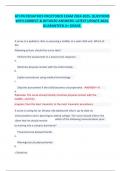
ATI PN PEDIATRICS PROCTORED EXAM . QUESTIONS WITH CORRECT & DETAILED ANSWERS. LATEST UPDATE 2024. GUARANTEED A+ GRADE.
ATI PN PEDIATRICS PROCTORED EXAM . QUESTIONS WITH CORRECT & DETAILED ANSWERS. LATEST UPDATE 2024. GUARANTEED A+ GRADE. A nurse in a pediatric clinic is assessing a toddler at a well-child visit. Which of the following actions should the nurse take? Perform the assessment in a head to toe sequence. a. Minimize physical contact with the child initially. b. Explain procedures using medical terminology. c. Stop the assessment if the child becomes uncooperative. -ANSWER B d. Rationale: The nurse should initially minimize physical contact with the toddler, and then progress from the least traumatic to the most traumatic procedures. which of the following immunizations prior A nurse is caring for an 18-year-old adolescent who is up-to-date on immunizations and is planning to attend college. The nurse should inform the client that he should receive to moving into a campus dormitory? Pneumococcal polysaccharide a. Meningococcal polysaccharide b. c.Rotavirus Herpes zoster -ANSWER B d. Rationale: The meningococcal polysaccharide immunization is used to prevent infection by certain groups of meningococcal bacteria. Meningococcal infection can cause life- threatening illnesses, such as meningococcal meningitis, which affects the brain, and meningococcemia, which affects the blood. Both of these conditions can be fatal. meningococcal disease relative to other persons their age. College freshmen, particularly those who live in dormitories, are at an increased risk for Therefore, the Centers for students receive the meningococcal immunization. Disease Control and Prevention has issued a recommendation that all incoming college A nurse is teaching the parent of an infant about food allergens. Which of the following foods should the nurse include as being the most common food allergy in children? Cow's milk a. Wheat bread b. Corn syrup c. Egg -ANSWER A d. Rationale: According to evidence-based practice, the nurse should instruct that cow's milk is the most common food allergy in children. the parent Some children are sensitive to the protein, called casein, found in cow's milk. casein and are, therefore, allergic to They have difficulty metabolizing the cow's milk. A nurse is teaching the parent of a toddler about home safety. Which of the following statements by the parent indicates an understanding of the teaching? "I lock my medications in the medicine cabinet." a. "I keep my child's crib mattress at the highest level." b. "I turn pot handles to the side of my stove while cooking." c. ANSWER A d."I will give my child syrup of ipecac if she swallows something poisonous." - Toddlers have improved gross and fine motor skills that allow for Rationale: Locking up medications and other potential poisons prevents access. further exploration of the environment and possible access to hazardous substances. A nurse is performing a physical assessment on a 6-month-old infant. Which of the following reflexes should the nurse expect to find? a. Stepping b. Babinski c. Extrusion d. Moro -ANSWER B Rationale: The Babinski reflex, which is elicited by stroking the bottom of the causing the toes to fan and the big toe to dorsiflex, should be foot and present until the age of 1 year. Persistence of neonatal reflexes might indicate neurological deficits. A nurse is preparing to administer recommended immunizations to a 2- month-old infant. Which of the following immunizations should the nurse plan to administer? Human papillomavirus (HPV) and hepatitis A a. Measles, mumps, rubella (MMR) and tetanus, diphtheria, and acellular pertussis b. (TDaP) Haemophilus influenzae type B (Hib) and inactivated polio virus (IPV) c. Varicella (VAR) and live attenuated influenza vaccine (LAIV) -ANSWER C d. Rationale: The recommended immunizations for a 2-month-old infant include Hib and IPV. The Hib immunization series consists of 3 to 4 doses, depending on the immunization used, and at a minimum is administered at the ages of months, and 12 to 15 months. The IPV immunization series 2 months, 4 consists of 4 doses and is administered at the ages of 2 months, 4 months, 6 to 18 months, and 4 to 6 years. A nurse is developing a plan of care for a school-age child who underwent a surgical procedure that resulted in temporary loss of vision. Which of the following interventions should the nurse include in the plan of care? Assign an assistive personnel to feed the child. a. Explain sounds the child is hearing. b. Have the child use a cane when ambulating. c. Rotate nurses caring for the child. -ANSWER B d. Rationale: The noises in a facility can be frightening to a child who is experiencing a sensory loss. It is important to explain these noises to allay the child's fears. A nurse is assessing a 3-year-old child who is 1 day postoperative following a tonsillectomy. Which of the following methods should the nurse use to determine if the child is experiencing pain? Ask the parents. a. Use the FACES scale. b. Use the numeric rating scale. c. Check the child's temperature. -ANSWER B d. years of age. Rationale: Pain is a subjective experience even for a 3-year-old child. The FACES scale can be used to accurately determine the presence of pain in children as young as 3
Documentinformatie
- Geüpload op
- 22 juni 2024
- Aantal pagina's
- 88
- Geschreven in
- 2023/2024
- Type
- Tentamen (uitwerkingen)
- Bevat
- Vragen en antwoorden


