Lecture 17
Neural Circuits
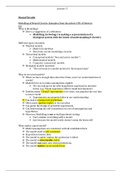
Modelling of Neural Circuits: Examples from the pyloric CPG of lobsters
nm
What is Modelling?
Here’s a suggestion of a definition:
Modelling (in biology) is making a representation of a
biological system with the intent of understanding it (better).
Different types of models
Physical models
Model of a skeleton
Electronic circuit emulating a neuron
Theoretical models
Conceptual models (“box and arrow models”)
Mathematical models
Computer (numerical) models
Biological models (systems)
“The rat brain is a model system for the human brain”
Why do we need models?
When we have enough data about the brain, won’t we understand how it
works?
Models force us to make assumptions explicit
We can only get so far with hypotheses expressed in intuitive
forms (e.g. ‘Visual experience affects visual development’)
Enables many “virtual” experiments to be done, can pinpoint the one that
is most crucial
Experiments can pinpoint holes in our understanding
Can lead to unexpected predictions
Often much quicker/easier to try out ideas
Can guide the design of potential experiments
Can help testing the self-consistency of a set of assumptions and
hypotheses
However, Modelling is not actual hypothesis testing
Can’t explain everything with a model
Just because the model works doesn’t mean the brain will
What makes a good model?
Model assumptions are consistent with all established facts
The model itself is self-consistent
Reproduces known data
The model is stable (unless the system isn’t either)
The model is structurally stable
The model can make non-trivial predictions
The model makes correct predictions
Neural Circuits
Modelling of Neural Circuits: Examples from the pyloric CPG of lobsters
nm
What is Modelling?
Here’s a suggestion of a definition:
Modelling (in biology) is making a representation of a
biological system with the intent of understanding it (better).
Different types of models
Physical models
Model of a skeleton
Electronic circuit emulating a neuron
Theoretical models
Conceptual models (“box and arrow models”)
Mathematical models
Computer (numerical) models
Biological models (systems)
“The rat brain is a model system for the human brain”
Why do we need models?
When we have enough data about the brain, won’t we understand how it
works?
Models force us to make assumptions explicit
We can only get so far with hypotheses expressed in intuitive
forms (e.g. ‘Visual experience affects visual development’)
Enables many “virtual” experiments to be done, can pinpoint the one that
is most crucial
Experiments can pinpoint holes in our understanding
Can lead to unexpected predictions
Often much quicker/easier to try out ideas
Can guide the design of potential experiments
Can help testing the self-consistency of a set of assumptions and
hypotheses
However, Modelling is not actual hypothesis testing
Can’t explain everything with a model
Just because the model works doesn’t mean the brain will
What makes a good model?
Model assumptions are consistent with all established facts
The model itself is self-consistent
Reproduces known data
The model is stable (unless the system isn’t either)
The model is structurally stable
The model can make non-trivial predictions
The model makes correct predictions