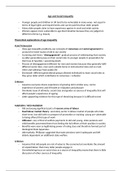
Age and Social Inequality
- Younger people and children in UK tend to be vulnerable in many ways- not equal in
terms of legal rights and requirements and can be paid less than older people
- Many older people claim to have experience ageism in work and wide society
- Women appear more vulnerable to age discrimination because they are judged on
different criteria e.g. beauty
Theoretical explanations of age inequality
FUNCTIONALISM
- View age inequality positively-use concepts of consensus and social agreement to
account for lower status of old in our society
- Cumming and Henry- ‘disengagement’- gradual process of withdrawing from society
as older generations pass on their social roles to younger people in preparation for
their loss of faculties / upcoming death
- Process of disengagement different for men and women because they generally fulfil
different social roles- men work outside home in instrumental roles and so must
retire and withdraw from public life
- Eisenstadt- different generational groups allowed individuals to learn social roles as
they grow older which contributes to consensus / cohesion
Criticism
- Assumes everyone shares experience of growing old in similar way- can be
experience of poverty and ill-health or relaxation and pleasure
- Overlooks issue of ethnicity, social class and gender as sources of inequality that will
affect people’s experience of ageing
- Little supporting evidence for this type of theorising because it is difficult to test
MARXISM / NEO-MARXISM
- Old and young significant parts of reserve army of labour
- Dual labour market theory- secondary sector in labour market of people who take
short-term, low-skill with no prospect of promotion or training- young are vulnerable
to being offered this type of work
- Althusser- very critical of welfare payments to old and young- state pensions and
child benefits prevented them from feeling the full effects of their position in society
- Benefits were seen as legitimising power of ruling class and therefore formed part of
Ideological State Apparatus
- Alternatively, Philipson suggested that state pensions were inadequate and left
elderly dependent on additional state welfare
Criticism
- Assumes that old people are not of value to the economy but overlooks the amount
of unpaid labour that many older people engage in
- Overwhelming focus on social class as a source of inequality means that there is little
discussion of other sources of inequality
- Younger people and children in UK tend to be vulnerable in many ways- not equal in
terms of legal rights and requirements and can be paid less than older people
- Many older people claim to have experience ageism in work and wide society
- Women appear more vulnerable to age discrimination because they are judged on
different criteria e.g. beauty
Theoretical explanations of age inequality
FUNCTIONALISM
- View age inequality positively-use concepts of consensus and social agreement to
account for lower status of old in our society
- Cumming and Henry- ‘disengagement’- gradual process of withdrawing from society
as older generations pass on their social roles to younger people in preparation for
their loss of faculties / upcoming death
- Process of disengagement different for men and women because they generally fulfil
different social roles- men work outside home in instrumental roles and so must
retire and withdraw from public life
- Eisenstadt- different generational groups allowed individuals to learn social roles as
they grow older which contributes to consensus / cohesion
Criticism
- Assumes everyone shares experience of growing old in similar way- can be
experience of poverty and ill-health or relaxation and pleasure
- Overlooks issue of ethnicity, social class and gender as sources of inequality that will
affect people’s experience of ageing
- Little supporting evidence for this type of theorising because it is difficult to test
MARXISM / NEO-MARXISM
- Old and young significant parts of reserve army of labour
- Dual labour market theory- secondary sector in labour market of people who take
short-term, low-skill with no prospect of promotion or training- young are vulnerable
to being offered this type of work
- Althusser- very critical of welfare payments to old and young- state pensions and
child benefits prevented them from feeling the full effects of their position in society
- Benefits were seen as legitimising power of ruling class and therefore formed part of
Ideological State Apparatus
- Alternatively, Philipson suggested that state pensions were inadequate and left
elderly dependent on additional state welfare
Criticism
- Assumes that old people are not of value to the economy but overlooks the amount
of unpaid labour that many older people engage in
- Overwhelming focus on social class as a source of inequality means that there is little
discussion of other sources of inequality