MRSO study material questions with answers
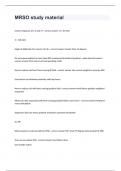
MRSO study materialCenter frequency of 1.5 and 3T - correct answer 1.5= 64 mHz 3 = 128 mHz Angle of deflection for concern of risk - correct answer Greater than 45 degrees Do not expose patient to more than 80% maximum threshold of gradient - what does this mean? - correct answer Must stay in normal operating mode How to reduce risk from Time-varying RF field - correct answer Use correct weight for accurate SAR Use barriers to eliminate proximity and loop burns How to reduce risk with time varying gradient field - correct answer Avoid heavy gradient weighted sequences Where do risks associated with time-varying gradient fields come from? - correct answer Peripheral nerve stimulation Sequences that use heavy gradient activations promote stimulation Ex: EPI What sequence could provide less PNS - correct answer FSE. (Uses 99 degree pulse instead of 180) How can we reduce PNS - correct answer Use thicker slices Use smaller matrix Use larger field of view How can we reduce patient heating - correct answer Use Gradient Echo pulse (it uses minimal RF pulses) Eliminate fatsat and saturation band Avoid inverse recovery Decrease flip angle Increase TR and echo spacing (by decreasing bw) Decrease slices and matrix Increase concatenations Use parallel imaging Decrease averages To reduce SAR - correct answer Increase each spacing Reduce bandwidth Increase frequency encoding Increase echo times Decrease phase encoding Parallel imaging Half Fourier Use gradient echoes Decrease ETL
Geschreven voor
- Instelling
- MRSO
- Vak
- MRSO
Documentinformatie
- Geüpload op
- 16 april 2024
- Aantal pagina's
- 3
- Geschreven in
- 2023/2024
- Type
- Tentamen (uitwerkingen)
- Bevat
- Vragen en antwoorden
Onderwerpen
-
mrso study material

Ook beschikbaar in voordeelbundel