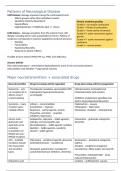
Patterns of Neurological Disease
UMN lesions: damage anywhere along the corticospinal tracts
- Affects groups rather than individual muscles
- Spasticity (velocity-dependent) Muscle weakness grading
- Hyperreflexia Grade 0 = no muscle contraction
- Upgoing plantars (+ Babkinski sign) +/- clonus Grade I = Flicker of contraction
Grade II = Some active movement
LMN lesions – damage anywhere from the anterior horn cells Grade III = active movement against
distally, including nerve roots and peripheral nerves. Pattern of gravity
weakness corresponds to muscles supplied by involved neurones Grade IV = active movement against
- Wasting resistance
- Fasciculation Grade V = normal power
- Hypotonia/flaccidity
- Reduced or absent reflexes
Possible to have mixed UMN/LMN e.g. MND, B12 deficiency
Sensory deficits
Pain and temperature = anterolateral (spinothalamic) tracts in the cord and brainstem
Joint position and vibration = large dorsal columns
Major neurotransmitters + associated drugs
Neurotransmitter Drugs increasing activity (agonists) Drugs decreasing activity (antagonists)
Dopamine – acts Pramipexole, levodopa, apomorphine (PD) Chlorpromazine (schizophrenia)
on receptors D1-5, Cabergoline (hyperprolactinaemia, Metoclopramide (anti-emetic)
affects mood + acromegaly)
reward-seeking Inhibition of dopamine signalling may
lead to drug induced parkinsonism
Serotonin – many Lithium – mood stabiliser Ondansetron – nausea
receptor types, Sumatriptan – migraine Mirtazapine – depression
multiple effects Buspirone – partial agonist, anxiety Olanzapine, clozapine – schizophrenia
Fluoxetine, sertraline – reuptake
inhibitors, depression
Amino acids – Gabapentin, valproate – GABA agonists, Memantine – glutamate antagonist,
glutamate and epilepsy and neuropathic pain dementia
aspartate act as Benzodiazepines – GABA agonist, sedation
excitatory Baclofen – GABA agonists, spasticity
transmitters on Alcohol – GABA agonist
NMDA and non-
NMDA receptors
ACh – multiple Pilocarpine – peripheral agonist, glaucoma Ipratropium – peripheral antagonist,
receptors classed Anticholinesterases – myasthenia asthma
into muscarinin Atropine – peripheral antagonist,
and nicotininc Donepazil, galantamine, rivastigmine – incontinence, dilate pupils, increase HR
types acetylcholinesterase inhibitors, dementia
Procyclidine, trihexyphenidyl – drug-
induced Parkinsonism
Histamines and Cyclizine – antihistamine, nausea
, purines
Neuropeptides – Exogenous opioids Aprepitant – decreased chemotherapy-
includes opioids related nausea by blocking substance P
and substance P receptors
Noradrenaline, Clonidine (refractory hypotension)
adrenaline TCA and venlafaxine
Cerebral blood supply
Internal carotid arteries
Anterior 2/3 brain and basal ganglia
Can cause total infarction in these areas, or more often similar to MCA occlusion
Circle of Willis
Fed by 3 arteries: ICAs + basilar artery (posteriorly, formed by joining of two vertebral arteries)
Cerebral arteries
ACA + MCA = branches of ICA
In 80% the basilar artery divides into the two PCAs
ACA – frontal and medial part of cerebrum. Occlusion may cause a weak, numb contralateral leg +/- similar
(if milder) arm symptoms
Facial sparing
Bilateral infarction is a rare cause of paraplegia
MCA – supplies lateral part of each hemisphere
Occlusion may cause
- Contralateral hemiparesis
- Hemisensory loss
- Contralateral homonymous hemianopia
- Cognitive change: including dysphasia
- Visuo-spatial disturbance
PCA – supplies the occipital lobe
,Occlusion gives contralateral homonymous hemianopia (often with macula sparing)
Vertebrobasilar circulation
Supplies cerebellum, brainstem, occipital lobes
Occlusion may cause: hemianopia, cortical blindness, diplopia, vertigo, nystagmus, ataxia, dysarthria,
dysphasia, hemi/quadriplegia, unilateral or bilateral sensory symptoms, hiccups, coma
Locked in syndrome – damage to ventral pons due to pontine artery occlusion
Lateral medullary syndrome – occlusion of one vertebral artery or posterior inferior cerebellar artery
causes infarction of the lateral medulla and inferior cerebellar surface
Subclavian steal syndrome
Subclavian artery stenosis proximal to origin of the vertebral artery may cause blood to be stolen by
retrograde flow down this vertebral artery down into arm causing brainstem ischaemia typically after use
of the arm
Neuropathies
Autonomic neuropathy
May be isolated or part of generalised sensorimotor peripheral neuropathy
Causes
- DM
- Amyloidosis
- GBS
- Sjogren’s
- HIV
- Leprosy
- SLE
- Toxic
- Genetic
- Paraneoplastic
Signs
Sympathetic: postural hypotension, sweating, ejaculatory failure, Horner’s syndrome
Parasympathetic: constipation, nocturnal diarrhoea, urine retention, ED, Holmes-Adie pupil
Investigations
- BP: Postural drop of > 20/10 mmHg is abnormal
- Bladder pressure studies
- Paraneoplastic antibodies
Primary autonomic failure
Occurs alone, as part of multisystem atrophy, or with PD, typically in middle-aged/elderly man.
Onset: insidious, symptoms as listed previously
, Headaches
History
Onset
Rapid onset
- SAH – sudden onset, worst-ever headache, often occipital, stiff neck, focal signs, decreased
consciousness
- Meningitis – fever, photophobia, stiff neck, purpuric rash, coma. May be associated with neck
stiffness – do LP and start abx
- Encephalitis – fever, odd behaviour, fits, reduced consciousness. Do urgent CT head and LP for signs
of infection
- Post-coital headache
Subacute/gradual onset
- Venous sinus thrombosis: subacute headache, papilloedema
- Sinusitis – dull, constant ache over frontal/maxillary sinuses with tenderness +/- postnasal drip.
Worse on bending over, common with coryza
- Tropical illness e.g. malaria, travel hx, flu-like illness, typhus
- Intracranial hypotension: CSF leakage e.g. iatrogenic after LP or epidural. Suspect if headache worse
on standing, treat with epidural blood patch over leak, if conservative management with IV fluids
and caffeine fails
Character
Tight band tension headache (usual cause of bilateral, non-pulsatile headache +/- scalp muscle
tenderness)
Throbbing/pulsatile/lateralising migraine
Frequency
Headaches that recur tend to be benign
- Migraine
- Cluster headache
- Trigeminal neuralgia
- Recurrent meningitis – suspect if fever/meningism with each headache
Duration
Chronic, progressive headaches can indicate ICP: typically worse on waking, lying, bending forward, or
coughing
Also: vomiting, papilloedema, seizures, false localising signs, odd behaviour
Inv: do imaging to exclude space-occupying lesion and consider idiopathic intracranial hypertension
LP contraindicated until after imaging
Associated features
- Eye pain
o Acute glaucoma constant pain around one eye, reduced vision, haloes, red congested eye
- Jaw claudication
o GCA – subacute onset headache with ESR > 40
o Exclude in all > 50 yrs with headache lasting > few weeks, prompt diagnosis to avoid
blindness
Precipitating causes
- Head trauma – commonly localised pain but can be more generalised. Lasts around 2wks and often
resistant to analgesia
UMN lesions: damage anywhere along the corticospinal tracts
- Affects groups rather than individual muscles
- Spasticity (velocity-dependent) Muscle weakness grading
- Hyperreflexia Grade 0 = no muscle contraction
- Upgoing plantars (+ Babkinski sign) +/- clonus Grade I = Flicker of contraction
Grade II = Some active movement
LMN lesions – damage anywhere from the anterior horn cells Grade III = active movement against
distally, including nerve roots and peripheral nerves. Pattern of gravity
weakness corresponds to muscles supplied by involved neurones Grade IV = active movement against
- Wasting resistance
- Fasciculation Grade V = normal power
- Hypotonia/flaccidity
- Reduced or absent reflexes
Possible to have mixed UMN/LMN e.g. MND, B12 deficiency
Sensory deficits
Pain and temperature = anterolateral (spinothalamic) tracts in the cord and brainstem
Joint position and vibration = large dorsal columns
Major neurotransmitters + associated drugs
Neurotransmitter Drugs increasing activity (agonists) Drugs decreasing activity (antagonists)
Dopamine – acts Pramipexole, levodopa, apomorphine (PD) Chlorpromazine (schizophrenia)
on receptors D1-5, Cabergoline (hyperprolactinaemia, Metoclopramide (anti-emetic)
affects mood + acromegaly)
reward-seeking Inhibition of dopamine signalling may
lead to drug induced parkinsonism
Serotonin – many Lithium – mood stabiliser Ondansetron – nausea
receptor types, Sumatriptan – migraine Mirtazapine – depression
multiple effects Buspirone – partial agonist, anxiety Olanzapine, clozapine – schizophrenia
Fluoxetine, sertraline – reuptake
inhibitors, depression
Amino acids – Gabapentin, valproate – GABA agonists, Memantine – glutamate antagonist,
glutamate and epilepsy and neuropathic pain dementia
aspartate act as Benzodiazepines – GABA agonist, sedation
excitatory Baclofen – GABA agonists, spasticity
transmitters on Alcohol – GABA agonist
NMDA and non-
NMDA receptors
ACh – multiple Pilocarpine – peripheral agonist, glaucoma Ipratropium – peripheral antagonist,
receptors classed Anticholinesterases – myasthenia asthma
into muscarinin Atropine – peripheral antagonist,
and nicotininc Donepazil, galantamine, rivastigmine – incontinence, dilate pupils, increase HR
types acetylcholinesterase inhibitors, dementia
Procyclidine, trihexyphenidyl – drug-
induced Parkinsonism
Histamines and Cyclizine – antihistamine, nausea
, purines
Neuropeptides – Exogenous opioids Aprepitant – decreased chemotherapy-
includes opioids related nausea by blocking substance P
and substance P receptors
Noradrenaline, Clonidine (refractory hypotension)
adrenaline TCA and venlafaxine
Cerebral blood supply
Internal carotid arteries
Anterior 2/3 brain and basal ganglia
Can cause total infarction in these areas, or more often similar to MCA occlusion
Circle of Willis
Fed by 3 arteries: ICAs + basilar artery (posteriorly, formed by joining of two vertebral arteries)
Cerebral arteries
ACA + MCA = branches of ICA
In 80% the basilar artery divides into the two PCAs
ACA – frontal and medial part of cerebrum. Occlusion may cause a weak, numb contralateral leg +/- similar
(if milder) arm symptoms
Facial sparing
Bilateral infarction is a rare cause of paraplegia
MCA – supplies lateral part of each hemisphere
Occlusion may cause
- Contralateral hemiparesis
- Hemisensory loss
- Contralateral homonymous hemianopia
- Cognitive change: including dysphasia
- Visuo-spatial disturbance
PCA – supplies the occipital lobe
,Occlusion gives contralateral homonymous hemianopia (often with macula sparing)
Vertebrobasilar circulation
Supplies cerebellum, brainstem, occipital lobes
Occlusion may cause: hemianopia, cortical blindness, diplopia, vertigo, nystagmus, ataxia, dysarthria,
dysphasia, hemi/quadriplegia, unilateral or bilateral sensory symptoms, hiccups, coma
Locked in syndrome – damage to ventral pons due to pontine artery occlusion
Lateral medullary syndrome – occlusion of one vertebral artery or posterior inferior cerebellar artery
causes infarction of the lateral medulla and inferior cerebellar surface
Subclavian steal syndrome
Subclavian artery stenosis proximal to origin of the vertebral artery may cause blood to be stolen by
retrograde flow down this vertebral artery down into arm causing brainstem ischaemia typically after use
of the arm
Neuropathies
Autonomic neuropathy
May be isolated or part of generalised sensorimotor peripheral neuropathy
Causes
- DM
- Amyloidosis
- GBS
- Sjogren’s
- HIV
- Leprosy
- SLE
- Toxic
- Genetic
- Paraneoplastic
Signs
Sympathetic: postural hypotension, sweating, ejaculatory failure, Horner’s syndrome
Parasympathetic: constipation, nocturnal diarrhoea, urine retention, ED, Holmes-Adie pupil
Investigations
- BP: Postural drop of > 20/10 mmHg is abnormal
- Bladder pressure studies
- Paraneoplastic antibodies
Primary autonomic failure
Occurs alone, as part of multisystem atrophy, or with PD, typically in middle-aged/elderly man.
Onset: insidious, symptoms as listed previously
, Headaches
History
Onset
Rapid onset
- SAH – sudden onset, worst-ever headache, often occipital, stiff neck, focal signs, decreased
consciousness
- Meningitis – fever, photophobia, stiff neck, purpuric rash, coma. May be associated with neck
stiffness – do LP and start abx
- Encephalitis – fever, odd behaviour, fits, reduced consciousness. Do urgent CT head and LP for signs
of infection
- Post-coital headache
Subacute/gradual onset
- Venous sinus thrombosis: subacute headache, papilloedema
- Sinusitis – dull, constant ache over frontal/maxillary sinuses with tenderness +/- postnasal drip.
Worse on bending over, common with coryza
- Tropical illness e.g. malaria, travel hx, flu-like illness, typhus
- Intracranial hypotension: CSF leakage e.g. iatrogenic after LP or epidural. Suspect if headache worse
on standing, treat with epidural blood patch over leak, if conservative management with IV fluids
and caffeine fails
Character
Tight band tension headache (usual cause of bilateral, non-pulsatile headache +/- scalp muscle
tenderness)
Throbbing/pulsatile/lateralising migraine
Frequency
Headaches that recur tend to be benign
- Migraine
- Cluster headache
- Trigeminal neuralgia
- Recurrent meningitis – suspect if fever/meningism with each headache
Duration
Chronic, progressive headaches can indicate ICP: typically worse on waking, lying, bending forward, or
coughing
Also: vomiting, papilloedema, seizures, false localising signs, odd behaviour
Inv: do imaging to exclude space-occupying lesion and consider idiopathic intracranial hypertension
LP contraindicated until after imaging
Associated features
- Eye pain
o Acute glaucoma constant pain around one eye, reduced vision, haloes, red congested eye
- Jaw claudication
o GCA – subacute onset headache with ESR > 40
o Exclude in all > 50 yrs with headache lasting > few weeks, prompt diagnosis to avoid
blindness
Precipitating causes
- Head trauma – commonly localised pain but can be more generalised. Lasts around 2wks and often
resistant to analgesia