
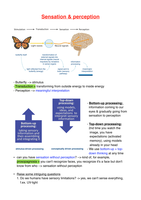
Sensation & perception
butterfly itself transformation of
external signals into
internal signals (neural
impulses) by receptors information
in sense organs processing
light reflected from the signal sent to meaningful
butterfly (energy) brain (sensory interpretation
pathway)
27/10/2016
- Butterfly --> stimulus
- Transduction = transforming from outside energy to inside energy
- Perception --> meaningful interpretation
Top-down
processing: - Bottom-up processing:
using models, information coming to our
ideas, and eyes & gradually going from
expectations to
interpret sensory sensation to perception
information
Bottom-up - Top-down processing:
processing:
2nd time you watch the
taking sensory
information and image, you have
then assembling expectations (activated
and integrating it
memory), using models
already in your head
stimulus-driven processing conceptually driven processing - We use bottom-up + top-
down thinking at any time
• can you have sensation without perception? --> kind of, for example,
prosopagnosia = you can't recognize faces, you recognize it's a face but don't
know from who --> sensation without perception
• Raise some intriguing questions
1. Do we humans have sensory limitations? -> yes, we can't sense everything,
3
f.ex. UV-light
what is sensation without full perception like?
the case of prosopagnosia
, 2. How do we know wether the world we experience (the perceived world) is the
same as the external world? -> We don't, perception is different for everyone
--> the perceived world is different for everyone, sensation will mostly be the
same for everyone but perception will be different
3. Do you have the same experience (perception) of things as I do? -> No
• Issue --> how can we measure a perceptual experience? --> percepts don't have
lengths, weight or a physical shape --> we must rely on what people tell us
they're perceiving
• Psychophysics = study of the relationship between the physical stimuli in the
world & the sensations that we experience
-> Name comes from Gustav Teodor Fechner --> set out to solve the mind-body
problem of philosophy, based on the greek roots psyche (mind) and physike
(naturally occurring phenomena)
-> He had to solve 3 problems to describe the relationship between our physical
bodies & our mental experiences
1. Find a way to measure the minimum intensity of a stimulus that we can
perceive --> problem of detection
2. Devise a way to measure how different stimuli must be before they no
longer appear to be the same --> problem of discrimination
3. Describe the relationship between the intensity of the stimulus and the
intensity of our sensation --> problem of scaling
How does stimulation become sensation?
• See scheme with butterfly
-> the brain senses the world indirectly bc the sense organs convert stimulation
into the language of the nervous system --> neural messages
-> thus, sensory impressions of the world involve neural representations of
stimuli - not the actual stimuli themselves
• Sensation
- Immediate/fast --> must be faster than perception
- Veridical (relatively faithful/accurate representation)
= like the pixels on a photograph
- Initial steps of a continuum that leads to perception --> no interpretation yet
- Has certain limitations
-> What type of information is picked up (e.g. compare with other creatures)
-> Differences between individuals
--> sensitivity: f.ex. how sensitive are you for light, how bright does a picture
have to be for you to see it


