Section 3 : Organic Chemistry
Chromatography
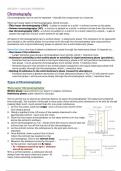
Chromatography can be used to separate + identify the components in a mixture.
There are many types of chromatography, which include…
• Thin-layer chromatography (TLC) - a plate is coated w/ a solid + a solvent moves up the plate.
• Column chromatography (CC) - a column is packed w/ a solid + a solvent moves down the column.
• Gas chromatography (GC) - a column is packed w/ a solid or w/ a solid coated by a liquid, + a gas is
passed through the column under pressure at high temp.
All types of chromatography have a mobile phase + a stationary phase. The substance to be separated
are initially in the mobile phase, but as they move through the chromatogram they may partition
themselves into a liquid stationary phase or adsorb onto a solid stationary phase.
Retention time: the time it takes a substance to pass through the stationary phase. It depends on…
• Size/mass of the substance.
- Larger particles pass along a chromatogram more slowly, which ↑ retention time.
• Substance’s solubility in the mobile phase vs solubility in liquid stationary phase (partition).
- Particles that are more soluble in the liquid stationary phase in GC will partition themselves into
this phase + move along the chromatogram more slowly, which ↑ retention time.
- Particles that are very soluble in the mobile phase compared to the liquid stationary phase will
move quickly through the chromatogram, which ↓ retention time.
• Binding of substance to the solid stationary phase (caused by adsorption).
- Particles that have a greater attraction to a solid stationary phase in TLC + CC will adsorb more
onto this phase + will move more slowly through the chromatogram, which ↑ retention time.
Types of Chromatography
Thin-layer Chromatography
Mobile phase: liquid solvent (e.g. water or organic solvents).
Stationary phase: plate coated w/ silica gel.
TLC is carried out in almost an identical fashion to paper chromatography. TLC plates are prepared
from silica gel. The surface of silica gel is very polar, which allows polar substances to be held by the gel
making their movt. much slower than for non-polar substances.
1. On the TLC plate, mark the origin + put a cross at the centre of the
line using a pencil.
2. Using a capillary tube, lift some of the sample dissolved in the
appropriate solvent + spot onto the cross.
3. Place the thin-layer chromatogram in the same solvent (w/ the origin
above the solvent’s surface).
4. Allow chromatogram to run - check every few mins to ensure that the
solvent has not run off the top end of the chromatogram.
5. As the solvent moves, the substances in the spot also move up +
separate.
6. Once nished, draw a pencil line to show
where the solvent has reached on the
chromatogram. This is the solvent front.
7. Measure the distance moved by the spot +
by the solvent. Calculate the Rf value.
• Rf = distance moved by spot / distance
moved by solvent
W/in a solvent system, a substance should
always have the same retention times + Rf
value, hence allowing comparison.
fi
Chromatography
Chromatography can be used to separate + identify the components in a mixture.
There are many types of chromatography, which include…
• Thin-layer chromatography (TLC) - a plate is coated w/ a solid + a solvent moves up the plate.
• Column chromatography (CC) - a column is packed w/ a solid + a solvent moves down the column.
• Gas chromatography (GC) - a column is packed w/ a solid or w/ a solid coated by a liquid, + a gas is
passed through the column under pressure at high temp.
All types of chromatography have a mobile phase + a stationary phase. The substance to be separated
are initially in the mobile phase, but as they move through the chromatogram they may partition
themselves into a liquid stationary phase or adsorb onto a solid stationary phase.
Retention time: the time it takes a substance to pass through the stationary phase. It depends on…
• Size/mass of the substance.
- Larger particles pass along a chromatogram more slowly, which ↑ retention time.
• Substance’s solubility in the mobile phase vs solubility in liquid stationary phase (partition).
- Particles that are more soluble in the liquid stationary phase in GC will partition themselves into
this phase + move along the chromatogram more slowly, which ↑ retention time.
- Particles that are very soluble in the mobile phase compared to the liquid stationary phase will
move quickly through the chromatogram, which ↓ retention time.
• Binding of substance to the solid stationary phase (caused by adsorption).
- Particles that have a greater attraction to a solid stationary phase in TLC + CC will adsorb more
onto this phase + will move more slowly through the chromatogram, which ↑ retention time.
Types of Chromatography
Thin-layer Chromatography
Mobile phase: liquid solvent (e.g. water or organic solvents).
Stationary phase: plate coated w/ silica gel.
TLC is carried out in almost an identical fashion to paper chromatography. TLC plates are prepared
from silica gel. The surface of silica gel is very polar, which allows polar substances to be held by the gel
making their movt. much slower than for non-polar substances.
1. On the TLC plate, mark the origin + put a cross at the centre of the
line using a pencil.
2. Using a capillary tube, lift some of the sample dissolved in the
appropriate solvent + spot onto the cross.
3. Place the thin-layer chromatogram in the same solvent (w/ the origin
above the solvent’s surface).
4. Allow chromatogram to run - check every few mins to ensure that the
solvent has not run off the top end of the chromatogram.
5. As the solvent moves, the substances in the spot also move up +
separate.
6. Once nished, draw a pencil line to show
where the solvent has reached on the
chromatogram. This is the solvent front.
7. Measure the distance moved by the spot +
by the solvent. Calculate the Rf value.
• Rf = distance moved by spot / distance
moved by solvent
W/in a solvent system, a substance should
always have the same retention times + Rf
value, hence allowing comparison.
fi