EDF 6225 Test #2 Solved 100% Correct -2023
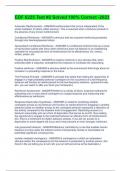
Automatic Reinforcement - ANSWER-reinforcement that occurs independent of the social mediation of others (often sensory). This is assumed when a behavior persists in the absence of any known reinforcement. Conditioned Reinforcer - ANSWER-a stimulus that has acquired reinforcing properties through prior learning/species history. Generalized Conditioned Reinforcer - ANSWER-A conditioned reinforcer that as a result of having been paired with many other reinforcers does not depend on an establishing operation for any particular form of reinforcement for its effectiveness. Ex: money, smiles, praise, etc. Positive Reinforcement - ANSWER-A positive reinforcer is any stimulus that, when presented after a response, strengthens the response or increases the responding. Positive reinforcer - ANSWER-a stimulus added to the environment that brings about an increase in a preceding response in the future. The Premack Principle - ANSWER-A principle that states that making the opportunity to engage in a high-probability behavior contingent on the occurrence of a low-frequency behavior will function as reinforcement for the low-frequency behavior. (grandma's law). (Ex: you can watch tv after you finish your homework.) Reinforcer Assessment - ANSWER-Refers to a variety of direct, empirical methods for presenting one or more stimuli contingent on a target response and measuring their effectiveness as reinforcers. Response Deprivation Hypothesis - ANSWER-A model for predicting whether contingent access to one behavior will function as reinforcement for engaging in another behavior based on whether access to the contingent behavior represents a restriction of the activity compared to the baseline level of engagement. Restricting access to a behavior presumably acts as a form of deprivation that serves as an EO, thus making the opportunity to engage in the restricted behavior an effective form of reinforcement. (Ex: iPad is a reinforcers for Sally's behavior already. If you list her access to it, deprivation to some degree will occur and it may become an even stronger reinforcer). rule goverened behavior - ANSWER-Behavior controlled by a rule that enables human behavior to come under the indirect control of temporarily remote or improbable but potentially significant consequences. socially mediated contingency - ANSWER-A contingency in which an antecedent stimulus and/or the consequence for the behavior is presented by another person. (Ex: friend in the car telling you to turn left, you turn left and arrive at the destination.) stimulus preference assessment (SPA) - ANSWER-A variety of procedures used to determine the stimuli that a person prefers, the relative preference values (high vs. low) of those stimuli, the conditions under which those preference values remain in effect, and their presumed value as reinforcers. Unconditioned Reinforcer - ANSWER-A stimulus change that increases the frequency of any behavior that immediately precedes it, as a result of species history. Avoidance contingency - ANSWER-A contingency in which a response prevents or postpones the presentation of a stimulus. (Example: flopping in the hallway may get you out of half of all of the class you do not want to go to). conditioned negative reinforcer - ANSWER-A previously neutral stimulus change that functions as a negative reinforcer because of prior pairing with one or more negative reinforcers. Discriminated Avoidance - ANSWER-A contingency in which responding in the presence of a signal prevents the onset of a stimulus from which escape is a reinforcer. (Example: a certain teacher is more likely to let you out of class when you cry. So, when that teacher is working in your classroom, you cry more often so that you can get out of the class you do not like). Escape Contingency - ANSWER-contingency in which a response terminates (produces escape from) an ongoing stimulus. (Example: you come home form work and your roommate is arguing with her boyfriend. You say "Stop!" to get them to be quiet and alleviate the loud noise). Free-operant avoidance - ANSWER-A contingency in which responses at any time during an interval prior to the scheduled onset of an aversive stimulus delays the presentation of the aversive stimulus. (does not need a signal). Example: doing your homework right after school so that your mom doesn't yell at you later for not doing it. Negative Reinforcement - ANSWER-a response that produces the termination, reduction, postponement or avoidance of a stimulus, with leads to an increase in the future occurrence of that response. (Example: If I kick my teacher when she asks me to do my work, I temporarily get out of doing my work because she sends me to the hall.) unconditioned negative reinforcer - ANSWER-stimuli whose removal strengthens behavior in the absence of prior learning (due to species history). How do we correct the sentence "Candy is a reinforcer for John" ? - ANSWER-Candy has functioned as a reinforcer for John's ______ behavior in the past. Always remember to aim towards...... - ANSWER-natural reinforcers (that occur in the real world and without your involvement!) Undesirable consequences (ex: time out) can actually be positive reinforcers if they function to strengthen a behavior. Give an example. - ANSWER-Time out is supposed to be a punisher. But if the student did not like the classroom in the first place, time-out may be serving as a reinforcer for their "bad" behavior if the unwanted behavior continues to occur or increase. Behavioral contrast - ANSWER-refers to the phenomenon in which a change in one component of a multiple schedule that increases the decreases the rate of responding on that component is accompanied by a change in the response rate in the opposite direction on the other, unaltered component of the schedule. Conditioned punisher - ANSWER-(also called secondary punished or learned punisher) is a stimulus change whose presentation functions as punishment as a results of a persons conditioned history, A conditioned punisher acquires the capability to function as a punisher through stimulus-stimulus pairing with one or more unconditioned, or previously conditioned punishers. (ex Police Car) Discriminative stimulus for punishment - ANSWER-SDP: can be defined as a stimulus condition in the presence of which a response has a lower probability of occurrence than it does in the absence as a result of response contingent punishment delivery in the presence of the stimulus example: SDP: beach picnic Response: leave sandwich unattended SP: bird flies away with sandwich ...so the SDP is beach picnic. Unlikely to leave sandwich unattended again! generalized conditioned punisher - ANSWER-a stimulus change that has been paired with numerous forms of unconditioned and conditioned punishers become a generalized condition punisher (reprimands such as "no!" or "don't do that!" and disapproving gestures such as scowls, frowns, and head shakes are generalized conditioned punishers for many people because they have been paired repeatedly with a wide range of unconditioned or conditioned punishers, such as a burned fingers or loss of privileges. They are independent of specific motivating conditions and will function as punishment under most conditions.
Geschreven voor
- Instelling
- EDF 6225
- Vak
- EDF 6225
Documentinformatie
- Geüpload op
- 11 juni 2023
- Aantal pagina's
- 14
- Geschreven in
- 2022/2023
- Type
- Tentamen (uitwerkingen)
- Bevat
- Vragen en antwoorden
Onderwerpen
-
edf 6225
-
edf 6225 test 2
-
automatic reinforcement
-
conditioned reinforcer
-
edf 6225 test 2 solved 100 correct 2023
-
generalized conditioned reinforcer

Ook beschikbaar in voordeelbundel