NR 283 PATHOPHYSIOLOGY – FINAL EXAM STUDY GUIDE
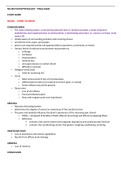
NR 283 PATHOPHYSIOLOGY – FINAL EXAM STUDY GUIDE NEURO – TERMS TO KNOW CONSCIOUSNESS • The state of being aware, or perceiving physical facts or mental concepts; a state of general wakefulness and responsiveness to environment; a functioning sensorium. [L. conscio, to know, to be aware of] • totally aware of surrounding activities and incoming stimuli • oriented to time, place, and people • person can respond quickly and appropriately to questions, commands, or events. • Various levels of reduced consciousness may present as o Lethargy o Confusion o Disorientation o memory loss o unresponsiveness to verbal stimuli o difficulty in arousal • Glasgow Coma Scale o Used for assessing LOC • Coma o Most serious level of loss of consciousness o Affected person does not respond to stimuli (pain, or verbal) o Some reflexes may still be present • Deep coma o Loss of all reflexes o Fixed and dilated pupils o Slow and irregular pulse and respirations AROUSAL • Reticular Activating System • determines the degree of arousal or awareness of the cerebral cortex • The pons and medulla influence the brain's awareness of the incoming pain stimuli o PONS – composed of bundles of both afferent (incoming) and efferent (outgoing) fibers o MEDULLA ▪ contains vital control centers that regulate respiratory and cardiovascular function ▪ contains the coordinating centers that govern coughing, swallowing, vomiting VEGETATIVE STATE • Loss of awareness and mental capabilities • Results from diffuse brain damage AMNESIA • Loss of memory CONVULSION • sudden, involuntary movement with loss of awareness, caused by uncontrolled neuronal discharge in the brain. TONIC • In a state of continuous unremitting action; denoting especially a muscular contraction. 2. Invigorating; increasing physical or mental tone or strength. CLONIC/CLONIC STATE/CLONIC SPASM • Relating to or characterized by clonus • Movement marked by repetitive muscle contractions and relaxations in rapid succession. • Alternate involuntary contraction and relaxation of a muscle DYSPHASIA • Difficulty comprehending language or speaking; partial impairment of communicating ability • Less severe form of aphasia • Caused by damage to the brain APHASIA • Inability to comprehend or express language; total loss of communicating ability • Receptive—damage to Wernicke’s area • Expressive—damage to Broca’s area • Mixed, global—damage to both areas or to the fibers and tracts between them PARESIS • Muscle weakness • Mild paralysis OTORRHEA • Leaking of CSF from the ear • Occurs with fractures • Tearing of meninges o Allows CSF to pass out of the subarachnoid space SEIZURES Seizures (look up types of seizures) ● Generalized o Absence seizures (petit mal) ▪ Lapses of awareness lasting only a few seconds ▪ Appear without warning/end abruptly ▪ More common in children ▪ Are frequently so brief, they go undetected o Tonic-clonic (grand mal) ▪ Most common ▪ Begin with stiffening of limbs (tonic phase) ▪ Followed by jerking of the limbs/face (clonic phase) o Myoclonic ▪ Rapid, brief contractions of bodily muscles ▪ Occur at the same time on both sides of body ▪ Usually involve one arm or a foot ▪ “sudden jerk” movements or “clumsiness” o Atonic (akinetic, astatic, or drop attacks) ▪ Abrupt loss of muscle tone ▪ Can produce head drops, loss of posture, or sudden collapse ▪ Appear without warning ▪ Can result in injuries to head and face ▪ Seizures are resistance to Rx therapy ▪ Protective headgear recommended o Lennox-Gastaut Syndrome (febrile seizures) ▪ Form of severe epilepsy ▪ Begins in childhood ▪ Characterized by multiple types of seizures and intellectual disability ▪ Child experiences frequent seizures (mixed type seizures) ▪ Interrupts neurological development ▪ resulting in learning disabilities ▪ delayed motor development ▪ Difficult to control, even with Rx medication ● Partial o Simple partial ▪ one area of the body is experiencing spasm/twitch ▪ person does not lose consciousness during seizure ▪ while fully aware, person may not be able to speak/move until seizure is over ▪ person may feel odd or altered sensations (affects all five senses) ▪ nausea may be present ▪ emotions may also be affected o Complex partial (psychomotor) ▪ Affect larger area of brain ▪ Affect consciousness; person may appear to altered state of consciousness ▪ During a seizure, person cannot interact normally ▪ Actions are typically unorganized, confused, and unfocused ▪ Unable to control body movements, speech, and actions ▪ Unaware of actions ▪ Does not remember what happened during seizure ▪ “temporal lobe epilepsy” ● Continuous seizures (status epilepticus) o in/out of seizures every second – constant/continuous state of seizure o Increased metabolism of glucose and oxygen o May be life-threatening o primary focus = PATIENT SAFETY ▪ cannot stop a seizure ▪ ABCs + safety o Death or brain damage from status seizures (as opposed to death from the underlying cause) is most likely to result from: ▪ Direct damage to the brain caused by the injury that causes the seizures ▪ Stress on the system from repeated generalized tonic clonic seizures ▪ Injury from repeated electrical discharge in the brain
Geschreven voor
- Instelling
- Chamberlain College Of Nursing
- Vak
- NR 283
Documentinformatie
- Geüpload op
- 10 september 2022
- Aantal pagina's
- 52
- Geschreven in
- 2022/2023
- Type
- Tentamen (uitwerkingen)
- Bevat
- Vragen en antwoorden
Onderwerpen
-
nr 283 pathophysiology – final exam study guide neuro – terms to know consciousness • the state of being aware
-
or perceiving physical facts or mental concepts a state of general wakefulness and res

Ook beschikbaar in voordeelbundel