

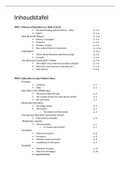
Inhoudstafel
PWP 1: History of Education as a field of study
No understanding without history > Why? P. 2 sv
What? P. 2 sv
How do we do History? P. 3 sv
What is a Paradigm? P. 3 sv
Historism p. 3 sv
A history of ideas p. 4 sv
New cultural history of education p. 4-5 sv
Implications p. 6 sv
What’s What (Historism and Historicizing) p. 6 sv
Example p. 6 sv
The Historian of education’s Métier p. 7 sv
The subject of our historical narrative (change) p. 7 sv
What does the historian of education do? P. 7 sv
Why history? P. 8 sv
PWP 2: Education in early Modern times
Prologue
Confucius p. 1
Plato p. 2
Education in the Middle Ages
The church takes the lead p. 3
The creation of the first ‘educational centres’ p. 4
the curriculum p. 4
Elementary Education
The village school p. 5
The teacher p. 5
o The School and the teacher p. 6
Post-primary education (secondary school)
Post-primary education p. 6
“Reforming” society?
The reformation p. 7
o A ‘Counter-reformation’ p. 7
Humanism
What is Humanism? P. 8
Humanism p. 8
Catholics meets Humanism p. 9
Implications for Education p. 9
Examples
Desiderius Erasmus p. 10
Michel de Montaigne p. 10
Juan Luis Vives
, Humanism and its significance p. 10
PWP 3 The Enlightenment
The enlightenment
Definition P. 1
Sapere aude P. 1
o What is enlightenment
Radically new, or relatively old? (relation between Humanism and The Enlightenment)
John Amos Comenius P. 2-3
Reason or perception
Strands of enlightenment P. 4
A theory of mind
John Locke P. 4
The blank slate P. 4
Molyneux’s problem P. 5
Some thoughts concerning education p. 5
History of education for the disabled
Idiots in cages p. 6
The first initiatives p. 6
Educating the mentally disabled p. 6
The modernisation of education
The politics of education p. 7
‘Modern education’ p. 7
‘Modern education’ in the low countries p. 7
Sustainable reforms? P. 8
Impact of the enlightenment
The ‘enlightened’ school? P. 8
De-mythologizing the enlightenment? P. 8
The emergence of an educational paradox p. 9
PWP 4 Jean-Jacques Rousseau
Who’s who?
Jean-Jacques Rousseau p. 1
Emile ou de l’Education p. 2
Emile ou de l’Education
General introduction p. 2
Negative education p. 3
o Some examples p. 3-4
o Enlightenment idea p. 4
Natural education and cultural criticism p. 4
o Natural education p. 4
o Nature is intrinsically good p. 5
o Civilization as ‘unavoidable’ p. 5
o Importance of the senses p. 5
o The gradual process of maturity p. 5
Observation and illustration p. 6
PWP 1: History of Education as a field of study
No understanding without history > Why? P. 2 sv
What? P. 2 sv
How do we do History? P. 3 sv
What is a Paradigm? P. 3 sv
Historism p. 3 sv
A history of ideas p. 4 sv
New cultural history of education p. 4-5 sv
Implications p. 6 sv
What’s What (Historism and Historicizing) p. 6 sv
Example p. 6 sv
The Historian of education’s Métier p. 7 sv
The subject of our historical narrative (change) p. 7 sv
What does the historian of education do? P. 7 sv
Why history? P. 8 sv
PWP 2: Education in early Modern times
Prologue
Confucius p. 1
Plato p. 2
Education in the Middle Ages
The church takes the lead p. 3
The creation of the first ‘educational centres’ p. 4
the curriculum p. 4
Elementary Education
The village school p. 5
The teacher p. 5
o The School and the teacher p. 6
Post-primary education (secondary school)
Post-primary education p. 6
“Reforming” society?
The reformation p. 7
o A ‘Counter-reformation’ p. 7
Humanism
What is Humanism? P. 8
Humanism p. 8
Catholics meets Humanism p. 9
Implications for Education p. 9
Examples
Desiderius Erasmus p. 10
Michel de Montaigne p. 10
Juan Luis Vives
, Humanism and its significance p. 10
PWP 3 The Enlightenment
The enlightenment
Definition P. 1
Sapere aude P. 1
o What is enlightenment
Radically new, or relatively old? (relation between Humanism and The Enlightenment)
John Amos Comenius P. 2-3
Reason or perception
Strands of enlightenment P. 4
A theory of mind
John Locke P. 4
The blank slate P. 4
Molyneux’s problem P. 5
Some thoughts concerning education p. 5
History of education for the disabled
Idiots in cages p. 6
The first initiatives p. 6
Educating the mentally disabled p. 6
The modernisation of education
The politics of education p. 7
‘Modern education’ p. 7
‘Modern education’ in the low countries p. 7
Sustainable reforms? P. 8
Impact of the enlightenment
The ‘enlightened’ school? P. 8
De-mythologizing the enlightenment? P. 8
The emergence of an educational paradox p. 9
PWP 4 Jean-Jacques Rousseau
Who’s who?
Jean-Jacques Rousseau p. 1
Emile ou de l’Education p. 2
Emile ou de l’Education
General introduction p. 2
Negative education p. 3
o Some examples p. 3-4
o Enlightenment idea p. 4
Natural education and cultural criticism p. 4
o Natural education p. 4
o Nature is intrinsically good p. 5
o Civilization as ‘unavoidable’ p. 5
o Importance of the senses p. 5
o The gradual process of maturity p. 5
Observation and illustration p. 6


