

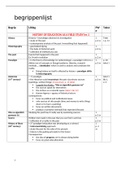
begrippenlijst
Begrip Uitleg PW Tekst
P
HISTORY OF EDUCATION AS A FIELD STUDY les 1
History Historia = knowledge obtained via investigation 1 Tekst
= study of the past p.2 sv 1 p. 13
= contemporary analysis of the past (=everything that happened)
Historiography = geschiedschrijving 1
= the body of historical work p.2 sv
= collection of methods you use
The past Events that happened in the past 1
Ex. French revolution p.2 sv
Paradigm = In the theory of knowledge (or epistemology), a paradigm refers to a 1 p. 20
distinct set of concepts or thought patterns, theories, research p.3 sv tekst 1
methods,… (denkkader) which is used to analyse and constitute the
reality.
Doing history on itself is affected by history = paradigm shifts
in historiography
st
Historism = 1 paradigm 1 tekst 1
(19th century) = the Historian could reconstruct the past via primary sources p.3 sv Blz 1,
(paintings, written things) (reconstruct: p. 13 tekst) 2, 3
Leopold Von Ranke: “Wie es eigentlich gewesen ist”
the sources speak for themselves
the archive as a romantic space (tekst 1 blz 12)
Human Agency = agency of historical actors
consequences:
focus on political and institutional issues
only sources of rich people (time and money to write things
down or to have a painting)
focus on written documents
produce a narrative (verhaal) that represent the past
Wie es eigentlich Studying the past how it really was by examining sources 1
gewesen ist p.3 sv
Source Written text made in the past that you can find in archives 1
= reflection of a reality in the past p.3 sv
History of ideas = 2nd paradigm (education was developing as a science) 1
(20th century) = instrumentalizing approach p. 4
= study the past for the sake of the present sv
= history is the guiding principle for the future
Consequences:
the idea of progress; we’re always doing better
focus on great educationalists
1
, New Cultural Challenged some of the assumptions of Modernism (bovenstaande 1
approach = paradigmas) and involves a series of approaches and disciplines p. 4
Postmodernism from within (context) sv
(1990) from below (involving the real, ordinary people)
multitude / triangulation of sources
Linguistic turn : Language matters
Linguistic turn History is not the same as the past because of the language that is p. 5
used. sv
Ex. When you write a story, it will not be exactly the same as the
thoughts you had.
Historicizing = 3th paradigm 1 Tekst
= a new aim of historical education p. 6 1 blz ,
construction of a narrative (= verhaal) of the past sv 7
(with our own interpretation, not exactly reproduced) (archi)
Agency of the subject (tekst 1 blz 7)
(how did someone do something: influence context)
The source is not neutral
The archive as construction site (tekst 1 blz 7)
Sources are also a history on their own
Perspectivism An idea invented by Nietzsche. There is no single viewpoint to see the 1
world. There is no single truth. (reconstruction is impossible) p.7 sv
There are many different perspectives
Presentism Understanding the past with concepts that are contemporary which 1
we think are important. p.7 sv
Instrumentalization = Studying history to learn from it and to be helpful in the present or 1
future. p. 8
history for the present sv
learning from the past
what is good and what is bad ?
Critical = Studying history to understand the present. 1
understanding history of the present p. 8
understanding the past from within sv
contextualizing contemporary issues in education (SEMINAR 2)
Problematization: question what is taken for granted in
education !!!!!!
EDUCATION IN EARLY MODERN TIMES les 2
Early modern times Era before enlightenment (17-18th century)
Sophists Trained children to succeed in public life p. 2
teach them to be aliquant and retorex sv
Centers of 6-12th century: education took place in religious places p. 4
education • Liberal arts are being thought and they were very religious sv
The village school Chaotic and less structured classrooms (when you compare them with p. 5-6
21th century) sv
• No age groups
• Teacher was not a professional (no education himself)
• Lack of real study materials
• Irregular school attendance (cuz households, harvest season,…)
2
Begrip Uitleg PW Tekst
P
HISTORY OF EDUCATION AS A FIELD STUDY les 1
History Historia = knowledge obtained via investigation 1 Tekst
= study of the past p.2 sv 1 p. 13
= contemporary analysis of the past (=everything that happened)
Historiography = geschiedschrijving 1
= the body of historical work p.2 sv
= collection of methods you use
The past Events that happened in the past 1
Ex. French revolution p.2 sv
Paradigm = In the theory of knowledge (or epistemology), a paradigm refers to a 1 p. 20
distinct set of concepts or thought patterns, theories, research p.3 sv tekst 1
methods,… (denkkader) which is used to analyse and constitute the
reality.
Doing history on itself is affected by history = paradigm shifts
in historiography
st
Historism = 1 paradigm 1 tekst 1
(19th century) = the Historian could reconstruct the past via primary sources p.3 sv Blz 1,
(paintings, written things) (reconstruct: p. 13 tekst) 2, 3
Leopold Von Ranke: “Wie es eigentlich gewesen ist”
the sources speak for themselves
the archive as a romantic space (tekst 1 blz 12)
Human Agency = agency of historical actors
consequences:
focus on political and institutional issues
only sources of rich people (time and money to write things
down or to have a painting)
focus on written documents
produce a narrative (verhaal) that represent the past
Wie es eigentlich Studying the past how it really was by examining sources 1
gewesen ist p.3 sv
Source Written text made in the past that you can find in archives 1
= reflection of a reality in the past p.3 sv
History of ideas = 2nd paradigm (education was developing as a science) 1
(20th century) = instrumentalizing approach p. 4
= study the past for the sake of the present sv
= history is the guiding principle for the future
Consequences:
the idea of progress; we’re always doing better
focus on great educationalists
1
, New Cultural Challenged some of the assumptions of Modernism (bovenstaande 1
approach = paradigmas) and involves a series of approaches and disciplines p. 4
Postmodernism from within (context) sv
(1990) from below (involving the real, ordinary people)
multitude / triangulation of sources
Linguistic turn : Language matters
Linguistic turn History is not the same as the past because of the language that is p. 5
used. sv
Ex. When you write a story, it will not be exactly the same as the
thoughts you had.
Historicizing = 3th paradigm 1 Tekst
= a new aim of historical education p. 6 1 blz ,
construction of a narrative (= verhaal) of the past sv 7
(with our own interpretation, not exactly reproduced) (archi)
Agency of the subject (tekst 1 blz 7)
(how did someone do something: influence context)
The source is not neutral
The archive as construction site (tekst 1 blz 7)
Sources are also a history on their own
Perspectivism An idea invented by Nietzsche. There is no single viewpoint to see the 1
world. There is no single truth. (reconstruction is impossible) p.7 sv
There are many different perspectives
Presentism Understanding the past with concepts that are contemporary which 1
we think are important. p.7 sv
Instrumentalization = Studying history to learn from it and to be helpful in the present or 1
future. p. 8
history for the present sv
learning from the past
what is good and what is bad ?
Critical = Studying history to understand the present. 1
understanding history of the present p. 8
understanding the past from within sv
contextualizing contemporary issues in education (SEMINAR 2)
Problematization: question what is taken for granted in
education !!!!!!
EDUCATION IN EARLY MODERN TIMES les 2
Early modern times Era before enlightenment (17-18th century)
Sophists Trained children to succeed in public life p. 2
teach them to be aliquant and retorex sv
Centers of 6-12th century: education took place in religious places p. 4
education • Liberal arts are being thought and they were very religious sv
The village school Chaotic and less structured classrooms (when you compare them with p. 5-6
21th century) sv
• No age groups
• Teacher was not a professional (no education himself)
• Lack of real study materials
• Irregular school attendance (cuz households, harvest season,…)
2


