Les 6. Heteroscedasticity
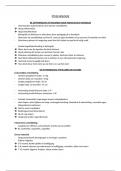
OLS: Ordinary Least Squares
Technique to determine the “best” curve through a scatter diagram
Regression: Y i= β^ 0 + β^ 1 X 1 i+ …+ ^β k X ki + u^ i
(Implied) Causality from right to left
Separate the random component from the systematic component
N 2
How? Ordinary Least Squares : arg min Σ i=1 ui
β
Why squares?
o Work with positive values
o Easy to compute derivatives
o Reweights large deviations (ui >1 increases in ∎ 2/ ui <1
decreases in ∎ 2)
Results
^ β j : estimated slope parameter effect of X on Y
2
2 σu
σ β= 2 2
: standard error uncertainty around the effect estimate
σ X (1−r X )
OLS estimate is BLUE (Best Linear Unbiased Estimator)
⇔ if Gauss-Markov Assumptions are satisfied.
The Classical Assumptions Stu, Ch. 4 aka. Gauss-Markov
Assumptions
Gauss-Markov Assumptions:
1. The regression model is linear in its parameters, is correctly specified, and
has an additive error term
2. All explanatory variables are uncorrelated with the error term (no
endogeneity)
3. Observations of the error term are uncorrelated with each other over time
(no serial correlation)
4. The error term has a constant variance (no heteroskedasticity)
5. No explanatory variable is a perfect linear function of any other
explanatory variable(s) (no perfect multicollinearity)
6. The error term is normally distributed with zero mean.
Assumption 1 and 2
Correct Model Specification =
Complete specification
Underfitting: omitted variable bias
Biased parameters: wrong effects (+ endogeneity)
Biased standard error: unreliable inference
Overfitting:
High risk of inflated standard errors (multicollinearity)
Correct functional form: linear in its parameters
Polynomials Detect and Compute Minima and/or Maxima
Logarithmic effects Interpretation in percentages
Detection: visuals (avplots) and statistics (Ramsey RESET-test)
∂y
Effect interpretation ‘marginal effects’ β j =
∂ xj
• Raw variables unit changes
1
• Standardized variables changes in ‘standard deviation from the mean’
• Log-transformed variables percentage changes
, Before anything of this applies: !!! First know your data !!!
Good results depend on good data
Ex ante:
Find mistakes and extreme values
Ex post:
Check for outliers and/or influential values
Visuals: rvfplot, avplot(s)
Standardized DfBeta(s): |SDfBeta|>1
Studentized Residuals: |Stud . Residual|>3
Correct errors
Delete observation
Extreme Case Dummy
Assumption 6
Normality Assumption
Not necessary for OLS-estimation
Necessary for Hypothesis testing Statistical Inference
Statistical Inference
From Sample to Population
Null Hypothesis Testing => see procedure: 5 steps
Under the null, how likely are my results?
Null hypothesis implies a restriction
Joint F-test = parameters simultaan gelijk aan 0 stellen.
CHOW-test = zijn er structuurbreuken? Structurele
veranderingen gegeven 2 groepen/ tijdsmomenten? Wat is
de impact?
Assumption 5
Multicollinearity
2
OLS: Ordinary Least Squares
Technique to determine the “best” curve through a scatter diagram
Regression: Y i= β^ 0 + β^ 1 X 1 i+ …+ ^β k X ki + u^ i
(Implied) Causality from right to left
Separate the random component from the systematic component
N 2
How? Ordinary Least Squares : arg min Σ i=1 ui
β
Why squares?
o Work with positive values
o Easy to compute derivatives
o Reweights large deviations (ui >1 increases in ∎ 2/ ui <1
decreases in ∎ 2)
Results
^ β j : estimated slope parameter effect of X on Y
2
2 σu
σ β= 2 2
: standard error uncertainty around the effect estimate
σ X (1−r X )
OLS estimate is BLUE (Best Linear Unbiased Estimator)
⇔ if Gauss-Markov Assumptions are satisfied.
The Classical Assumptions Stu, Ch. 4 aka. Gauss-Markov
Assumptions
Gauss-Markov Assumptions:
1. The regression model is linear in its parameters, is correctly specified, and
has an additive error term
2. All explanatory variables are uncorrelated with the error term (no
endogeneity)
3. Observations of the error term are uncorrelated with each other over time
(no serial correlation)
4. The error term has a constant variance (no heteroskedasticity)
5. No explanatory variable is a perfect linear function of any other
explanatory variable(s) (no perfect multicollinearity)
6. The error term is normally distributed with zero mean.
Assumption 1 and 2
Correct Model Specification =
Complete specification
Underfitting: omitted variable bias
Biased parameters: wrong effects (+ endogeneity)
Biased standard error: unreliable inference
Overfitting:
High risk of inflated standard errors (multicollinearity)
Correct functional form: linear in its parameters
Polynomials Detect and Compute Minima and/or Maxima
Logarithmic effects Interpretation in percentages
Detection: visuals (avplots) and statistics (Ramsey RESET-test)
∂y
Effect interpretation ‘marginal effects’ β j =
∂ xj
• Raw variables unit changes
1
• Standardized variables changes in ‘standard deviation from the mean’
• Log-transformed variables percentage changes
, Before anything of this applies: !!! First know your data !!!
Good results depend on good data
Ex ante:
Find mistakes and extreme values
Ex post:
Check for outliers and/or influential values
Visuals: rvfplot, avplot(s)
Standardized DfBeta(s): |SDfBeta|>1
Studentized Residuals: |Stud . Residual|>3
Correct errors
Delete observation
Extreme Case Dummy
Assumption 6
Normality Assumption
Not necessary for OLS-estimation
Necessary for Hypothesis testing Statistical Inference
Statistical Inference
From Sample to Population
Null Hypothesis Testing => see procedure: 5 steps
Under the null, how likely are my results?
Null hypothesis implies a restriction
Joint F-test = parameters simultaan gelijk aan 0 stellen.
CHOW-test = zijn er structuurbreuken? Structurele
veranderingen gegeven 2 groepen/ tijdsmomenten? Wat is
de impact?
Assumption 5
Multicollinearity
2