
SAMENVATTING
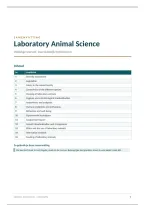
Laboratory Animal Science
Volledige leerstof, overzichtelijk herschreven
Inhoud
Nr. Hoofdstuk
1 Severity assessment
2 Legislation
3 Safety in the animal facility
4 Zootechnics of the different species
5 Housing of laboratory animals
6 Hygiene and microbiological standardisation
7 Anaesthesia and analgesia
8 Humane endpoints and euthanasia
9 Behaviour and well-being
10 Experimental techniques
11 Surgical techniques
12 Genetic standardisation and transgenesis
13 Ethics and the use of laboratory animals
14 Alternative methods
15 Feeding of laboratory animals
Zo gebruik je deze samenvatting
De leerstof staat in het Engels, zoals in de cursus. Belangrijke kernpunten staan in een kader zoals dit.
Laboratory Animal Science | Samenvatting 1
,HOOFDSTUK 1
Severity assessment
Why perform a severity assessment?
A severity assessment is required for every project that uses laboratory animals. It is a direct application of the
3Rs: by thinking ahead about what an animal will go through, you can reduce and refine.
Estimating pain and suffering
• Estimate the impact of the experiment on the animal
• Look for ways to reduce pain and suffering
• A procedure is any use of an animal for experimental or scientific purposes that may cause pain or lasting
harm equal to or higher than the pain of a needle prick
◦ Invasive and non-invasive procedures
◦ Procedures with a known and with an unknown outcome
◦ Procedures for educational purposes
◦ Not a procedure: killing an animal only to use its organs or tissues
Severity classification
The classification is partly subjective, so it must be well argued.
Category What it means
No harm Less than the pain of a needle prick
Terminal (non- Procedure fully under general anaesthesia
recovery) The animal never regains consciousness
Euthanasia at the end of the procedure
Mild Short-term mild pain
No significant effect on well-being
Moderate Short-term moderate pain
Long-lasting mild pain
Moderate effect on well-being
Severe Severe pain
Severe effect on well-being
Post mortem Only used at KU Leuven
Euthanasia only for tissue collection, no prior procedure
Not included in the official statistics
Assessing severity
Assessing severity means reflecting on what you actually do to the animals.
• Identify the painful or stressful steps and refine them
• Animals that suffer more receive extra attention
Laboratory Animal Science | Samenvatting 2
, Severity assessment is an important welfare advantage: it forces you to look at every step from the animal's
point of view.
Factors that influence severity
The procedure or technique
• Surgical versus non-surgical
• Effect of the procedure (for example injection of a toxic versus a non-toxic agent)
• Analgesia versus anaesthesia
• New model or procedure (unknown side effects)
• Level and duration of restraint
• Environment: housing and food
• Stress
Animal-specific factors
• Natural behaviour and biology
◦ Social animals should be kept in groups
◦ Senses (for example, vision is very important for primates)
• Strain and phenotype
◦ Immunodeficient mice have special needs so they do not get sick
• Sex, age, ...
◦ 10% weight loss is more severe in a young animal
Frequency, intensity and duration
• More frequent does not automatically mean more severe
◦ Animals can be trained
◦ Anticipating a stressful event can make it more severe
Refinement
• Analgesia can lower a severe procedure to moderate
• Good enrichment, housing and care reduce stress
• Poor care increases stress: metabolic cages, solitary housing, no enrichment
Non-procedural issues
• Cage flooding, fighting, illness, trauma
• These are not part of the protocol, but they still affect animal welfare
Prospective and actual severity
Prospective severity Actual severity
Estimated when the project is written Can differ from the expected severity
An assumption about the severity The highest level of suffering the animal experienced during its
Determined before the experiment life
Based on the animal's own experience
This number goes into the statistics
Lower than expected: for example control animals
Higher than expected: unexpected side effects
Assessing severity in practice
1. Define what the study does to the animals
Laboratory Animal Science | Samenvatting 3
, 2. Define what the animals will experience (= adverse effects)
3. Define how you will refine each step (= humane endpoints)
4. Decide on the severity
Laboratory Animal Science | Samenvatting 4
Laboratory Animal Science
Volledige leerstof, overzichtelijk herschreven
Inhoud
Nr. Hoofdstuk
1 Severity assessment
2 Legislation
3 Safety in the animal facility
4 Zootechnics of the different species
5 Housing of laboratory animals
6 Hygiene and microbiological standardisation
7 Anaesthesia and analgesia
8 Humane endpoints and euthanasia
9 Behaviour and well-being
10 Experimental techniques
11 Surgical techniques
12 Genetic standardisation and transgenesis
13 Ethics and the use of laboratory animals
14 Alternative methods
15 Feeding of laboratory animals
Zo gebruik je deze samenvatting
De leerstof staat in het Engels, zoals in de cursus. Belangrijke kernpunten staan in een kader zoals dit.
Laboratory Animal Science | Samenvatting 1
,HOOFDSTUK 1
Severity assessment
Why perform a severity assessment?
A severity assessment is required for every project that uses laboratory animals. It is a direct application of the
3Rs: by thinking ahead about what an animal will go through, you can reduce and refine.
Estimating pain and suffering
• Estimate the impact of the experiment on the animal
• Look for ways to reduce pain and suffering
• A procedure is any use of an animal for experimental or scientific purposes that may cause pain or lasting
harm equal to or higher than the pain of a needle prick
◦ Invasive and non-invasive procedures
◦ Procedures with a known and with an unknown outcome
◦ Procedures for educational purposes
◦ Not a procedure: killing an animal only to use its organs or tissues
Severity classification
The classification is partly subjective, so it must be well argued.
Category What it means
No harm Less than the pain of a needle prick
Terminal (non- Procedure fully under general anaesthesia
recovery) The animal never regains consciousness
Euthanasia at the end of the procedure
Mild Short-term mild pain
No significant effect on well-being
Moderate Short-term moderate pain
Long-lasting mild pain
Moderate effect on well-being
Severe Severe pain
Severe effect on well-being
Post mortem Only used at KU Leuven
Euthanasia only for tissue collection, no prior procedure
Not included in the official statistics
Assessing severity
Assessing severity means reflecting on what you actually do to the animals.
• Identify the painful or stressful steps and refine them
• Animals that suffer more receive extra attention
Laboratory Animal Science | Samenvatting 2
, Severity assessment is an important welfare advantage: it forces you to look at every step from the animal's
point of view.
Factors that influence severity
The procedure or technique
• Surgical versus non-surgical
• Effect of the procedure (for example injection of a toxic versus a non-toxic agent)
• Analgesia versus anaesthesia
• New model or procedure (unknown side effects)
• Level and duration of restraint
• Environment: housing and food
• Stress
Animal-specific factors
• Natural behaviour and biology
◦ Social animals should be kept in groups
◦ Senses (for example, vision is very important for primates)
• Strain and phenotype
◦ Immunodeficient mice have special needs so they do not get sick
• Sex, age, ...
◦ 10% weight loss is more severe in a young animal
Frequency, intensity and duration
• More frequent does not automatically mean more severe
◦ Animals can be trained
◦ Anticipating a stressful event can make it more severe
Refinement
• Analgesia can lower a severe procedure to moderate
• Good enrichment, housing and care reduce stress
• Poor care increases stress: metabolic cages, solitary housing, no enrichment
Non-procedural issues
• Cage flooding, fighting, illness, trauma
• These are not part of the protocol, but they still affect animal welfare
Prospective and actual severity
Prospective severity Actual severity
Estimated when the project is written Can differ from the expected severity
An assumption about the severity The highest level of suffering the animal experienced during its
Determined before the experiment life
Based on the animal's own experience
This number goes into the statistics
Lower than expected: for example control animals
Higher than expected: unexpected side effects
Assessing severity in practice
1. Define what the study does to the animals
Laboratory Animal Science | Samenvatting 3
, 2. Define what the animals will experience (= adverse effects)
3. Define how you will refine each step (= humane endpoints)
4. Decide on the severity
Laboratory Animal Science | Samenvatting 4


