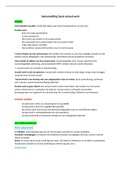
Samenvatting ARMS General Part
Lecture 1
Simple linear regression
o Involves 1 outcome (y) and 1 predictor (x)
o Outcome = the dependent variable (DV)
o Predictor = the independent variable (IV)
Yi = B 0+B 1 xi+ Ei
Multiple linear regression
o Involves 1 outcome and multiple predictors
o Meaning, one DV and multiple IVs
Yi = B 0+B 1 x 1 i+ B 2 x 2 i+ B 3 X 3 i+ Ei
* Slope = B0
* Slope of x1 = B1 x1i
* Slope of x2 = B2 x2i
* Residual = Ei
Types of variables
o Formal distinction in 4 measurement levels:
1) Nominal
2) Ordinal
3) Interval
4) Ratio
o Usually:
Nominal + ordinal (categorical/qualitative)
Interval + ratio (continous/ qualitative/numerical)
o Outcome = continuous continous predictors
o Dummy variable = always two options 0 or 1
Multiple linear regression and hierarchical multiple linear regression
o R² = sample value
o Adjusted R² = estimated population bias value (without bias)
o R² change = improvement of fit compared to previous model
Exploration of theory evaluation
o Method enter (forced entry) with hypothesis
o Stepwise method: all predictors are explores (without hypothesis)
Model assumptions
statistical inference is based on many assumptions
this may lead to incorrect results check assumptions carefully
o Distribution-free methods:
1) Non-parametic tests (not part of this course)
2) Bootstrapping methods
, Lecture 2
Moderation
o The effect of predictor x1 on outcome y is different for different levels of a second
predictor x2
o Example: gender different for males than for females
X1 Y X1
Gender Y
Gender
Gender
*
X1
Equation: Yi = B0 + B1Xi + B2 Gender i + B3X1i Gender i
Mediation
o The effect of the independent variable on a dependent variable is explained by a
third intermediate variable
Negative
life events Depression
Withdrawal
behavior
Negative
Depression
life events
C
C is a total effect (of x on y)
X C Y
C’
X Y C’ is a direct effect (of x on y)
A B
M
Lecture 1
Simple linear regression
o Involves 1 outcome (y) and 1 predictor (x)
o Outcome = the dependent variable (DV)
o Predictor = the independent variable (IV)
Yi = B 0+B 1 xi+ Ei
Multiple linear regression
o Involves 1 outcome and multiple predictors
o Meaning, one DV and multiple IVs
Yi = B 0+B 1 x 1 i+ B 2 x 2 i+ B 3 X 3 i+ Ei
* Slope = B0
* Slope of x1 = B1 x1i
* Slope of x2 = B2 x2i
* Residual = Ei
Types of variables
o Formal distinction in 4 measurement levels:
1) Nominal
2) Ordinal
3) Interval
4) Ratio
o Usually:
Nominal + ordinal (categorical/qualitative)
Interval + ratio (continous/ qualitative/numerical)
o Outcome = continuous continous predictors
o Dummy variable = always two options 0 or 1
Multiple linear regression and hierarchical multiple linear regression
o R² = sample value
o Adjusted R² = estimated population bias value (without bias)
o R² change = improvement of fit compared to previous model
Exploration of theory evaluation
o Method enter (forced entry) with hypothesis
o Stepwise method: all predictors are explores (without hypothesis)
Model assumptions
statistical inference is based on many assumptions
this may lead to incorrect results check assumptions carefully
o Distribution-free methods:
1) Non-parametic tests (not part of this course)
2) Bootstrapping methods
, Lecture 2
Moderation
o The effect of predictor x1 on outcome y is different for different levels of a second
predictor x2
o Example: gender different for males than for females
X1 Y X1
Gender Y
Gender
Gender
*
X1
Equation: Yi = B0 + B1Xi + B2 Gender i + B3X1i Gender i
Mediation
o The effect of the independent variable on a dependent variable is explained by a
third intermediate variable
Negative
life events Depression
Withdrawal
behavior
Negative
Depression
life events
C
C is a total effect (of x on y)
X C Y
C’
X Y C’ is a direct effect (of x on y)
A B
M