
Comprehensive Overview: Research Methods and Data Processing
Definition of Research
- a detailed study aimed at discovering new information or gaining new insights.
- The goal is to explore a subject in depth, either to find previously unknown facts or to reach a new level of
understanding.
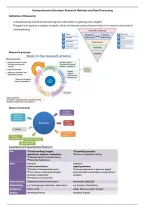
Research process
Types of research
Qualitative and Quantitative Research
,- Quantitative Research
o Based on the “scientific method” and follows a positivist philosophy
objective scientific truths exist and can be systematically studied.
o focused on cause-effect relationships = natural events are consistent, and not random.
Any randomness can be explained by discovering the underlying causes.
o Characteristics
Systematic: Follows clear steps in the research process.
Empirical: Involves collecting objective, observable data.
Controlled: External factors unrelated to the study variables are carefully controlled.
Critical examination: Research undergoes scrutiny to ensure reliability and to minimize bias.
- Qualitative Research
o Built on constructivism
emphasizes understanding complex phenomena within their natural context.
aims to explore experiences, perceptions, and social phenomena, using non-numeric data.
Basic vs. Applied Research
- Basic Research
o Conducted to increase knowledge without immediate practical application, often in a laboratory
setting (e.g., studying a substance in a petri dish).
- Applied Research
o Focuses on solving practical problems, especially in clinical settings
o The aim is to improve health outcomes through evidence-based practices (EBP).
Clinical and Non-clinical Research
- Non-clinical Research
o Takes place outside healthcare settings, often exploring basic science questions without direct
patient involvement.
- Clinical Research
o A structured process aimed at improving individual and public health.
o It involves investigating facts and theories in healthcare settings.
Patient-oriented research: Understanding disease mechanisms.
Epidemiological and behavioral studies: Describing patterns + identifying risk factors for
diseases.
Health services research: Exploring how research findings can be applied to improve public
health through evidence-based practices.
, o Clinical Research Methods
Randomized Controlled Trials (RCTs)
→ Considered the gold standard for testing the effectiveness of interventions.
→ Involves a range of disciplines such as
➢ movement scientists
➢ rehabilitation scientists
➢ epidemiologists
➢ cardiologists
Frameworks in Research
- (Paradigm: set of assumptions that construct a framework to view reality within an intellectual community
- Evidence-Based Practice (EBP)
o Involves making well-informed healthcare decisions based on three key components:
Best available scientific evidence
Clinical expertise of healthcare providers.
Patient preferences and values.
o EBP is relevant for diagnosis, prognosis, and treatment decisions.
- Translational Research
o Aims to apply findings from basic science to clinical practice.
o It addresses questions that arise from clinical problems and seeks to
translate scientific discoveries into real-world health improvements.
o Known as taking research “from bench to bedside” and back
an exchange of knowledge between laboratory research and
patient care.
Effectiveness Research
- Effectiveness research focuses on testing interventions in real-world settings, often using pragmatic
clinical trials
o Comparative effectiveness research
Comparing different treatments to identify which works best in a particular context.
o Practice-based evidence
Collecting data in real-world environments to inform healthcare practices
o Outcomes research
Analyzing the overall impact of interventions, such as patient satisfaction and cost-
effectiveness.
, Patient-centered outcomes research
→ Involves patients in the research process, particularly in the development of
questions and measures that are meaningful to them.
Patient-reported outcome measures (PROMs) focus on what patients consider important,
such as quality of life and personal satisfaction with treatments.
Efficacy vs Effectiveness
- Efficacy
o Refers to how well an intervention works in controlled environments such as laboratory settings.
o The sample is often selective and artificial, ensuring minimal external factors.
- Effectiveness:
o Evaluates how the intervention works in more diverse, real-world populations.
o This often includes people with other conditions or on other medications, making it more
representative of actual healthcare scenarios.
Next Step: Translating Evidence into Practice
- Once sufficient evidence supports the effectiveness of a practice, the focus shifts to implementation
science
- this field ensures that research findings are not only proven to be effective but are also integrated into
regular clinical practice.
- The aim is to determine why some findings are not translated into practice and to develop strategies to
improve uptake.
- Implementation Science
o This field focuses on how to integrate evidence-based practices (EBPs) into routine clinical care.
o Key areas of study include:
Feasibility: Whether the intervention is practical in real-world settings.
Acceptance: How well clinicians and patients accept the practice.
Adoption: The rate at which evidence-based practices are incorporated.
Sustainability: Whether the practices can be maintained over time.
o Methods used in implementation science include
Education
Definition of Research
- a detailed study aimed at discovering new information or gaining new insights.
- The goal is to explore a subject in depth, either to find previously unknown facts or to reach a new level of
understanding.
Research process
Types of research
Qualitative and Quantitative Research
,- Quantitative Research
o Based on the “scientific method” and follows a positivist philosophy
objective scientific truths exist and can be systematically studied.
o focused on cause-effect relationships = natural events are consistent, and not random.
Any randomness can be explained by discovering the underlying causes.
o Characteristics
Systematic: Follows clear steps in the research process.
Empirical: Involves collecting objective, observable data.
Controlled: External factors unrelated to the study variables are carefully controlled.
Critical examination: Research undergoes scrutiny to ensure reliability and to minimize bias.
- Qualitative Research
o Built on constructivism
emphasizes understanding complex phenomena within their natural context.
aims to explore experiences, perceptions, and social phenomena, using non-numeric data.
Basic vs. Applied Research
- Basic Research
o Conducted to increase knowledge without immediate practical application, often in a laboratory
setting (e.g., studying a substance in a petri dish).
- Applied Research
o Focuses on solving practical problems, especially in clinical settings
o The aim is to improve health outcomes through evidence-based practices (EBP).
Clinical and Non-clinical Research
- Non-clinical Research
o Takes place outside healthcare settings, often exploring basic science questions without direct
patient involvement.
- Clinical Research
o A structured process aimed at improving individual and public health.
o It involves investigating facts and theories in healthcare settings.
Patient-oriented research: Understanding disease mechanisms.
Epidemiological and behavioral studies: Describing patterns + identifying risk factors for
diseases.
Health services research: Exploring how research findings can be applied to improve public
health through evidence-based practices.
, o Clinical Research Methods
Randomized Controlled Trials (RCTs)
→ Considered the gold standard for testing the effectiveness of interventions.
→ Involves a range of disciplines such as
➢ movement scientists
➢ rehabilitation scientists
➢ epidemiologists
➢ cardiologists
Frameworks in Research
- (Paradigm: set of assumptions that construct a framework to view reality within an intellectual community
- Evidence-Based Practice (EBP)
o Involves making well-informed healthcare decisions based on three key components:
Best available scientific evidence
Clinical expertise of healthcare providers.
Patient preferences and values.
o EBP is relevant for diagnosis, prognosis, and treatment decisions.
- Translational Research
o Aims to apply findings from basic science to clinical practice.
o It addresses questions that arise from clinical problems and seeks to
translate scientific discoveries into real-world health improvements.
o Known as taking research “from bench to bedside” and back
an exchange of knowledge between laboratory research and
patient care.
Effectiveness Research
- Effectiveness research focuses on testing interventions in real-world settings, often using pragmatic
clinical trials
o Comparative effectiveness research
Comparing different treatments to identify which works best in a particular context.
o Practice-based evidence
Collecting data in real-world environments to inform healthcare practices
o Outcomes research
Analyzing the overall impact of interventions, such as patient satisfaction and cost-
effectiveness.
, Patient-centered outcomes research
→ Involves patients in the research process, particularly in the development of
questions and measures that are meaningful to them.
Patient-reported outcome measures (PROMs) focus on what patients consider important,
such as quality of life and personal satisfaction with treatments.
Efficacy vs Effectiveness
- Efficacy
o Refers to how well an intervention works in controlled environments such as laboratory settings.
o The sample is often selective and artificial, ensuring minimal external factors.
- Effectiveness:
o Evaluates how the intervention works in more diverse, real-world populations.
o This often includes people with other conditions or on other medications, making it more
representative of actual healthcare scenarios.
Next Step: Translating Evidence into Practice
- Once sufficient evidence supports the effectiveness of a practice, the focus shifts to implementation
science
- this field ensures that research findings are not only proven to be effective but are also integrated into
regular clinical practice.
- The aim is to determine why some findings are not translated into practice and to develop strategies to
improve uptake.
- Implementation Science
o This field focuses on how to integrate evidence-based practices (EBPs) into routine clinical care.
o Key areas of study include:
Feasibility: Whether the intervention is practical in real-world settings.
Acceptance: How well clinicians and patients accept the practice.
Adoption: The rate at which evidence-based practices are incorporated.
Sustainability: Whether the practices can be maintained over time.
o Methods used in implementation science include
Education


