
Kunstwerken
Les 1: Introduction
Willem van
Haecht, The
Gallery of
Cornelis van
der Geest,
1628, Antwerp,
Rubens House
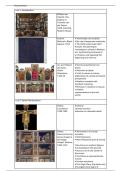
Kazimir ▪ Technically not complex
Malevich, Black ▪ No use of expensive materials
Square, 1915 ▪ ‘My child could make that!’
And yet, the painting is
considered a climax in Western
art, synthesizing centuries of
art history, and signaling the
beginning of a new era.
Jan and Hubert ▪ Technical perfection (oil
Van Eyck, paint)
Ghent ▪ Attention to detail
Altarpiece, ▪ Truth to nature in colors,
1432-35 application of central and aerial
perspective
▪ Realism invested with
symbolic meaning
▪ Mimesis = imitation of nature;
imitative
representation of the real
world.
Les 2: Italian Renaissance
Giotto, Anatomy
Crucifixion, Human emotion
1290-1295 Attention to naturalist detail
Giotto, ▪ 39 scenes in a circular
Frescoes for the narrative
Arena chapel or ▪ Old Testament
Scrovegni ▪ New Testament (Life of Christ)
chapel, Padova,
1305-1310 New focus on realism (figures
are standing on the ground)
▪ Jesus is not in the center of
the scene
▪ The Divine is represented as
human
▪ Human emotions
▪ The Virgin Mary, the saints and
the angles show signs of
, suffering and have their own
personalities
▪ The figures and the landscape
play a role in creating the
perspective
▪ Two figures with their backs to
the viewer
▪ Rock creates sense of three-
dimensionality
▪ Symbolism of the tree
Patron?
▪ Enrico Scrovegni
▪ Rich banker (not member of
clergy)
▪ Tension between faith and
economic development
Lorenzo ▪ Use of bas-relief (= a
Ghiberti, East sculptural technique
doors of the that involves lightly carving a
Florence design into a
Baptistry (Gates surface)
of Paradise), ▪ Classical architecture
1429-1447 ▪ Roman clothing
▪ Anatomy: muscular bodies,
voluminous and
dynamic figures
▪ Sculptural depth, and
emotion
▪ Emphasis on spatial realism
and movement
Masaccio, The Funerary monument painted
Trinity, 1427 on the wall of the Church of
Santa Maria Novella
▪ Illusionistic chapel
▪ Creation of depth
▪ Triangular composition,
echoing the subject matter of
the Holy Trinity (Father, Son,
Holy Ghost)
Funerary monument painted
on the wall of the Church of
Santa Maria Novella
▪ Illusionistic chapel
▪ Creation of depth
▪ Triangular composition,
echoing the subject matter of
the Holy Trinity (Father, Son,
Holy Ghost)
,Leonardo Da Aerial perspective or
Vinci, Mona atmospheric perspective =
Lisa, c. 1503-06 ▪ the technique of creating an
illusion of depth by depicting
distant objects as paler, less
detailed, and usually bluer than
near objects.
▪ This technique was
introduced in painting to
portray what was observed in
nature and evident in his
interest in optics.
▪ Aim: depict how we perceive
the world.
Masaccio, The
Tribute Money,
1424
Benozzo From the east wall of the
Gozzoli, Journey Chapel of the Palazzo
of the Magi to Medici Riccardi
Bethlemem, ▪ Combines biblical narrative
1459 with Medici portraits into
an idiosyncratic
iconography
Plautilla Nelli, first-known depiction of the
The Last biblical tale by a woman,
Supper, 1568 painted
for the refectory of the
monastery, rediscovered in
1990s and carefully restored
Sofonisba
Anguissola, The Representing her sisters in
Game of Chess intellectual pursuits (chess
(or Portrait of game)
the artist’s ▪ Signed and dated on the edge
sisters playing of the chessboard:
chess), c. 1555 SOPHONISBA ANGUSSOLA
VIRGO AMILCARIS FILIA EX
VERA EFFIGIE TRES SUAS
SORORES ET ANCILLAM PINXIT
MDLV (“Sofonisba Angussola
virgin daughter of Amilcare
painted from life her three
sisters and a maid
1555”)
, Lavinia Considered the first female
Fontana, nude painted by a woman artist
Minerva
Dressing, c.
1613
Boticelli, The Commissioned by the
Birth of Venus, Medici, likely to decorate
1482 one of their country houses
▪ Classical mythology (Venus
= Roman goddess of love)
▪ Rare female nude
▪ Platonic ideals of beauty
and love
▪ Stylized beauty over realism
▪ Inspired by a hymn by
Homerus about Venus
Donatello, First freestanding nude since
David, 1440 antiquity
Commissioned by Cosimo de’
Medici: Reflecting his interest
in
Classical antiquity
▪ Created for the inner
courtyard of the Palazzo De’
Medici
▪ Sensual, youthful sculpture
as an allegory for Florence’s
resilience
▪ Classical contrapposto
Michelangelo ▪ Monumental marble nude
Buonarroti, (5.17 m)
David, 1501- ▪ Contrapposto
1504 ▪ Intended for public space
▪ Symbol of Florence
▪ Emphasis on rational control
over physical power
Florence, Museo
dell’Accademia
Perugino, Christ ➢ Harmony, classical
Delivering the architecture, linear perspective
Keys to St. > reference to eternity of the
Peter, 1481- Christian Church
1482
Les 1: Introduction
Willem van
Haecht, The
Gallery of
Cornelis van
der Geest,
1628, Antwerp,
Rubens House
Kazimir ▪ Technically not complex
Malevich, Black ▪ No use of expensive materials
Square, 1915 ▪ ‘My child could make that!’
And yet, the painting is
considered a climax in Western
art, synthesizing centuries of
art history, and signaling the
beginning of a new era.
Jan and Hubert ▪ Technical perfection (oil
Van Eyck, paint)
Ghent ▪ Attention to detail
Altarpiece, ▪ Truth to nature in colors,
1432-35 application of central and aerial
perspective
▪ Realism invested with
symbolic meaning
▪ Mimesis = imitation of nature;
imitative
representation of the real
world.
Les 2: Italian Renaissance
Giotto, Anatomy
Crucifixion, Human emotion
1290-1295 Attention to naturalist detail
Giotto, ▪ 39 scenes in a circular
Frescoes for the narrative
Arena chapel or ▪ Old Testament
Scrovegni ▪ New Testament (Life of Christ)
chapel, Padova,
1305-1310 New focus on realism (figures
are standing on the ground)
▪ Jesus is not in the center of
the scene
▪ The Divine is represented as
human
▪ Human emotions
▪ The Virgin Mary, the saints and
the angles show signs of
, suffering and have their own
personalities
▪ The figures and the landscape
play a role in creating the
perspective
▪ Two figures with their backs to
the viewer
▪ Rock creates sense of three-
dimensionality
▪ Symbolism of the tree
Patron?
▪ Enrico Scrovegni
▪ Rich banker (not member of
clergy)
▪ Tension between faith and
economic development
Lorenzo ▪ Use of bas-relief (= a
Ghiberti, East sculptural technique
doors of the that involves lightly carving a
Florence design into a
Baptistry (Gates surface)
of Paradise), ▪ Classical architecture
1429-1447 ▪ Roman clothing
▪ Anatomy: muscular bodies,
voluminous and
dynamic figures
▪ Sculptural depth, and
emotion
▪ Emphasis on spatial realism
and movement
Masaccio, The Funerary monument painted
Trinity, 1427 on the wall of the Church of
Santa Maria Novella
▪ Illusionistic chapel
▪ Creation of depth
▪ Triangular composition,
echoing the subject matter of
the Holy Trinity (Father, Son,
Holy Ghost)
Funerary monument painted
on the wall of the Church of
Santa Maria Novella
▪ Illusionistic chapel
▪ Creation of depth
▪ Triangular composition,
echoing the subject matter of
the Holy Trinity (Father, Son,
Holy Ghost)
,Leonardo Da Aerial perspective or
Vinci, Mona atmospheric perspective =
Lisa, c. 1503-06 ▪ the technique of creating an
illusion of depth by depicting
distant objects as paler, less
detailed, and usually bluer than
near objects.
▪ This technique was
introduced in painting to
portray what was observed in
nature and evident in his
interest in optics.
▪ Aim: depict how we perceive
the world.
Masaccio, The
Tribute Money,
1424
Benozzo From the east wall of the
Gozzoli, Journey Chapel of the Palazzo
of the Magi to Medici Riccardi
Bethlemem, ▪ Combines biblical narrative
1459 with Medici portraits into
an idiosyncratic
iconography
Plautilla Nelli, first-known depiction of the
The Last biblical tale by a woman,
Supper, 1568 painted
for the refectory of the
monastery, rediscovered in
1990s and carefully restored
Sofonisba
Anguissola, The Representing her sisters in
Game of Chess intellectual pursuits (chess
(or Portrait of game)
the artist’s ▪ Signed and dated on the edge
sisters playing of the chessboard:
chess), c. 1555 SOPHONISBA ANGUSSOLA
VIRGO AMILCARIS FILIA EX
VERA EFFIGIE TRES SUAS
SORORES ET ANCILLAM PINXIT
MDLV (“Sofonisba Angussola
virgin daughter of Amilcare
painted from life her three
sisters and a maid
1555”)
, Lavinia Considered the first female
Fontana, nude painted by a woman artist
Minerva
Dressing, c.
1613
Boticelli, The Commissioned by the
Birth of Venus, Medici, likely to decorate
1482 one of their country houses
▪ Classical mythology (Venus
= Roman goddess of love)
▪ Rare female nude
▪ Platonic ideals of beauty
and love
▪ Stylized beauty over realism
▪ Inspired by a hymn by
Homerus about Venus
Donatello, First freestanding nude since
David, 1440 antiquity
Commissioned by Cosimo de’
Medici: Reflecting his interest
in
Classical antiquity
▪ Created for the inner
courtyard of the Palazzo De’
Medici
▪ Sensual, youthful sculpture
as an allegory for Florence’s
resilience
▪ Classical contrapposto
Michelangelo ▪ Monumental marble nude
Buonarroti, (5.17 m)
David, 1501- ▪ Contrapposto
1504 ▪ Intended for public space
▪ Symbol of Florence
▪ Emphasis on rational control
over physical power
Florence, Museo
dell’Accademia
Perugino, Christ ➢ Harmony, classical
Delivering the architecture, linear perspective
Keys to St. > reference to eternity of the
Peter, 1481- Christian Church
1482


