
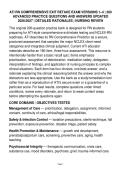
ATI RN COMPREHENSIVE EXIT RETAKE EXAM VERSIONS 1–4 | 200
ADVANCED PRACTICE QUESTIONS AND ANSWERS UPDATED
2026/2027 | DETAILED RATIONALES | NURSING REVIEW
This original 200-question practice bank is designed for RN students
preparing for ATI-style comprehensive exit/retake testing and NCLEX-RN
readiness. ATI describes its RN Comprehensive Predictor as a secure,
proctored assessment that samples the major NCLEX client-need
categories and integrates clinical judgment. Current ATI educator
materials describe an 180-item, three-hour assessment. This resource is
intentionally harder than a basic recall quiz: items emphasize
prioritization, recognition of deterioration, medication safety, delegation,
interpretation of findings, and application of nursing principles to complex
clinical situations. Each item has four choices, one best answer, and a
rationale explaining the clinical reasoning behind the answer and why the
distractors are less appropriate. Use the bank as a study/remediation tool
rather than as a reproduction of ATI's secure exam or a guarantee of a
particular score. For best results, complete questions under timed
conditions, review every rationale, and return to weak content areas
before attempting the questions again.
CORE DOMAINS / OBJECTIVES TESTED
Management of Care — prioritization, delegation, assignment, informed
consent, continuity of care, ethical/legal responsibilities.
Safety & Infection Control — isolation precautions, sterile technique, fall
prevention, exposure prevention, disaster triage, patient safety.
Health Promotion & Maintenance — growth and development,
prenatal/postpartum care, screening, preventive care, aging, health
teaching.
Psychosocial Integrity — therapeutic communication, crisis care,
substance use, mood disorders, psychosis, grief, trauma-informed care.
Page 1
,Basic Care & Comfort — mobility, nutrition, elimination, sleep, hygiene,
pain, skin integrity, positioning and comfort.
Pharmacological & Parenteral Therapies — medication safety, adverse
effects, antidotes, IV therapy, insulin, anticoagulants, high-alert
medications.
Reduction of Risk Potential — laboratory trends, diagnostic
procedures, postoperative complications, monitoring, tubes/drains, early
deterioration.
Physiological Adaptation — acute/chronic illness, shock, respiratory
failure, cardiac emergencies, neurologic disorders, endocrine crises.
Practice-bank note
These are original practice questions written for study use. They are not
reproduced ATI questions, and no claim is made that they are official,
live, leaked, or 'verified' ATI exam items.
Page 2
,SECTION: MANAGEMENT OF CARE
Q1: A nurse receives report on four clients. Which client should the
nurse assess first?
A) A client 2 days after hip arthroplasty reporting pain of 7/10 before
scheduled analgesia
B) A client with COPD whose oxygen saturation decreased from 94% to
90% while sleeping
C) A client 6 hours after thyroidectomy who is restless and
has new inspiratory stridor
D) A client with heart failure who gained 1 kg (2.2 lb) since yesterday
Rationale: The client with new stridor after thyroidectomy has a
potentially life-threatening airway obstruction and requires immediate
assessment. Pain, a modest oxygen change during sleep, and daily
weight gain are important but are less immediately threatening than an
obstructed airway.
Q2: A charge nurse is assigning clients to an experienced LPN/LVN.
Which assignment is most appropriate?
A) A client admitted with diabetic ketoacidosis receiving an insulin
infusion
B) A stable client 2 days after bowel resection who needs
routine oral medications and a dressing change
C) A client with new-onset chest pain awaiting an ECG
D) A client receiving a titrated heparin infusion for pulmonary embolism
Rationale: A stable postoperative client with predictable care is
appropriate for an LPN/LVN according to scope and facility policy.
Unstable clients, initial assessment of new symptoms, and titratable
high-risk infusions require RN-level assessment and management.
Page 3
, Q3: A client scheduled for a procedure says, 'I signed the consent,
but I still do not understand what the doctor is going to do.' What
should the nurse do?
A) Explain the procedure in detail and obtain a new signature
B) Witness the signature because the consent was already signed
C) Notify the provider that the client needs further
explanation before proceeding
D) Ask a family member to explain the procedure
Rationale: The provider performing the procedure is responsible for
explaining its nature, risks, benefits, and alternatives. The nurse should
recognize inadequate informed consent and notify the provider. The
nurse should not substitute personal teaching for the provider's
required disclosure.
Q4: A nurse is caring for a client who refuses a blood transfusion for
religious reasons. The client is alert and demonstrates
understanding of the consequences. Which action is appropriate?
A) Ask the family to authorize the transfusion
B) Respect the refusal and notify the provider
C) Administer the transfusion because it is life-saving
D) Obtain an emergency court order independently
Rationale: An informed adult with decision-making capacity has the
right to refuse treatment, even treatment that could be life-saving. The
nurse should respect the decision, communicate it to the provider, and
document the discussion.
Q5: A nurse is delegating care to an assistive personnel (AP). Which
task is appropriate?
A) Evaluate a newly admitted client's swallowing ability
B) Teach a client how to use an incentive spirometer
Page 4
ADVANCED PRACTICE QUESTIONS AND ANSWERS UPDATED
2026/2027 | DETAILED RATIONALES | NURSING REVIEW
This original 200-question practice bank is designed for RN students
preparing for ATI-style comprehensive exit/retake testing and NCLEX-RN
readiness. ATI describes its RN Comprehensive Predictor as a secure,
proctored assessment that samples the major NCLEX client-need
categories and integrates clinical judgment. Current ATI educator
materials describe an 180-item, three-hour assessment. This resource is
intentionally harder than a basic recall quiz: items emphasize
prioritization, recognition of deterioration, medication safety, delegation,
interpretation of findings, and application of nursing principles to complex
clinical situations. Each item has four choices, one best answer, and a
rationale explaining the clinical reasoning behind the answer and why the
distractors are less appropriate. Use the bank as a study/remediation tool
rather than as a reproduction of ATI's secure exam or a guarantee of a
particular score. For best results, complete questions under timed
conditions, review every rationale, and return to weak content areas
before attempting the questions again.
CORE DOMAINS / OBJECTIVES TESTED
Management of Care — prioritization, delegation, assignment, informed
consent, continuity of care, ethical/legal responsibilities.
Safety & Infection Control — isolation precautions, sterile technique, fall
prevention, exposure prevention, disaster triage, patient safety.
Health Promotion & Maintenance — growth and development,
prenatal/postpartum care, screening, preventive care, aging, health
teaching.
Psychosocial Integrity — therapeutic communication, crisis care,
substance use, mood disorders, psychosis, grief, trauma-informed care.
Page 1
,Basic Care & Comfort — mobility, nutrition, elimination, sleep, hygiene,
pain, skin integrity, positioning and comfort.
Pharmacological & Parenteral Therapies — medication safety, adverse
effects, antidotes, IV therapy, insulin, anticoagulants, high-alert
medications.
Reduction of Risk Potential — laboratory trends, diagnostic
procedures, postoperative complications, monitoring, tubes/drains, early
deterioration.
Physiological Adaptation — acute/chronic illness, shock, respiratory
failure, cardiac emergencies, neurologic disorders, endocrine crises.
Practice-bank note
These are original practice questions written for study use. They are not
reproduced ATI questions, and no claim is made that they are official,
live, leaked, or 'verified' ATI exam items.
Page 2
,SECTION: MANAGEMENT OF CARE
Q1: A nurse receives report on four clients. Which client should the
nurse assess first?
A) A client 2 days after hip arthroplasty reporting pain of 7/10 before
scheduled analgesia
B) A client with COPD whose oxygen saturation decreased from 94% to
90% while sleeping
C) A client 6 hours after thyroidectomy who is restless and
has new inspiratory stridor
D) A client with heart failure who gained 1 kg (2.2 lb) since yesterday
Rationale: The client with new stridor after thyroidectomy has a
potentially life-threatening airway obstruction and requires immediate
assessment. Pain, a modest oxygen change during sleep, and daily
weight gain are important but are less immediately threatening than an
obstructed airway.
Q2: A charge nurse is assigning clients to an experienced LPN/LVN.
Which assignment is most appropriate?
A) A client admitted with diabetic ketoacidosis receiving an insulin
infusion
B) A stable client 2 days after bowel resection who needs
routine oral medications and a dressing change
C) A client with new-onset chest pain awaiting an ECG
D) A client receiving a titrated heparin infusion for pulmonary embolism
Rationale: A stable postoperative client with predictable care is
appropriate for an LPN/LVN according to scope and facility policy.
Unstable clients, initial assessment of new symptoms, and titratable
high-risk infusions require RN-level assessment and management.
Page 3
, Q3: A client scheduled for a procedure says, 'I signed the consent,
but I still do not understand what the doctor is going to do.' What
should the nurse do?
A) Explain the procedure in detail and obtain a new signature
B) Witness the signature because the consent was already signed
C) Notify the provider that the client needs further
explanation before proceeding
D) Ask a family member to explain the procedure
Rationale: The provider performing the procedure is responsible for
explaining its nature, risks, benefits, and alternatives. The nurse should
recognize inadequate informed consent and notify the provider. The
nurse should not substitute personal teaching for the provider's
required disclosure.
Q4: A nurse is caring for a client who refuses a blood transfusion for
religious reasons. The client is alert and demonstrates
understanding of the consequences. Which action is appropriate?
A) Ask the family to authorize the transfusion
B) Respect the refusal and notify the provider
C) Administer the transfusion because it is life-saving
D) Obtain an emergency court order independently
Rationale: An informed adult with decision-making capacity has the
right to refuse treatment, even treatment that could be life-saving. The
nurse should respect the decision, communicate it to the provider, and
document the discussion.
Q5: A nurse is delegating care to an assistive personnel (AP). Which
task is appropriate?
A) Evaluate a newly admitted client's swallowing ability
B) Teach a client how to use an incentive spirometer
Page 4


