
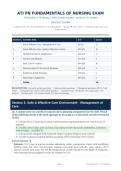
ATI PN FUNDAMENTALS OF NURSING EXAM
70 Questions | 70 Minutes | 100% Correct Answers - Verified & A+ Graded
2026/2027 EDITION
Aligned with ATI PN Fundamentals Test Blueprint • NCLEX-PN Test Plan • Practical Nursing Core
Competencies
Section Content Area Q# Count
1 Safe & Effective Care - Management of Care Q1-Q12 12
2 Safe & Effective Care - Safety & Infection Control Q13-Q24 12
3 Health Promotion & Maintenance Q25-Q32 8
4 Psychosocial Integrity Q33-Q40 8
5 Basic Care & Comfort Q41-Q50 10
6 Pharmacological & Parenteral Therapies Q51-Q58 8
7 Reduction of Risk Potential Q59-Q64 6
8 Physiological Adaptation Q65-Q70 6
TOTAL 70
EXAM FEATURES: 10 priority-setting questions • 8 pharmacology questions • 8 delegation questions (LPN vs. UAP
scope) • 3 integrated case studies with related questions • Cognitive levels: 20% Recall / 50% Application / 30%
Analysis • Question style: 75% scenario-based, 25% direct knowledge.
Section 1: Safe & Effective Care Environment - Management of
Care
Q1: A charge nurse on a medical-surgical unit is planning assignments for the shift. Which
of the following clients is the most appropriate to assign to a Unlicensed Assistive Personnel
(UAP)?
A. A client who is 2 hours post-cardiac catheterization requiring femoral site checks every 15
minutes
B. A stable client 3 days post-op from a hip replacement who needs ambulation assistance
with a walker [CORRECT]
C. A client newly admitted with suspected stroke requiring frequent neuro checks
D. A client receiving a heparin infusion requiring aPTT monitoring every 6 hours
Correct Answer: B
Rationale: UAP scope of practice includes ambulating stable, postoperative clients with established
mobility plans. The other clients require ongoing assessment (post-cath site, neuro checks, aPTT)
which is outside UAP scope. Per ATI PN Fundamentals and the NCLEX-PN Five Rights of Delegation,
tasks requiring nursing judgment cannot be delegated to UAP.
Page 1 70 Questions | 70 Minutes
,ATI PN Fundamentals of Nursing Exam - 2026/2027 Edition
Q2: The practical nurse receives morning shift report on four clients. Which client should
the nurse assess FIRST?
A. A client 1 day postoperative requesting pain medication for incisional pain rated 6/10
B. A client with chronic obstructive pulmonary disease (COPD) with an SpO2 of 88% on room
air [CORRECT]
C. A client with diabetes whose breakfast tray has arrived and morning insulin is due
D. A client with heart failure reporting 2+ pitting edema of the lower extremities
Correct Answer: B
Rationale: Using the ABC priority framework (Airway, Breathing, Circulation), the COPD client with
SpO2 of 88% is experiencing respiratory compromise and must be seen first. Pain (option A) follows
Maslow's physiological needs but is not life-threatening. Insulin administration (C) and edema
assessment (D) are important but lower priority than an acute oxygenation deficit per NCLEX-PN
prioritization principles.
Q3: A client is scheduled for an emergency appendectomy and is unable to sign the consent
form due to being under the influence of sedatives administered in the emergency
department. Which action should the practical nurse take?
A. Witness the client's spouse sign the consent form as a surrogate decision-maker
B. Have the client sign the form anyway to avoid delaying the surgery
C. Notify the surgeon that informed consent cannot be obtained and document the finding
[CORRECT]
D. Ask the UAP to sign as a witness since the client is incapacitated
Correct Answer: C
Rationale: Informed consent requires the client to have full capacity to understand the procedure,
risks, and alternatives. When capacity is impaired, the nurse's role is to notify the provider; consent
may then be obtained from a legally authorized representative or through emergency exception per
state law. Forcing an impaired client to sign is illegal and unethical. UAP cannot witness consent (ATI
PN Fundamentals: Legal Issues).
Q4: Which of the following tasks is appropriate for the charge nurse to assign to a Licensed
Practical Nurse (LPN) rather than a UAP?
A. Ambulating a stable client to the bathroom
B. Taking routine vital signs on a stable postoperative client
C. Reinforcing teaching about a newly prescribed diabetic diet for a stable client
[CORRECT]
D. Performing the initial admission assessment of a newly admitted client
Correct Answer: C
Rationale: LPNs may reinforce (not initiate) teaching for stable clients with established care plans,
which falls within their scope per the ATI PN delegation model. Initial admission assessments (D) must
be performed by an RN. Ambulation (A) and routine vital signs (B) on stable clients can be delegated to
UAP. LPN scope includes focused assessments, medication administration, and reinforcing established
teaching plans.
Q5: A client's adult daughter approaches the nurse at the nurses' station and asks for
information about her mother's diagnosis. Which response by the nurse demonstrates
appropriate understanding of HIPAA?
Page 2 70 Questions | 70 Minutes
, ATI PN Fundamentals of Nursing Exam - 2026/2027 Edition
A. "I can share her diagnosis with you since you are her daughter and listed as family."
B. "I cannot discuss her condition without her permission; let me check if she has authorized
me to share information with you." [CORRECT]
C. "She is doing well; I'll let her know you asked about her."
D. "You will need to speak directly with the provider about her medical condition."
Correct Answer: B
Rationale: HIPAA protects all protected health information (PHI) and requires the client's explicit
authorization before disclosure to anyone, including family. Being a family member does not
automatically grant access. The nurse should verify whether the client has authorized release of
information. Option C still discloses status information; option D incorrectly redirects. ATI PN
Fundamentals emphasizes verifying authorization before any disclosure.
Q6: At 0800, the practical nurse is caring for four clients. Which client requires the nurse's
immediate attention?
A. A client reporting nausea after receiving morphine 30 minutes ago
B. A client whose IV pump is alarming and the IV site appears swollen and cool to touch
[CORRECT]
C. A client scheduled for physical therapy at 0900 who needs pre-therapy pain medication
D. A client requesting water after being NPO since midnight for a procedure at 1000
Correct Answer: B
Rationale: The IV pump alarm with a swollen, cool IV site suggests infiltration - a complication
requiring immediate intervention to prevent tissue damage and ensure continued therapy. Using the
ABC and acute-vs-chronic prioritization framework, an infiltrated IV with active fluid/medication
issues takes priority. Nausea from morphine (A), scheduled pre-therapy pain med (C), and NPO status
(D) are important but not immediately threatening.
Q7: A client with terminal cancer has a signed Do-Not-Resuscitate (DNR) order in the
medical record. The client becomes unresponsive and a family member begs the nurse to
"do something." Which is the most appropriate nursing action?
A. Initiate cardiopulmonary resuscitation (CPR) because the family is requesting it
B. Call a code immediately and let the team decide whether to resuscitate
C. Honor the DNR order, provide comfort measures, and notify the provider and family of
the change in status [CORRECT]
D. Ask the family to leave the room while waiting for the provider to arrive
Correct Answer: C
Rationale: A signed DNR order is a legally binding advance directive that must be honored regardless
of family requests at the time of arrest. The nurse should provide comfort care, support the family, and
notify the provider. Initiating CPR (A) violates the client's autonomy and legal directive. Per ATI PN
Fundamentals: Advance Directives, the nurse advocates for the client's documented wishes.
Q8: Which of the following tasks is within the scope of practice for a UAP working on a
medical-surgical unit?
A. Measuring and recording intake and output (I&O;) on a stable client [CORRECT]
B. Administering oral medications to a stable client
C. Performing a sterile dressing change on a postoperative wound
D. Developing a plan of care for a newly admitted client
Page 3 70 Questions | 70 Minutes
70 Questions | 70 Minutes | 100% Correct Answers - Verified & A+ Graded
2026/2027 EDITION
Aligned with ATI PN Fundamentals Test Blueprint • NCLEX-PN Test Plan • Practical Nursing Core
Competencies
Section Content Area Q# Count
1 Safe & Effective Care - Management of Care Q1-Q12 12
2 Safe & Effective Care - Safety & Infection Control Q13-Q24 12
3 Health Promotion & Maintenance Q25-Q32 8
4 Psychosocial Integrity Q33-Q40 8
5 Basic Care & Comfort Q41-Q50 10
6 Pharmacological & Parenteral Therapies Q51-Q58 8
7 Reduction of Risk Potential Q59-Q64 6
8 Physiological Adaptation Q65-Q70 6
TOTAL 70
EXAM FEATURES: 10 priority-setting questions • 8 pharmacology questions • 8 delegation questions (LPN vs. UAP
scope) • 3 integrated case studies with related questions • Cognitive levels: 20% Recall / 50% Application / 30%
Analysis • Question style: 75% scenario-based, 25% direct knowledge.
Section 1: Safe & Effective Care Environment - Management of
Care
Q1: A charge nurse on a medical-surgical unit is planning assignments for the shift. Which
of the following clients is the most appropriate to assign to a Unlicensed Assistive Personnel
(UAP)?
A. A client who is 2 hours post-cardiac catheterization requiring femoral site checks every 15
minutes
B. A stable client 3 days post-op from a hip replacement who needs ambulation assistance
with a walker [CORRECT]
C. A client newly admitted with suspected stroke requiring frequent neuro checks
D. A client receiving a heparin infusion requiring aPTT monitoring every 6 hours
Correct Answer: B
Rationale: UAP scope of practice includes ambulating stable, postoperative clients with established
mobility plans. The other clients require ongoing assessment (post-cath site, neuro checks, aPTT)
which is outside UAP scope. Per ATI PN Fundamentals and the NCLEX-PN Five Rights of Delegation,
tasks requiring nursing judgment cannot be delegated to UAP.
Page 1 70 Questions | 70 Minutes
,ATI PN Fundamentals of Nursing Exam - 2026/2027 Edition
Q2: The practical nurse receives morning shift report on four clients. Which client should
the nurse assess FIRST?
A. A client 1 day postoperative requesting pain medication for incisional pain rated 6/10
B. A client with chronic obstructive pulmonary disease (COPD) with an SpO2 of 88% on room
air [CORRECT]
C. A client with diabetes whose breakfast tray has arrived and morning insulin is due
D. A client with heart failure reporting 2+ pitting edema of the lower extremities
Correct Answer: B
Rationale: Using the ABC priority framework (Airway, Breathing, Circulation), the COPD client with
SpO2 of 88% is experiencing respiratory compromise and must be seen first. Pain (option A) follows
Maslow's physiological needs but is not life-threatening. Insulin administration (C) and edema
assessment (D) are important but lower priority than an acute oxygenation deficit per NCLEX-PN
prioritization principles.
Q3: A client is scheduled for an emergency appendectomy and is unable to sign the consent
form due to being under the influence of sedatives administered in the emergency
department. Which action should the practical nurse take?
A. Witness the client's spouse sign the consent form as a surrogate decision-maker
B. Have the client sign the form anyway to avoid delaying the surgery
C. Notify the surgeon that informed consent cannot be obtained and document the finding
[CORRECT]
D. Ask the UAP to sign as a witness since the client is incapacitated
Correct Answer: C
Rationale: Informed consent requires the client to have full capacity to understand the procedure,
risks, and alternatives. When capacity is impaired, the nurse's role is to notify the provider; consent
may then be obtained from a legally authorized representative or through emergency exception per
state law. Forcing an impaired client to sign is illegal and unethical. UAP cannot witness consent (ATI
PN Fundamentals: Legal Issues).
Q4: Which of the following tasks is appropriate for the charge nurse to assign to a Licensed
Practical Nurse (LPN) rather than a UAP?
A. Ambulating a stable client to the bathroom
B. Taking routine vital signs on a stable postoperative client
C. Reinforcing teaching about a newly prescribed diabetic diet for a stable client
[CORRECT]
D. Performing the initial admission assessment of a newly admitted client
Correct Answer: C
Rationale: LPNs may reinforce (not initiate) teaching for stable clients with established care plans,
which falls within their scope per the ATI PN delegation model. Initial admission assessments (D) must
be performed by an RN. Ambulation (A) and routine vital signs (B) on stable clients can be delegated to
UAP. LPN scope includes focused assessments, medication administration, and reinforcing established
teaching plans.
Q5: A client's adult daughter approaches the nurse at the nurses' station and asks for
information about her mother's diagnosis. Which response by the nurse demonstrates
appropriate understanding of HIPAA?
Page 2 70 Questions | 70 Minutes
, ATI PN Fundamentals of Nursing Exam - 2026/2027 Edition
A. "I can share her diagnosis with you since you are her daughter and listed as family."
B. "I cannot discuss her condition without her permission; let me check if she has authorized
me to share information with you." [CORRECT]
C. "She is doing well; I'll let her know you asked about her."
D. "You will need to speak directly with the provider about her medical condition."
Correct Answer: B
Rationale: HIPAA protects all protected health information (PHI) and requires the client's explicit
authorization before disclosure to anyone, including family. Being a family member does not
automatically grant access. The nurse should verify whether the client has authorized release of
information. Option C still discloses status information; option D incorrectly redirects. ATI PN
Fundamentals emphasizes verifying authorization before any disclosure.
Q6: At 0800, the practical nurse is caring for four clients. Which client requires the nurse's
immediate attention?
A. A client reporting nausea after receiving morphine 30 minutes ago
B. A client whose IV pump is alarming and the IV site appears swollen and cool to touch
[CORRECT]
C. A client scheduled for physical therapy at 0900 who needs pre-therapy pain medication
D. A client requesting water after being NPO since midnight for a procedure at 1000
Correct Answer: B
Rationale: The IV pump alarm with a swollen, cool IV site suggests infiltration - a complication
requiring immediate intervention to prevent tissue damage and ensure continued therapy. Using the
ABC and acute-vs-chronic prioritization framework, an infiltrated IV with active fluid/medication
issues takes priority. Nausea from morphine (A), scheduled pre-therapy pain med (C), and NPO status
(D) are important but not immediately threatening.
Q7: A client with terminal cancer has a signed Do-Not-Resuscitate (DNR) order in the
medical record. The client becomes unresponsive and a family member begs the nurse to
"do something." Which is the most appropriate nursing action?
A. Initiate cardiopulmonary resuscitation (CPR) because the family is requesting it
B. Call a code immediately and let the team decide whether to resuscitate
C. Honor the DNR order, provide comfort measures, and notify the provider and family of
the change in status [CORRECT]
D. Ask the family to leave the room while waiting for the provider to arrive
Correct Answer: C
Rationale: A signed DNR order is a legally binding advance directive that must be honored regardless
of family requests at the time of arrest. The nurse should provide comfort care, support the family, and
notify the provider. Initiating CPR (A) violates the client's autonomy and legal directive. Per ATI PN
Fundamentals: Advance Directives, the nurse advocates for the client's documented wishes.
Q8: Which of the following tasks is within the scope of practice for a UAP working on a
medical-surgical unit?
A. Measuring and recording intake and output (I&O;) on a stable client [CORRECT]
B. Administering oral medications to a stable client
C. Performing a sterile dressing change on a postoperative wound
D. Developing a plan of care for a newly admitted client
Page 3 70 Questions | 70 Minutes


