

2025-2026 Parasitology Guy Caljon
HUMAN PARASITES, MICRO-
ORGANISMS AND ZOONOSES
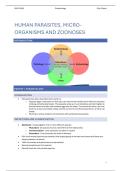
INTRODUCTION
Epidemiology
Infections
Pathology viruses, bacteria, Immunology
parasites, fungi
Clinic
PARTIM I: PARASITOLOGY
INTRODUCTION
• Parasites have been described since early on
o Papyrus egypt: instruction on how you can remove the medina worm which is acquired
drinking contaminated water. This parasite ends up in our intestines and will migrate to
the feet where it breaks and releases eggs into the water. To remove the worm, you can
bind it to a stick and rotate it daily until its out (not to much because there’s a risk it can
break)
o Mummies: shows evidence of infections with schistosoma parasites
DEFINITIONS AND CLASSIFICATION
• Symbiosis = living together of 2 or more different species
o Mutualism: all species receive a benefit from the relationship
o Commensalism: 1 has a benefit, the other is neutral
o Parasitism: 1 has a benefit, the other is harmed
• 50% of all animal species are parasitic (the largest group of animals are insects and these are
always parasitic to plants)
• 100% of animals and plants become parasitized
• Several parasites per host species
• Several hosts for one parasite species
1
,2025-2026 Parasitology Guy Caljon
• Parasitology = the study of parasitic symbiosis = protozoa, helminths and arthropods
o Parasite: morphology, biology and diagnosis
o Relation between host and parasite: physiology, biochemistry and cell biology
o Immunology: immune mechanisms (humoral, cellular)
o Epidemiology: transmission and distribution
o Clinical disease and treatment: pharmacology, clinics and pathology
• Parasitic definitions
o Obligate: parasite can’t survive/develop outside their host (e.g. tick is and obligate blood
feeder)
o Facultative: parasite can survive/develop outside their host (e.g. mosquitos are
facultative blood feeders à they can survive without, but not reproduce)
o Permanent: total cycle happens in the host (e.g. lice)
o Temporary: part of the cycle happens in the host (e.g. flees)
o Incidental: relatively rare in this particular host (e.g. when we eat an anisakis infected
fish, humans are accidental hosts to this parasite)
o Erratic: abnormal location within the host (e.g. cutaneous larva migrans, these normally
don’t infect humans but can penatrate the skin)
o Stenoxene: high host specificity (e.g. lice)
o Euryxene: low host-specificity (e.g. tick)
o Homoxene: one host within their life cycle (e.g. lice or anisakis)
o Heteroxene: more hosts within their life cycle (e.g. leishmania… most parasites)
• Host definitions
o Definitive host: the host where the parasite enters the adult, reproductive stage
o Intermediate host: the host where the parasite is in a larval stage with development
o Paratenic: the host where the parasite is in a larval stage without development
§ E.g. when fish eats a smaller, infected fish. The big fish is now the host of the
parasite without development of this parasite
o Vector: also a host, important role in transmission
§ Biologic transmission: the parasite undergoes a part of its lifecycle in this
vector (e.g. malaria in the mosquito)
§ Mechanical transmission: the vector simply carries the parasite (e.g. bacteria
on the external body of a fly)
• Prepatent period: the period between infection and becoming infections (e.g. the eggs of
parasites)
• Patent period: infectious period
Patente fase
#Eitjes
Prepatente
fase
o When infected, larvae will develop in adults which lay eggs present in your feces that can
Infectie
infect other persons. There’s a period between the development of the parasite and the
laying of eggs.
• Endo-parasite: lives within the host (e.g. tape worm)
• Ecto-parasite: lives on the host (e.g. lice)
• Meso-parasite: lives in external cavities (mouth, ear, sinuses, genitals…) (e.g. trichomonas
vaginalis)
2
,2025-2026 Parasitology Guy Caljon
• Reservoir: normal biotope of the parasite, the place where the parasite persists in the host à
from here they can be transmitted to humans = zoonosis (transmission from human to animal)
• Zoonosis = transmission from vertebrate animal to human
• Anthroponosis = transmission from human to human
• One health = also considers zoonotic infections à used to create a stable environment for
human and animal
LIFE CYCLE
• Some parasites have a complex life cycle
o 1-4 successive hosts
o Inclusion of invertebrate and vertebrate hosts
o Alternation between ‘terrestrial’ and ‘aquatic’ biotopes
o Horizontal (human to human) and vertical (mother to offspring) transmission
• An ideal parasite will not kill the host, if the host is dead, the parasite will be dead to
ADAPTATIONS
• Parasite must adapt for establishment in the host (infection, survival and reproduction)
• These adaptations/characteristics can be used
o E.g. we can use repellants because mosquitos are attracted to our scents
Adaptations
• Morphological:
o Size, form, locomotion, attachments (claws, hooks, suckers…)
o Sensory function
o Digestive system
• Biological
o Increase of reproductive potential like:
§ Egg production
§ Hermaphroditism
§ Parthenogenesis = eggs don’t need to be fertilised for an offspring
§ Loss of seasonality
§ Short pre-adult phase à the host becomes infectious faster
§ Survival
§ Inclusion of asexual multiplication
§ Inclusion of secondary and tertiary hosts à helps survival when the primary host
is not accessible/infectable
• Immunological
o Absorption of ‘host’ antigen
o Antigenic variation
o Immunologic ‘sanctuary’ sites (e.g. leishmania in stem cells in the bone marrow)
o Disruption of host immunity
o ‘masking’ surface antigens
• Biochemical
o Energy metabolism (aerobe/anaerobe, micro-aerophilic)
o Uptake of nutrients
o Increase of transporter system
3
, 2025-2026 Parasitology Guy Caljon
PARASITE-HOST INTERACTIONS
• Infection mechanisms
o Passive = via food, drinking water of via direct contact (e.g. trichomonas vaginalis)
o Active = vectors (sucking, biting), specific adaptations of infective larvae and vertical
transmission (rarely, e.g. toxoplasma will actively migrate to the placenta)
• Survival and immunity
o Ectoparasites = limited interaction with the host (e.g. ticks)
o Endoparasites
§ Intracellular = immune avoidance
§ Extracellular = immune evasion
• Antigenic variation
• Incorporation of host Ag
• Formation of protective wall (cyst)
ANTI PARASITE IMMUNOLOGY (JUST FOR INFORMATION)
• Intracellular parasite = cellular immunity
• Extracellular parasite = humoral immunity
• Different immune cells play e role in different infections
Anti-parasite immunity
o E.g. infection with the helmlinth will cause an elevated level of eosinophils
See course (found in the
Immunology
blood), mastcells will also rise but these are tissue cells (not found in the blood)
4
HUMAN PARASITES, MICRO-
ORGANISMS AND ZOONOSES
INTRODUCTION
Epidemiology
Infections
Pathology viruses, bacteria, Immunology
parasites, fungi
Clinic
PARTIM I: PARASITOLOGY
INTRODUCTION
• Parasites have been described since early on
o Papyrus egypt: instruction on how you can remove the medina worm which is acquired
drinking contaminated water. This parasite ends up in our intestines and will migrate to
the feet where it breaks and releases eggs into the water. To remove the worm, you can
bind it to a stick and rotate it daily until its out (not to much because there’s a risk it can
break)
o Mummies: shows evidence of infections with schistosoma parasites
DEFINITIONS AND CLASSIFICATION
• Symbiosis = living together of 2 or more different species
o Mutualism: all species receive a benefit from the relationship
o Commensalism: 1 has a benefit, the other is neutral
o Parasitism: 1 has a benefit, the other is harmed
• 50% of all animal species are parasitic (the largest group of animals are insects and these are
always parasitic to plants)
• 100% of animals and plants become parasitized
• Several parasites per host species
• Several hosts for one parasite species
1
,2025-2026 Parasitology Guy Caljon
• Parasitology = the study of parasitic symbiosis = protozoa, helminths and arthropods
o Parasite: morphology, biology and diagnosis
o Relation between host and parasite: physiology, biochemistry and cell biology
o Immunology: immune mechanisms (humoral, cellular)
o Epidemiology: transmission and distribution
o Clinical disease and treatment: pharmacology, clinics and pathology
• Parasitic definitions
o Obligate: parasite can’t survive/develop outside their host (e.g. tick is and obligate blood
feeder)
o Facultative: parasite can survive/develop outside their host (e.g. mosquitos are
facultative blood feeders à they can survive without, but not reproduce)
o Permanent: total cycle happens in the host (e.g. lice)
o Temporary: part of the cycle happens in the host (e.g. flees)
o Incidental: relatively rare in this particular host (e.g. when we eat an anisakis infected
fish, humans are accidental hosts to this parasite)
o Erratic: abnormal location within the host (e.g. cutaneous larva migrans, these normally
don’t infect humans but can penatrate the skin)
o Stenoxene: high host specificity (e.g. lice)
o Euryxene: low host-specificity (e.g. tick)
o Homoxene: one host within their life cycle (e.g. lice or anisakis)
o Heteroxene: more hosts within their life cycle (e.g. leishmania… most parasites)
• Host definitions
o Definitive host: the host where the parasite enters the adult, reproductive stage
o Intermediate host: the host where the parasite is in a larval stage with development
o Paratenic: the host where the parasite is in a larval stage without development
§ E.g. when fish eats a smaller, infected fish. The big fish is now the host of the
parasite without development of this parasite
o Vector: also a host, important role in transmission
§ Biologic transmission: the parasite undergoes a part of its lifecycle in this
vector (e.g. malaria in the mosquito)
§ Mechanical transmission: the vector simply carries the parasite (e.g. bacteria
on the external body of a fly)
• Prepatent period: the period between infection and becoming infections (e.g. the eggs of
parasites)
• Patent period: infectious period
Patente fase
#Eitjes
Prepatente
fase
o When infected, larvae will develop in adults which lay eggs present in your feces that can
Infectie
infect other persons. There’s a period between the development of the parasite and the
laying of eggs.
• Endo-parasite: lives within the host (e.g. tape worm)
• Ecto-parasite: lives on the host (e.g. lice)
• Meso-parasite: lives in external cavities (mouth, ear, sinuses, genitals…) (e.g. trichomonas
vaginalis)
2
,2025-2026 Parasitology Guy Caljon
• Reservoir: normal biotope of the parasite, the place where the parasite persists in the host à
from here they can be transmitted to humans = zoonosis (transmission from human to animal)
• Zoonosis = transmission from vertebrate animal to human
• Anthroponosis = transmission from human to human
• One health = also considers zoonotic infections à used to create a stable environment for
human and animal
LIFE CYCLE
• Some parasites have a complex life cycle
o 1-4 successive hosts
o Inclusion of invertebrate and vertebrate hosts
o Alternation between ‘terrestrial’ and ‘aquatic’ biotopes
o Horizontal (human to human) and vertical (mother to offspring) transmission
• An ideal parasite will not kill the host, if the host is dead, the parasite will be dead to
ADAPTATIONS
• Parasite must adapt for establishment in the host (infection, survival and reproduction)
• These adaptations/characteristics can be used
o E.g. we can use repellants because mosquitos are attracted to our scents
Adaptations
• Morphological:
o Size, form, locomotion, attachments (claws, hooks, suckers…)
o Sensory function
o Digestive system
• Biological
o Increase of reproductive potential like:
§ Egg production
§ Hermaphroditism
§ Parthenogenesis = eggs don’t need to be fertilised for an offspring
§ Loss of seasonality
§ Short pre-adult phase à the host becomes infectious faster
§ Survival
§ Inclusion of asexual multiplication
§ Inclusion of secondary and tertiary hosts à helps survival when the primary host
is not accessible/infectable
• Immunological
o Absorption of ‘host’ antigen
o Antigenic variation
o Immunologic ‘sanctuary’ sites (e.g. leishmania in stem cells in the bone marrow)
o Disruption of host immunity
o ‘masking’ surface antigens
• Biochemical
o Energy metabolism (aerobe/anaerobe, micro-aerophilic)
o Uptake of nutrients
o Increase of transporter system
3
, 2025-2026 Parasitology Guy Caljon
PARASITE-HOST INTERACTIONS
• Infection mechanisms
o Passive = via food, drinking water of via direct contact (e.g. trichomonas vaginalis)
o Active = vectors (sucking, biting), specific adaptations of infective larvae and vertical
transmission (rarely, e.g. toxoplasma will actively migrate to the placenta)
• Survival and immunity
o Ectoparasites = limited interaction with the host (e.g. ticks)
o Endoparasites
§ Intracellular = immune avoidance
§ Extracellular = immune evasion
• Antigenic variation
• Incorporation of host Ag
• Formation of protective wall (cyst)
ANTI PARASITE IMMUNOLOGY (JUST FOR INFORMATION)
• Intracellular parasite = cellular immunity
• Extracellular parasite = humoral immunity
• Different immune cells play e role in different infections
Anti-parasite immunity
o E.g. infection with the helmlinth will cause an elevated level of eosinophils
See course (found in the
Immunology
blood), mastcells will also rise but these are tissue cells (not found in the blood)
4


