

Samenvatting emerging technologies for
business opportunities
ADOPTING A DIGITAL TE&CHNOLOGY
• Requires change management
• VARIOUS IT adoption and acceptance theories
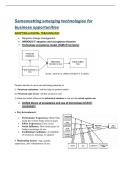
1. Technology acceptance model (TAM) (Fred davis)
People’s decision to use a new technology depends on
(1. Perceived usefulness: “will this help me perform better”)
(2. Perceived ease of use: “will this be easy to use)
→ these two beliefs influence the behavioral intention to use and the actual system use
2. Unified theory of acceptance and use of technology (UTAUT)
(venkatesh)
• Key determinants:
• Performance Expectancy: Belief that
using the system helps achieve goals.
• Effort Expectancy: Ease of use.
• Social Influence: How much peers or
leaders encourage its use.
• Facilitating Conditions: Availability
of resources, training, or support.
• Moderating factors: Age, gender,
experience, and voluntariness of use
, 3. Technology - organization - environment framework (TOE) (Fleischer)
→ explains adoption at the organizational
level
1) Technology: features of tech
2) Organization: internal context
(example. budget and staff
readiness)
3) Environment: external context
(example. Government regulations)
4. Theory on the diffusion of innovations (ROGERS)
Innovators: first individuals to
adopt an innovation (risk-takers),
Lowest expectations
Early adopters: embracing new
ideas early but carefully
Early majority: adopt innovations
before the average person
Late majority: skeptical and adopt
innovations after the average
person
Laggards: the last group to adopt, highly skeptical, high expectations
5. Technological evolution graph or hype cycle (GARTNER)
1) Technology trigger: innovation sparks
interest
2) Peak of inflated expectations: overhype,
unrealistic expectations
3) Trough of Disillusionment: disappointment
when tech fails ot meet expectations
4) Slope of enlightment: realistic understand,
practical uses emerge
5) Plateau of productivity: stable adoption,
mainstream use
,SESSION 2 BUSINESS MODELS IN A DIGITAL ECONOMY
RISE OF A DIGITAL ECONOMY
o Increasing number of technology-driven business opportunities
→ information society
o Impact of computer and the internet
o Now there are rapidly emerging digital technologies with a disruptive effect
Fourth industrial revolution?
(industry 4.0)
→ hannover fair: fair where
innovations are showcased within the
industrial value chain (automation,
robotics, AI)
→ objective = integrating digital tech
into manufacturing to create “smart
factories”
→ refers to digital transformation
across all sectors
→ IoT, AI
Industry 5.0
→ complementing industry
4.0 but with more focus om
sustainability, human-
centricity and resilience ro the
preservation of resources,
climate change and social
stability
o Because most of these
emerging technologies heavily rely on data centers which require energy
consumption
o Internet, Big data, Cloud, cybersecurity
RISE OF A DIGITAL ECONOMY (Digital economy scope)
, o Digital IT sector
o digital products produced by the IT-
sector (digital services, goods,
information, data
o Digital economy (narrow scope)
o Plus, digital technology use in all
organizational sectors
o Digitalized economy (broad scope)
o Plus, all activities related to e-
commerce and industry 4.0 technology
integration, a whole economy
Link to digi-related concepts
o Purposes of a digital economy for organizations
o Creating business value (internal)
o By creating value for customers (external)
o Increasing customer demands
→ want to buy when and where they want, personalized, sharing products,
clean and green production
o Need for new business models and new business processes
→ customization, servitization, crowdsourcing, sharing platforms
Digital economy characteristics =
ExConomy
EX stands for experience and
experimentation
CO stands for co-reshaping and
E-co-ystem → collaboration with others,
outsourcing to bundle value
DIFINING DIGI-RELATED CONCEPTS
1) IT versus digital technology
o Information technology (IT), information & communication technology (ICT)
o Strict sense
o Collector, storage, processor and transmitter of information by covering a
digital (software) or physical (hardware) appearance
business opportunities
ADOPTING A DIGITAL TE&CHNOLOGY
• Requires change management
• VARIOUS IT adoption and acceptance theories
1. Technology acceptance model (TAM) (Fred davis)
People’s decision to use a new technology depends on
(1. Perceived usefulness: “will this help me perform better”)
(2. Perceived ease of use: “will this be easy to use)
→ these two beliefs influence the behavioral intention to use and the actual system use
2. Unified theory of acceptance and use of technology (UTAUT)
(venkatesh)
• Key determinants:
• Performance Expectancy: Belief that
using the system helps achieve goals.
• Effort Expectancy: Ease of use.
• Social Influence: How much peers or
leaders encourage its use.
• Facilitating Conditions: Availability
of resources, training, or support.
• Moderating factors: Age, gender,
experience, and voluntariness of use
, 3. Technology - organization - environment framework (TOE) (Fleischer)
→ explains adoption at the organizational
level
1) Technology: features of tech
2) Organization: internal context
(example. budget and staff
readiness)
3) Environment: external context
(example. Government regulations)
4. Theory on the diffusion of innovations (ROGERS)
Innovators: first individuals to
adopt an innovation (risk-takers),
Lowest expectations
Early adopters: embracing new
ideas early but carefully
Early majority: adopt innovations
before the average person
Late majority: skeptical and adopt
innovations after the average
person
Laggards: the last group to adopt, highly skeptical, high expectations
5. Technological evolution graph or hype cycle (GARTNER)
1) Technology trigger: innovation sparks
interest
2) Peak of inflated expectations: overhype,
unrealistic expectations
3) Trough of Disillusionment: disappointment
when tech fails ot meet expectations
4) Slope of enlightment: realistic understand,
practical uses emerge
5) Plateau of productivity: stable adoption,
mainstream use
,SESSION 2 BUSINESS MODELS IN A DIGITAL ECONOMY
RISE OF A DIGITAL ECONOMY
o Increasing number of technology-driven business opportunities
→ information society
o Impact of computer and the internet
o Now there are rapidly emerging digital technologies with a disruptive effect
Fourth industrial revolution?
(industry 4.0)
→ hannover fair: fair where
innovations are showcased within the
industrial value chain (automation,
robotics, AI)
→ objective = integrating digital tech
into manufacturing to create “smart
factories”
→ refers to digital transformation
across all sectors
→ IoT, AI
Industry 5.0
→ complementing industry
4.0 but with more focus om
sustainability, human-
centricity and resilience ro the
preservation of resources,
climate change and social
stability
o Because most of these
emerging technologies heavily rely on data centers which require energy
consumption
o Internet, Big data, Cloud, cybersecurity
RISE OF A DIGITAL ECONOMY (Digital economy scope)
, o Digital IT sector
o digital products produced by the IT-
sector (digital services, goods,
information, data
o Digital economy (narrow scope)
o Plus, digital technology use in all
organizational sectors
o Digitalized economy (broad scope)
o Plus, all activities related to e-
commerce and industry 4.0 technology
integration, a whole economy
Link to digi-related concepts
o Purposes of a digital economy for organizations
o Creating business value (internal)
o By creating value for customers (external)
o Increasing customer demands
→ want to buy when and where they want, personalized, sharing products,
clean and green production
o Need for new business models and new business processes
→ customization, servitization, crowdsourcing, sharing platforms
Digital economy characteristics =
ExConomy
EX stands for experience and
experimentation
CO stands for co-reshaping and
E-co-ystem → collaboration with others,
outsourcing to bundle value
DIFINING DIGI-RELATED CONCEPTS
1) IT versus digital technology
o Information technology (IT), information & communication technology (ICT)
o Strict sense
o Collector, storage, processor and transmitter of information by covering a
digital (software) or physical (hardware) appearance


