
Samenvatting oefeningen - opgaven
BPM1.
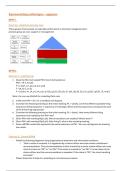
Exercise: classify by process type
These groups of processes are typically performed at a university. Categorize each
process group as core, support or management
BPM2.
Exercise 1: workflow net
1. Draw the Petri net (called PN1) that is formalized as:
PN1 = (P, T, F) with
P = { start , p1, p2, p3, p4, end}
T = {A, B, C, D, E}
F = {( start, A ), (A, p1), (A, p2), (p1,B), (p2,C), (B, p3), (C, p4), (p3,D), (D, p1), (p3,E), (p4,E), ( E, end )}
Note: You can use WoPeD for modelling Petri nets.
2. Is Petri net PN1 = (P, T, F) a workflow net? Explain.
3. Consider the following marking as the initial marking: M 0 = [start]. List three different possible firing
sequences (firing sequence = sequence of markings). Which activity sequences correspond to each
of the three firing sequences?
4. Consider the following marking as the initial marking: M 0 = [start]. How many different firing
sequences are implied by this Petri net?
5. Given PN1 with marking M[p1,p4]. Which transitions are enabled? Which aren’t?
6. Given PN1 with marking M[p2,p3]. After firing D, what is the resulting marking.
7. Draw a BPMN model that represents the same behaviour as PN1. You can use Signavio for drawing
the model.
Exercise 2: Simple BPMN
- Model the following fragment using organizational elements and information artefacts:
o “After a claim is received, it is registered by a claims officer who then writes a settlement
recommendation. This recommendation is then checked by a senior claims officer who may
mark the claim as “OK” or “not OK”. If the claim is marked as “not OK”, it is sent back to the
claims officer and the recommendation is repeated. If the claim is “OK”, the claim handling
proceeds.”
- Please follow the 5 steps for modelling as-is business processes.
,Exercise 3: multi-instance activity
After a car accident, a statement is sought from the witnesses that were present, in order to lodge the
insurance claim. As soon as the first two statements are received, the claim can be lodged to the insurance
company without waiting for the other statements.
- Model with organizational elements
- Make sure to introduce multi-instance activity or multi-instance sub-process
Exercise 4: ad-hoc sub-process
A typical army selection process starts by shortlisting all candidates’ applications. Those shortlisted are
then called to sit the following tests: drug and alcohol, eye, color vision, hearing, blood, urine, weight,
fingerprinting and doctor examination. The color vision can only be done after the eye test, while the doctor
examination can only be done after color vision, hearing, blood, urine and weight have been tested.
Moreover, it may be required for some candidates to repeat some of these tests multiple times in order to get
a correct assessment, e.g. the blood test may need be repeated if the candidate has taken too much sugar in
the previous 24 hours. The candidates that pass all tests are asked to sit a mental exam and a physical
exam, followed by an interview. Only those that also pass these two exams and perform well in the interview
can be recruited in the army.
Exercise 5: event-based decision
In the context of a claim handling process, it is sometimes necessary to send a questionnaire to the
claimant to gather additional information. The claimant is expected to return the questionnaire within five
days. If no response is received after five days, a reminder is sent to the claimant. If after another five
days there is still no response, another reminder is sent and so on until the completed questionnaire is
received.
Exercise 6: non-interrupting boundary events
- A Purchase Order (PO) handling process starts when a PO is received. The PO is first registered. If
the current date is not a working day, the process waits until the following working day before
proceeding. Otherwise, an availability check is performed and a “PO response” is sent back to the
customer.
- Anytime after the PO has been registered, the customer may send a “PO change request”. When
such a PO change request is received, any processing related to the PO must be stopped. The PO
change request is then registered. Thereafter, the process proceeds as it would do after a normal
PO is registered.
- Further, if the customer sends a “PO cancelation request” after the PO registration, the PO
processing must be stopped and the chance request needs to be handled
BPM4.
- Content creation can occur at any moment.
- Conference and journal paper can only happen after a new occurrence of content creation when
they are not enabled already.
- First seminar can only happen after conference, second seminar after journal paper.
- First and second seminar must be followed eventually by defense.
,BPM5.
Exercise 1
Which behavioral rules are violated in the model below?
Watch out! Not only due to gateways
Exercise 2
Explain which 7PMG guidelines point to potential for improvement. Remodel the process based on your
observations.
,BPM8.
Exercise 1
Consider the following process model. Each task is annotated with its mean processing time.
- Calculate the theoretical cycle time of this process.
- Let us assume that the cycle time of this process is 2 business days (16 hours). What is the cycle
time efficiency?
Exercise 2
Calculate the cycle time efficiency of the following process.
Exercise 3
- An insurance company receives 220 calls per day from customers who want to lodge an insurance
claim. The call center is open from 8am to 5pm. The arrival of calls follows a Poisson process.
Looking at the intensity of arrival of calls, we can distinguish three periods during the day: the period
8am to 11am, the period 11am to 2pm and the period 2pm to 5pm. During the first period, around 60
calls are received. During the 11am–2pm period, 120 calls are received, and during the 2pm–5pm
period, 40 calls are received. A customer survey has shown that customers tend to call between
11am and 2pm because during this time they have a break at work, and they take advantage of their
break to make their personal calls. Statistical analysis shows that the durations of calls follow an
exponential distribution. According to the company’s customer service charter, customers should
wait no more than one minute on average for their call to be answered.
- Assume that the call center can handle 70 calls per hour using seven call center agents. Is this
enough to meet the 1-minute constraint set in the customer service charter? Please explain your
answer by showing how you calculate the average length of the queue and the average waiting time.
- What happens if the call center’s capacity is increased so that it can handle 80 calls per hour (using
eight call center agents)?
, Exercise 4
Calculate cycle time
What is the average cycle time of this process?
A. 16,2 hours
B. 16,5 hours
C. 16,8 hours
D. 17,1 hours
E. 17,3 hours
Exercise 5
Calculate cycle time efficiency
What is the cycle time efficiency?
A. 11,3%
B. 21,3%
C. 31;3%
D. 41,3%
Exercise 5
A fast-food restaurant receives on average 1200 customers per day (between 10:00 and 22:00). During peak
times (12:00-15:00 and 18:00-21:00), the restaurant receives around 900 customers in total, and 90
customers can be found in the restaurant (on average) at a given point in time. At non-peak times, the
restaurant receives 300 customers in total, and 30 customers can be found in the restaurant (on average) at
a given point in time.
- What is the average time that a customer spends in the restaurant during peak times?
A. 28 minutes
B. 32 minutes
C. 36 minutes
D. 40 minutes
E. 44 minute
- What is the average time that a customer spends in the restaurant during non-peak times?
- The restaurant plans to launch a marketing campaign to attract more customers. However, the
restaurant’s capacity is limited and becomes too full during peak times. What can the restaurant do
to address this issue without investing in extending its building?
BPM1.
Exercise: classify by process type
These groups of processes are typically performed at a university. Categorize each
process group as core, support or management
BPM2.
Exercise 1: workflow net
1. Draw the Petri net (called PN1) that is formalized as:
PN1 = (P, T, F) with
P = { start , p1, p2, p3, p4, end}
T = {A, B, C, D, E}
F = {( start, A ), (A, p1), (A, p2), (p1,B), (p2,C), (B, p3), (C, p4), (p3,D), (D, p1), (p3,E), (p4,E), ( E, end )}
Note: You can use WoPeD for modelling Petri nets.
2. Is Petri net PN1 = (P, T, F) a workflow net? Explain.
3. Consider the following marking as the initial marking: M 0 = [start]. List three different possible firing
sequences (firing sequence = sequence of markings). Which activity sequences correspond to each
of the three firing sequences?
4. Consider the following marking as the initial marking: M 0 = [start]. How many different firing
sequences are implied by this Petri net?
5. Given PN1 with marking M[p1,p4]. Which transitions are enabled? Which aren’t?
6. Given PN1 with marking M[p2,p3]. After firing D, what is the resulting marking.
7. Draw a BPMN model that represents the same behaviour as PN1. You can use Signavio for drawing
the model.
Exercise 2: Simple BPMN
- Model the following fragment using organizational elements and information artefacts:
o “After a claim is received, it is registered by a claims officer who then writes a settlement
recommendation. This recommendation is then checked by a senior claims officer who may
mark the claim as “OK” or “not OK”. If the claim is marked as “not OK”, it is sent back to the
claims officer and the recommendation is repeated. If the claim is “OK”, the claim handling
proceeds.”
- Please follow the 5 steps for modelling as-is business processes.
,Exercise 3: multi-instance activity
After a car accident, a statement is sought from the witnesses that were present, in order to lodge the
insurance claim. As soon as the first two statements are received, the claim can be lodged to the insurance
company without waiting for the other statements.
- Model with organizational elements
- Make sure to introduce multi-instance activity or multi-instance sub-process
Exercise 4: ad-hoc sub-process
A typical army selection process starts by shortlisting all candidates’ applications. Those shortlisted are
then called to sit the following tests: drug and alcohol, eye, color vision, hearing, blood, urine, weight,
fingerprinting and doctor examination. The color vision can only be done after the eye test, while the doctor
examination can only be done after color vision, hearing, blood, urine and weight have been tested.
Moreover, it may be required for some candidates to repeat some of these tests multiple times in order to get
a correct assessment, e.g. the blood test may need be repeated if the candidate has taken too much sugar in
the previous 24 hours. The candidates that pass all tests are asked to sit a mental exam and a physical
exam, followed by an interview. Only those that also pass these two exams and perform well in the interview
can be recruited in the army.
Exercise 5: event-based decision
In the context of a claim handling process, it is sometimes necessary to send a questionnaire to the
claimant to gather additional information. The claimant is expected to return the questionnaire within five
days. If no response is received after five days, a reminder is sent to the claimant. If after another five
days there is still no response, another reminder is sent and so on until the completed questionnaire is
received.
Exercise 6: non-interrupting boundary events
- A Purchase Order (PO) handling process starts when a PO is received. The PO is first registered. If
the current date is not a working day, the process waits until the following working day before
proceeding. Otherwise, an availability check is performed and a “PO response” is sent back to the
customer.
- Anytime after the PO has been registered, the customer may send a “PO change request”. When
such a PO change request is received, any processing related to the PO must be stopped. The PO
change request is then registered. Thereafter, the process proceeds as it would do after a normal
PO is registered.
- Further, if the customer sends a “PO cancelation request” after the PO registration, the PO
processing must be stopped and the chance request needs to be handled
BPM4.
- Content creation can occur at any moment.
- Conference and journal paper can only happen after a new occurrence of content creation when
they are not enabled already.
- First seminar can only happen after conference, second seminar after journal paper.
- First and second seminar must be followed eventually by defense.
,BPM5.
Exercise 1
Which behavioral rules are violated in the model below?
Watch out! Not only due to gateways
Exercise 2
Explain which 7PMG guidelines point to potential for improvement. Remodel the process based on your
observations.
,BPM8.
Exercise 1
Consider the following process model. Each task is annotated with its mean processing time.
- Calculate the theoretical cycle time of this process.
- Let us assume that the cycle time of this process is 2 business days (16 hours). What is the cycle
time efficiency?
Exercise 2
Calculate the cycle time efficiency of the following process.
Exercise 3
- An insurance company receives 220 calls per day from customers who want to lodge an insurance
claim. The call center is open from 8am to 5pm. The arrival of calls follows a Poisson process.
Looking at the intensity of arrival of calls, we can distinguish three periods during the day: the period
8am to 11am, the period 11am to 2pm and the period 2pm to 5pm. During the first period, around 60
calls are received. During the 11am–2pm period, 120 calls are received, and during the 2pm–5pm
period, 40 calls are received. A customer survey has shown that customers tend to call between
11am and 2pm because during this time they have a break at work, and they take advantage of their
break to make their personal calls. Statistical analysis shows that the durations of calls follow an
exponential distribution. According to the company’s customer service charter, customers should
wait no more than one minute on average for their call to be answered.
- Assume that the call center can handle 70 calls per hour using seven call center agents. Is this
enough to meet the 1-minute constraint set in the customer service charter? Please explain your
answer by showing how you calculate the average length of the queue and the average waiting time.
- What happens if the call center’s capacity is increased so that it can handle 80 calls per hour (using
eight call center agents)?
, Exercise 4
Calculate cycle time
What is the average cycle time of this process?
A. 16,2 hours
B. 16,5 hours
C. 16,8 hours
D. 17,1 hours
E. 17,3 hours
Exercise 5
Calculate cycle time efficiency
What is the cycle time efficiency?
A. 11,3%
B. 21,3%
C. 31;3%
D. 41,3%
Exercise 5
A fast-food restaurant receives on average 1200 customers per day (between 10:00 and 22:00). During peak
times (12:00-15:00 and 18:00-21:00), the restaurant receives around 900 customers in total, and 90
customers can be found in the restaurant (on average) at a given point in time. At non-peak times, the
restaurant receives 300 customers in total, and 30 customers can be found in the restaurant (on average) at
a given point in time.
- What is the average time that a customer spends in the restaurant during peak times?
A. 28 minutes
B. 32 minutes
C. 36 minutes
D. 40 minutes
E. 44 minute
- What is the average time that a customer spends in the restaurant during non-peak times?
- The restaurant plans to launch a marketing campaign to attract more customers. However, the
restaurant’s capacity is limited and becomes too full during peak times. What can the restaurant do
to address this issue without investing in extending its building?


