
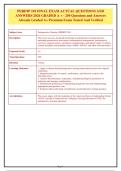
PERIOP 101 FINAL EXAM ACTUAL QUESTIONS AND
ANSWERS 2026 GRADED A + - 250 Questions and Answers
Already Graded A+ Premium Exam Tested And Verified
Subject Area Perioperative Nursing (PERIOP 101)
Description This exam assesses advanced knowledge in perioperative nursing practice,
including preoperative assessment, intraoperative management, postoperative
recovery, surgical asepsis, anesthesia considerations, and patient safety. It reflects
current standards and guidelines from AORN, ASPAN, and other relevant bodies.
Expected Grade A+
Total Questions 250
Duration 3 hours
Learning Outcomes 1. Apply evidence-based perioperative nursing interventions across the surgical
continuum.
2. Integrate principles of asepsis, sterilization, and infection control in the
operating room.
3. Analyze hemodynamic, respiratory, and pharmacological parameters to
anticipate and manage complications.
4. Demonstrate proficiency in interpreting diagnostic data and implementing
appropriate perioperative care.
5. Evaluate ethical and legal considerations in perioperative nursing practice.
Accreditation This exam aligns with the standards of the American Nurses Credentialing Center
(ANCC) and the Commission on Collegiate Nursing Education (CCNE) for
perioperative nursing education.
Page 1
,1. During a laparoscopic cholecystectomy, the surgeon requests a decrease in
insufflation pressure due to patient bradycardia and hypotension. Which
physiological effect of pneumoperitoneum most directly explains these changes?
A. Reduced venous return from increased intra-abdominal pressure
B. Vagal stimulation from peritoneal stretching
C. Absorption of carbon dioxide leading to respiratory acidosis
D. Compression of the aorta increasing afterload
Answer: B. Vagal stimulation from peritoneal stretching
Peritoneal stretching during insufflation can trigger a vagal response, causing
bradycardia and hypotension. While increased intra-abdominal pressure reduces
venous return, that typically causes hypotension with tachycardia. CO2 absorption
causes acidosis but not directly bradycardia. Aortic compression increases afterload,
which would raise blood pressure, not lower it.
2. A patient has a history of malignant hyperthermia (MH). The anesthesia provider
plans a total intravenous anesthesia (TIVA) technique. Which agent is
contraindicated?
A. Propofol
B. Remifentanil
C. Sevoflurane
D. Cisatracurium
Answer: C. Sevoflurane
Sevoflurane is a volatile anesthetic that triggers MH in susceptible patients. Propofol,
remifentanil (opioid), and cisatracurium (non-depolarizing neuromuscular blocker) are
safe for MH patients. TIVA avoids all volatile agents.
Page 2
,3. Which of the following is the most appropriate action when a surgical team
member's sterile gown becomes visibly contaminated with blood during a
procedure?
A. Apply an impervious sterile drape over the contaminated area
B. Remove the gown and replace it with a new sterile gown
C. Continue the procedure as long as the contamination is below the waist
D. Spray the area with an antiseptic solution and cover with a sterile towel
Answer: B. Remove the gown and replace it with a new sterile gown
Once a sterile gown is contaminated, it is no longer sterile. The only acceptable action is
to remove the gown and replace it with a new sterile gown. Covering with a drape or
towel does not restore sterility. Contamination anywhere on the gown compromises the
sterile field.
4. A patient undergoing a craniotomy in the sitting position suddenly develops
hypotension and a drop in end-tidal CO2. Which complication is most likely?
A. Venous air embolism
B. Hypovolemia from blood loss
C. Pneumothorax
D. Myocardial infarction
Answer: A. Venous air embolism
The sitting position increases the risk of venous air embolism (VAE) due to the surgical
site being above the heart. VAE causes hypotension and a sudden drop in end-tidal CO2
as air entrained into the venous system reduces cardiac output and pulmonary blood
flow. Hypovolemia and MI would not cause such a rapid drop in ETCO2.
5. Which of the following findings indicates that a sterilized package has been
properly processed and is safe for use?
A. The chemical indicator on the outside of the package has changed color
B. The package is dry and intact with no tears or punctures
C. The biological indicator (spore test) shows no growth after incubation
D. The sterilizer printout indicates the correct cycle parameters
Answer: C. The biological indicator (spore test) shows no growth after incubation
Biological indicators (spore tests) provide the highest level of assurance that
sterilization has been achieved. Chemical indicators and cycle printouts give secondary
evidence, but the definitive proof is a negative spore test. Package integrity is important
but does not confirm sterilization.
Page 3
, 6. A patient with a history of opioid use disorder is scheduled for total knee
arthroplasty. Which multimodal analgesic strategy is most appropriate to minimize
opioid use and prevent withdrawal?
A. Patient-controlled analgesia with morphine
B. Epidural analgesia with local anesthetic and fentanyl
C. Combination of acetaminophen, ketorolac, and a peripheral nerve block
D. Transdermal fentanyl patch with oral oxycodone as needed
Answer: C. Combination of acetaminophen, ketorolac, and a peripheral nerve
block
Multimodal analgesia using non-opioid medications (acetaminophen, NSAIDs) and
regional anesthesia (nerve block) reduces opioid requirements and avoids triggering
withdrawal in opioid-tolerant patients. Epidural fentanyl still uses opioids. PCA
morphine and transdermal fentanyl with oxycodone are opioid-heavy and could
precipitate withdrawal or misuse.
7. During a laparoscopic procedure, the electrosurgical unit (ESU) is set to
monopolar mode. The patient has a pacemaker. Which precaution is most critical?
A. Place the dispersive electrode as close to the surgical site as possible
B. Use bipolar electrosurgery instead of monopolar
C. Set the ESU to the lowest effective power setting
D. Apply a grounding pad to the patient's thigh
Answer: B. Use bipolar electrosurgery instead of monopolar
Monopolar electrosurgery can interfere with pacemaker function due to
electromagnetic interference. Bipolar electrosurgery confines current to the tissue
between forceps tips, significantly reducing the risk of pacemaker dysfunction.
Dispersive electrode placement and power settings are less critical than switching to
bipolar.
Page 4
ANSWERS 2026 GRADED A + - 250 Questions and Answers
Already Graded A+ Premium Exam Tested And Verified
Subject Area Perioperative Nursing (PERIOP 101)
Description This exam assesses advanced knowledge in perioperative nursing practice,
including preoperative assessment, intraoperative management, postoperative
recovery, surgical asepsis, anesthesia considerations, and patient safety. It reflects
current standards and guidelines from AORN, ASPAN, and other relevant bodies.
Expected Grade A+
Total Questions 250
Duration 3 hours
Learning Outcomes 1. Apply evidence-based perioperative nursing interventions across the surgical
continuum.
2. Integrate principles of asepsis, sterilization, and infection control in the
operating room.
3. Analyze hemodynamic, respiratory, and pharmacological parameters to
anticipate and manage complications.
4. Demonstrate proficiency in interpreting diagnostic data and implementing
appropriate perioperative care.
5. Evaluate ethical and legal considerations in perioperative nursing practice.
Accreditation This exam aligns with the standards of the American Nurses Credentialing Center
(ANCC) and the Commission on Collegiate Nursing Education (CCNE) for
perioperative nursing education.
Page 1
,1. During a laparoscopic cholecystectomy, the surgeon requests a decrease in
insufflation pressure due to patient bradycardia and hypotension. Which
physiological effect of pneumoperitoneum most directly explains these changes?
A. Reduced venous return from increased intra-abdominal pressure
B. Vagal stimulation from peritoneal stretching
C. Absorption of carbon dioxide leading to respiratory acidosis
D. Compression of the aorta increasing afterload
Answer: B. Vagal stimulation from peritoneal stretching
Peritoneal stretching during insufflation can trigger a vagal response, causing
bradycardia and hypotension. While increased intra-abdominal pressure reduces
venous return, that typically causes hypotension with tachycardia. CO2 absorption
causes acidosis but not directly bradycardia. Aortic compression increases afterload,
which would raise blood pressure, not lower it.
2. A patient has a history of malignant hyperthermia (MH). The anesthesia provider
plans a total intravenous anesthesia (TIVA) technique. Which agent is
contraindicated?
A. Propofol
B. Remifentanil
C. Sevoflurane
D. Cisatracurium
Answer: C. Sevoflurane
Sevoflurane is a volatile anesthetic that triggers MH in susceptible patients. Propofol,
remifentanil (opioid), and cisatracurium (non-depolarizing neuromuscular blocker) are
safe for MH patients. TIVA avoids all volatile agents.
Page 2
,3. Which of the following is the most appropriate action when a surgical team
member's sterile gown becomes visibly contaminated with blood during a
procedure?
A. Apply an impervious sterile drape over the contaminated area
B. Remove the gown and replace it with a new sterile gown
C. Continue the procedure as long as the contamination is below the waist
D. Spray the area with an antiseptic solution and cover with a sterile towel
Answer: B. Remove the gown and replace it with a new sterile gown
Once a sterile gown is contaminated, it is no longer sterile. The only acceptable action is
to remove the gown and replace it with a new sterile gown. Covering with a drape or
towel does not restore sterility. Contamination anywhere on the gown compromises the
sterile field.
4. A patient undergoing a craniotomy in the sitting position suddenly develops
hypotension and a drop in end-tidal CO2. Which complication is most likely?
A. Venous air embolism
B. Hypovolemia from blood loss
C. Pneumothorax
D. Myocardial infarction
Answer: A. Venous air embolism
The sitting position increases the risk of venous air embolism (VAE) due to the surgical
site being above the heart. VAE causes hypotension and a sudden drop in end-tidal CO2
as air entrained into the venous system reduces cardiac output and pulmonary blood
flow. Hypovolemia and MI would not cause such a rapid drop in ETCO2.
5. Which of the following findings indicates that a sterilized package has been
properly processed and is safe for use?
A. The chemical indicator on the outside of the package has changed color
B. The package is dry and intact with no tears or punctures
C. The biological indicator (spore test) shows no growth after incubation
D. The sterilizer printout indicates the correct cycle parameters
Answer: C. The biological indicator (spore test) shows no growth after incubation
Biological indicators (spore tests) provide the highest level of assurance that
sterilization has been achieved. Chemical indicators and cycle printouts give secondary
evidence, but the definitive proof is a negative spore test. Package integrity is important
but does not confirm sterilization.
Page 3
, 6. A patient with a history of opioid use disorder is scheduled for total knee
arthroplasty. Which multimodal analgesic strategy is most appropriate to minimize
opioid use and prevent withdrawal?
A. Patient-controlled analgesia with morphine
B. Epidural analgesia with local anesthetic and fentanyl
C. Combination of acetaminophen, ketorolac, and a peripheral nerve block
D. Transdermal fentanyl patch with oral oxycodone as needed
Answer: C. Combination of acetaminophen, ketorolac, and a peripheral nerve
block
Multimodal analgesia using non-opioid medications (acetaminophen, NSAIDs) and
regional anesthesia (nerve block) reduces opioid requirements and avoids triggering
withdrawal in opioid-tolerant patients. Epidural fentanyl still uses opioids. PCA
morphine and transdermal fentanyl with oxycodone are opioid-heavy and could
precipitate withdrawal or misuse.
7. During a laparoscopic procedure, the electrosurgical unit (ESU) is set to
monopolar mode. The patient has a pacemaker. Which precaution is most critical?
A. Place the dispersive electrode as close to the surgical site as possible
B. Use bipolar electrosurgery instead of monopolar
C. Set the ESU to the lowest effective power setting
D. Apply a grounding pad to the patient's thigh
Answer: B. Use bipolar electrosurgery instead of monopolar
Monopolar electrosurgery can interfere with pacemaker function due to
electromagnetic interference. Bipolar electrosurgery confines current to the tissue
between forceps tips, significantly reducing the risk of pacemaker dysfunction.
Dispersive electrode placement and power settings are less critical than switching to
bipolar.
Page 4


