

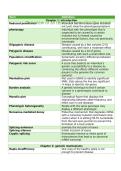
Term Definition
Chapter 1: introduction
Overview of all terms to know for the exam
Reduced penetrance Individual has the disease gene but does
not (yet) show the phenotype/symptoms
phenocopy Individual with the phenotype that is
suspected to be caused by a certain
mutation but is instead caused by
environmental factors, thus not genetically
inheritable
Oligogenic disease Disease caused by a few variants (2-5)
contributing, with each a moderate effect
Polygenic disease Disease caused by a lot of genes
contributing with each a small effect size
Population stratification Systematic ancestry differences between
patients and controls
Polygenic risk score A score that predicts an individual’s
genetic susceptibility to a disease by
combining the effects different variants
present in the genome (for common
variants)
Manhattan plot Plot used in GWAS to identify significant
SNPs. Dots above the line are significant
helps to identify risk genes
Burden analysis A genetic technique to test if certain
variants in a gene/region contribute to
disease
Manolio plot Conceptual figure that displays the
relationship between allele frequency and
effect size in rare diseases
Phenotypic heterogeneity People with the same genotype may
display a different phenotype
Nonsense-mediated decay Protective mechanism that degrades mRNA
with a nonsense mutation (premature stop
codon) when it is withing 50-55 nucleotides
from the last exon-junction to prevent the
formation of a toxic protein
Splicing enhancer promote the inclusion of exons
Splicing silencer Inhibit inclusion of exons
Cryptic splicing Erroneously remove or retain parts of
introns/exons that lead to an abnormal
mRNA transcript
Chapter 2: genetic mechanisms
Haplo-insufficiency One copy of the healthy allele is not
enough to prevent disease
, Dominant negative effect The diseased allele will influence the
healthy alleles & cause them to shift to
diseased too
Dominant GOF One diseased allele is enough to develop
the disease
Mutational heterogeneity Multiple different mutations may lead to
the same disease
Mutational homogeneity One specific mutation leads to one disease
in all patients
Retrogene mRNA that was reverse transcribed back
into DNA and re-inserted into the genome
Mosaic status Person has two or more genetically
different cell populations
Somatic mutation Mutation present in all of the somatic cells,
not inheritable (not present in the germline
cells)
Heteroplasmy Different ratios of mutational mtDNA vs
normal mtDNA in the cell (inheritance
through the mother)
Cryptic exons Pieces of DNA not normally included in final
mRNA but becomes included due to
abnormal splicing
Chapter 3: repeat expansion disorder
STR Short tandem repeat: 0-9 nucleotides long
(=microsatellite)
VNTR Variable number tandem repeat >10
nucleotides long (=minisatellite)
Premutation allele Repeat that is not yet pathogenic but is
very likely to expand & cause disease in
offspring
Permissive haplotype Minimally expanded repeat that is likely to
expand in offspring & cause disease
cause of geographical clustering and
linkage disequilibrium
Anticipation When an inherited disease has the
tendency to have an earlier age of onset &
worsening symptomatology in each
following generation
RNA foci RNA-aggregates in the nucleus that form
stable secondary structures. Initially a GOF
but leads to a LOF of RNA-binding proteins
RAN translation Abnormal way of cells translating a repeat
without an AUG start codon present leading
to the formation of toxic proteins that have
Chapter 1: introduction
Overview of all terms to know for the exam
Reduced penetrance Individual has the disease gene but does
not (yet) show the phenotype/symptoms
phenocopy Individual with the phenotype that is
suspected to be caused by a certain
mutation but is instead caused by
environmental factors, thus not genetically
inheritable
Oligogenic disease Disease caused by a few variants (2-5)
contributing, with each a moderate effect
Polygenic disease Disease caused by a lot of genes
contributing with each a small effect size
Population stratification Systematic ancestry differences between
patients and controls
Polygenic risk score A score that predicts an individual’s
genetic susceptibility to a disease by
combining the effects different variants
present in the genome (for common
variants)
Manhattan plot Plot used in GWAS to identify significant
SNPs. Dots above the line are significant
helps to identify risk genes
Burden analysis A genetic technique to test if certain
variants in a gene/region contribute to
disease
Manolio plot Conceptual figure that displays the
relationship between allele frequency and
effect size in rare diseases
Phenotypic heterogeneity People with the same genotype may
display a different phenotype
Nonsense-mediated decay Protective mechanism that degrades mRNA
with a nonsense mutation (premature stop
codon) when it is withing 50-55 nucleotides
from the last exon-junction to prevent the
formation of a toxic protein
Splicing enhancer promote the inclusion of exons
Splicing silencer Inhibit inclusion of exons
Cryptic splicing Erroneously remove or retain parts of
introns/exons that lead to an abnormal
mRNA transcript
Chapter 2: genetic mechanisms
Haplo-insufficiency One copy of the healthy allele is not
enough to prevent disease
, Dominant negative effect The diseased allele will influence the
healthy alleles & cause them to shift to
diseased too
Dominant GOF One diseased allele is enough to develop
the disease
Mutational heterogeneity Multiple different mutations may lead to
the same disease
Mutational homogeneity One specific mutation leads to one disease
in all patients
Retrogene mRNA that was reverse transcribed back
into DNA and re-inserted into the genome
Mosaic status Person has two or more genetically
different cell populations
Somatic mutation Mutation present in all of the somatic cells,
not inheritable (not present in the germline
cells)
Heteroplasmy Different ratios of mutational mtDNA vs
normal mtDNA in the cell (inheritance
through the mother)
Cryptic exons Pieces of DNA not normally included in final
mRNA but becomes included due to
abnormal splicing
Chapter 3: repeat expansion disorder
STR Short tandem repeat: 0-9 nucleotides long
(=microsatellite)
VNTR Variable number tandem repeat >10
nucleotides long (=minisatellite)
Premutation allele Repeat that is not yet pathogenic but is
very likely to expand & cause disease in
offspring
Permissive haplotype Minimally expanded repeat that is likely to
expand in offspring & cause disease
cause of geographical clustering and
linkage disequilibrium
Anticipation When an inherited disease has the
tendency to have an earlier age of onset &
worsening symptomatology in each
following generation
RNA foci RNA-aggregates in the nucleus that form
stable secondary structures. Initially a GOF
but leads to a LOF of RNA-binding proteins
RAN translation Abnormal way of cells translating a repeat
without an AUG start codon present leading
to the formation of toxic proteins that have


