Comparative political institutions
Lecture 1: Introduction to comparative institutions
1. What is comparative institutions?
Political theory
- Normative questions
-> Comparative politics
- Empirical questions, not normative questions. We want to explain why we have federal
states, etc. They want to explain real issues.
- Interactions within systems. They want to explain why Trump is there in the first place, etc.
They are more concerned about national politics or lower.
International relations
- Interactions between systems.
1.1 DEFINING POLITICS
Politics seen as the human activity of making public authoritative decisions. That is, politics is
about acquiring and maintaining power which produces conflict and competition.
[ The consequence of power is conflict, because people have a different opinion about certain
things. This can also lead to competition.
“At the root of all politics is the universal language of conflict” – Elmer Schattschneider
1.2 IMPORTANT QUESTIONS IN COMPARATIVE POLITICS
- Which decisions are made
[ For example: Invest in renewable energy, changing constitution, higher spending for
military, etc.
- How are decisions made
[ For example: Referendums, elections, protests, lobbying, etc.
- Who makes or influences these decisions
[ For example: Parties, lobby groups, voters, etc.
1
, 2. Aims of comparative politics
Describe Explain Predict
- Differences and - Explain why these - Which factors could
similarities between differences and cause such outcomes
political systems similarities occur
- Not exact
- Classifications and - Formulating
typologies hypotheses For example: Changing to a
first-past- the-post system will
For example: Two-party vs. For example: First-past-the- result in two major parties
Multi- party systems post electoral system leads to
two-party dominance
We want to describe the
political system we live in. It Explain how the differences
is filled with classifications and similarities come around.
and typologies.
2.1 DEFINING COMPARATIVE POLITICS
Long definition:
Comparative politics is one of the three main subfields of political science focusing on internal
political structures, actors, and processes, and analyzing them empirically by describing, explaining,
and predicting their variety (similarities and differences) across political systems (and over time) –
be they national political systems, regional, municipal, or even supranational systems.
Short definition:
Comparative politics studies internal politics empirically by comparing it across systems.
2.2 COMPARISON BETWEEN NATIONAL POLITICAL SYSTEMS PREDOMINANTLY
But keep in mind:
- Sub-national regional political systems (e.g. states in the US)
- Supranational units (e.g. EU)
- Types of system (e.g. democracy vs. autocracy)
- Single element of system (e.g. parliaments)
3. History of comparative politics
State and institutions (before WW2)
- Focus on formal institutions and legal documents and texts
- Western world
- Normative in nature
2
,Behavioral evolution (30s and 60s)
- Focus on processes that take place within institutions (based on sociology)
- Cases and phenomena beyond the West (populism in Latin America; socialism in Eastern
Europe)
- Empirical
New institutionalism
- Shaped by behavioral evolution
- Institutions shape how individual formulate preferences
Mid-range theories
- Removing abstraction in concepts (less ambitious theoretical perspectives)
- Narrowing geographical focus
- Advantage of studying few countries
Case-oriented analysis
- Stem from mid-range theories – focus on analysis of small number of cases
- Advantage for explaining phenomena that are not widely present
Rational – choice (end of 80s)
- Focus on individuals (but also organizations such as parties) that are rational (maximization
of preferences)
- Impacts how decisions are made
3.1 COMPARATIVE POLITICS TODAY
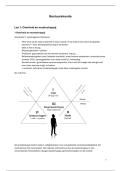
David Easton said that we all live in society or environment, with different values. In this
environment we do a certain input, that is led by demands and by support. The political will absorb
these demands and support, and they will decide. Which leads to the output. There will be feedback
on the output, which brings us back to the input.
3
, 4. Importance of theory in comparative politics
- Providing answers to puzzles and questions
- Provides us with a guideline for conducting research
- Helps us interpret findings
- Micro vs. Macro level (individuals vs. institutions)
- Explains why X has an influence on Y (why an independent variable influences a dependent
variable)
5. Approaches in comparative politics
HOW DO WE REACH AN ANSWER AS TO WHY X HAS AN IMPACT ON Y? THE FIVE ‘I’S
1. Institutions
Institutions are at the center of comparative politics: Institutions are the center of comparative
politics. Institutions shape the norms and rules, and it matters which type of political system a
certain country has.
- Shapes norms and rules (logic of appropriateness) – James March and Johan Olsen
- It matters a great deal if a country has presidential vs. parliamentary political system, is it
federal or unitary, etc.
- Includes formal (parliaments) and informal (elections) types
2. Intrests
Focuses on interests that are pursued by actors:
- Who gets what – Harold Lasswell
- Basis in rational-choice theory
- Concepts such as corporativisms, networks, consociationalism, cleavage etc.
3. Ideas
Ideas can (indirectly) shape outcomes: The idea that lives in our society, they are not the main
cause. However, they can shape the outcomes.
- Political culture (tension between values)
[ General level
[ Social capital – Robert Putnam
4
, [ Putman conducted a study on Southern and Northern Italians to see the difference in
their views on the political system. It focused on which values they believe in, how
much they trust others, and similar factors.
- Ideology
[ Powerful in the past (communism, fascism), less so today (neoliberalism)
- Policy ideas
[ Most concrete
[ If certain citizens believe we should put more effort into climate action, this also
influences how politics shapes policies.
4. Individuals
Individuals as an answer:
- Psychological studies, personality – explaining how elites act in office
[ Trump's personality explains a lot about how he shapes the political system.
- Includes political elites, but also ordinary citizens, participants in interest groups
[ You also need to look at the people, their ideas, and how these influence political
outcomes.
5. International environment
Globalized environment plays a role in a system: We cannot understand our own context if we do
not zoom out and look at global politics. For example, the EU – countries join the EU because it has
a big impact on world politics.
- Politics takes place in a globalized environment
- Impact varies across countries (e.g. US is not as dependent as other countries)
- EU (process of Europeanization)
- Difficult to make inferences
6. The sixth element: Interactions
- The world is too complex
- Interaction between approaches crucial in theory
- Between institutions and individuals
- For instance, combining institutions and individuals can provide more answers
5
, 6. Comparative method
6.1 A TOOL TO INVESTIGATE HYPOTHESIZED RELATIONSHIPS BETWEEN VARIABLES
- How and why an independent variable X has an impact on a dependent variable Y (theory
developments)
[ Hypothesis: Variation in state funding for renewable energy is dependent on the
strength of green parties in a country.
[ Dependent variable Y: State funding for renewable energy
[ Independent variable X: Strength of green parties
- We aim to establish causality and meaningful relationships (X has an impact on Y)
[ But remember the complexities of the real world: Various factors can impact funding
for renewable energy
- Comparative method is strong test of relationships because it is quasi-experimental
[ Control vs. treatment groups (e.g. a country with weak green parties and a country
with a strong green parties)
Research question Research design Research answer
- A toolkit that provides an There are two main research designs in
answer to a question comparative politics following J.S. Mill:
- Needs to meet the standards of
validity (internal and - Most Different System Design (MDSD)
external), reliability and
generalizability. - Most Similar Systems Design (MSSD)
6.2 HOW DOES COMPARATIVE METHOD WORK?
1. Most Different System Design (MDSD)
- Method of similarity
- Cases have similar outcomes (Y), despite major case differences
- Assumption is that similarity in these vastly different cases helps us identify causes (X)
There are two countries, who are totally different (langue, level of education, modernization,
religions, etc.). However, they still have the same outcome. We can explain this by the similarities
between the two countries. These similarities are easy to find, because the countries are so different.
It is obvious what is they have in common.
6
, 2. Most similar systems design (MSSD)
- Method of difference
- Cases have different outcomes (Y), despite minor case differences
- Assumption is that difference in these similar cases helps us identifying causes (X)
They are two countries that have a lot in common, but they have different outcomes. The different
outcome can be explained by the differences between them. By looking at the similarities, it
becomes easier to find the differences.
7. Methodology
Quantitative Qualitative
- Large number of observations - Small number of observations
- Variable oriented - Case oriented
- Hard and objective - Rich and deep
- E.g. Running statistical models - E.g. Conducting interviews
7
, Lecture 2: Democracy
1. What is democracy?
Democracy is a system where the government gets its power from the people and is commonly used
by leaders worldwide.
1.1 HISTORICAL MEANING
- Origins in ancient Greece
[ Athens (6th century BC)
- Direct democracy
[ Decision-making by citizens at assembly.
[ Democracy comes from Greece, specifically from Athens. They had direct
democracy there. Citizens made decisions themselves. They would gather and give
speeches about important topics. People had individual votes.
- Until 19th century it was considered a negative term
[ Minority rule
[ No constitutional protection
[ Decisions were arbitrary and inconsistent
[ It was seen as negative because there were many problems with how it worked. Only
a small group could vote (minority rule), mainly men with high positions. There was
also no higher authority to oversee society and the system (no constitutional
protection). Finally, the decisions were inconsistent.
1.2 MODERN MEANING
- Political regime in contemporary world where: Political decisions are delegated to
representatives (in parliament) and executive leaders (in government) who are accountable
to the electorate.
[ Political decisions are made by representatives in parliament and leaders in the
government. They must answer to the voters.
- Built on liberal principles
[ All citizens have political rights
[ All citizens and non-citizens enjoy social and human rights
8
, 1.3 DEFINING DEMOCRACY
Minimalist definition (Joseph Schumpeter)
Institutional arrangement for arriving at political decisions in which individuals acquire the power
to decide by means of a competitive struggle for the people’s vote.
[ It describes how we live today. We have elections where we give power to policymakers,
and they decide how the country is organized. The only thing missing from the definition is
the liberal principles: Who can vote? Does freedom exist?
Polarchy
- The government of the many – Robert Dahl
- Combination of open contestation for power and inclusive political participation.
[ He wrote a book called Polyarchy. He says we want to achieve polyarchy because it is
government by the majority. Liberal principles are also included. Everyone must have the
right to vote. The process must be transparent and inclusive. People's rights must be ensured.
2. Attributes of democracy
It comes from the modern understanding of democracy, where all elements must be present for a
country to be considered democratic.
1. Free and fair elections
The election process needs to be:
- Recurring (taking place often)
[ Elections must have a fixed term; there cannot be just one election allowing leaders
to stay in power for life. The term length varies between countries.
- Free (candidates can campaign; voters can vote)
[ Elections must also be free, meaning candidates can run campaigns, and voters can
choose freely.
- Fair (vote counting is correct; government vs. opposition is balanced)
[ Lastly, elections must be fair and follow the country's laws. There should also be a
balance between the government and the opposition, giving the opposition a chance
to present an alternative to the previous legislature.
9
, 2. Universal participation (Who has the right to vote?)
- Adult population has the right to vote and run for office.
- Applies to all individuals regardless of gender, income, education, etc.
[ Yet, foreigners are typically excluded, as are prisoners in some cases.
[ There should be no discrimination based on skin color or gender. However, they
must have citizenship.
- Minors do not have the right to vote
[ However, active citizenship in some countries does start at 16
[ Why do some countries allow voting from age 16?
Some countries grant this right to educate and motivate young people to become
interested in politics.
[ Why do some countries not allow it?
Some countries believe they are too young and easily influenced.
3. Civil liberties
- Governments do not commit human rights violations, censor critical voices, or restrict the
organization of political parties and interest groups.
[ The government cannot take away fundamental rights from citizens. It must ensure a
fair and equal playing field for both citizens and interest groups. We have freedom of
speech, but we cannot violate the rights of others. This means, for example, that
racist remarks are not allowed, as they harm the basic rights of others.
- Usually protected by the constitution
[ Independent judiciary (e.g. constitutional courts)
4. Responsible government
- Governments are not constrained in decision-making by any entity (the monarch, military,
religious organizations, etc.).
[ The government must not be influenced by other entities, such as the military or the
king. They cannot interfere or demand that politicians change their decisions.
- Constitutional court is allowed to overturn decisions that harm civil liberties.
[ However, there is a higher court that oversees the government and ensures that laws
align with the constitution. If laws do not comply, the higher court can overturn
them.
- Ultimately responsible to voters
10
Lecture 1: Introduction to comparative institutions
1. What is comparative institutions?
Political theory
- Normative questions
-> Comparative politics
- Empirical questions, not normative questions. We want to explain why we have federal
states, etc. They want to explain real issues.
- Interactions within systems. They want to explain why Trump is there in the first place, etc.
They are more concerned about national politics or lower.
International relations
- Interactions between systems.
1.1 DEFINING POLITICS
Politics seen as the human activity of making public authoritative decisions. That is, politics is
about acquiring and maintaining power which produces conflict and competition.
[ The consequence of power is conflict, because people have a different opinion about certain
things. This can also lead to competition.
“At the root of all politics is the universal language of conflict” – Elmer Schattschneider
1.2 IMPORTANT QUESTIONS IN COMPARATIVE POLITICS
- Which decisions are made
[ For example: Invest in renewable energy, changing constitution, higher spending for
military, etc.
- How are decisions made
[ For example: Referendums, elections, protests, lobbying, etc.
- Who makes or influences these decisions
[ For example: Parties, lobby groups, voters, etc.
1
, 2. Aims of comparative politics
Describe Explain Predict
- Differences and - Explain why these - Which factors could
similarities between differences and cause such outcomes
political systems similarities occur
- Not exact
- Classifications and - Formulating
typologies hypotheses For example: Changing to a
first-past- the-post system will
For example: Two-party vs. For example: First-past-the- result in two major parties
Multi- party systems post electoral system leads to
two-party dominance
We want to describe the
political system we live in. It Explain how the differences
is filled with classifications and similarities come around.
and typologies.
2.1 DEFINING COMPARATIVE POLITICS
Long definition:
Comparative politics is one of the three main subfields of political science focusing on internal
political structures, actors, and processes, and analyzing them empirically by describing, explaining,
and predicting their variety (similarities and differences) across political systems (and over time) –
be they national political systems, regional, municipal, or even supranational systems.
Short definition:
Comparative politics studies internal politics empirically by comparing it across systems.
2.2 COMPARISON BETWEEN NATIONAL POLITICAL SYSTEMS PREDOMINANTLY
But keep in mind:
- Sub-national regional political systems (e.g. states in the US)
- Supranational units (e.g. EU)
- Types of system (e.g. democracy vs. autocracy)
- Single element of system (e.g. parliaments)
3. History of comparative politics
State and institutions (before WW2)
- Focus on formal institutions and legal documents and texts
- Western world
- Normative in nature
2
,Behavioral evolution (30s and 60s)
- Focus on processes that take place within institutions (based on sociology)
- Cases and phenomena beyond the West (populism in Latin America; socialism in Eastern
Europe)
- Empirical
New institutionalism
- Shaped by behavioral evolution
- Institutions shape how individual formulate preferences
Mid-range theories
- Removing abstraction in concepts (less ambitious theoretical perspectives)
- Narrowing geographical focus
- Advantage of studying few countries
Case-oriented analysis
- Stem from mid-range theories – focus on analysis of small number of cases
- Advantage for explaining phenomena that are not widely present
Rational – choice (end of 80s)
- Focus on individuals (but also organizations such as parties) that are rational (maximization
of preferences)
- Impacts how decisions are made
3.1 COMPARATIVE POLITICS TODAY
David Easton said that we all live in society or environment, with different values. In this
environment we do a certain input, that is led by demands and by support. The political will absorb
these demands and support, and they will decide. Which leads to the output. There will be feedback
on the output, which brings us back to the input.
3
, 4. Importance of theory in comparative politics
- Providing answers to puzzles and questions
- Provides us with a guideline for conducting research
- Helps us interpret findings
- Micro vs. Macro level (individuals vs. institutions)
- Explains why X has an influence on Y (why an independent variable influences a dependent
variable)
5. Approaches in comparative politics
HOW DO WE REACH AN ANSWER AS TO WHY X HAS AN IMPACT ON Y? THE FIVE ‘I’S
1. Institutions
Institutions are at the center of comparative politics: Institutions are the center of comparative
politics. Institutions shape the norms and rules, and it matters which type of political system a
certain country has.
- Shapes norms and rules (logic of appropriateness) – James March and Johan Olsen
- It matters a great deal if a country has presidential vs. parliamentary political system, is it
federal or unitary, etc.
- Includes formal (parliaments) and informal (elections) types
2. Intrests
Focuses on interests that are pursued by actors:
- Who gets what – Harold Lasswell
- Basis in rational-choice theory
- Concepts such as corporativisms, networks, consociationalism, cleavage etc.
3. Ideas
Ideas can (indirectly) shape outcomes: The idea that lives in our society, they are not the main
cause. However, they can shape the outcomes.
- Political culture (tension between values)
[ General level
[ Social capital – Robert Putnam
4
, [ Putman conducted a study on Southern and Northern Italians to see the difference in
their views on the political system. It focused on which values they believe in, how
much they trust others, and similar factors.
- Ideology
[ Powerful in the past (communism, fascism), less so today (neoliberalism)
- Policy ideas
[ Most concrete
[ If certain citizens believe we should put more effort into climate action, this also
influences how politics shapes policies.
4. Individuals
Individuals as an answer:
- Psychological studies, personality – explaining how elites act in office
[ Trump's personality explains a lot about how he shapes the political system.
- Includes political elites, but also ordinary citizens, participants in interest groups
[ You also need to look at the people, their ideas, and how these influence political
outcomes.
5. International environment
Globalized environment plays a role in a system: We cannot understand our own context if we do
not zoom out and look at global politics. For example, the EU – countries join the EU because it has
a big impact on world politics.
- Politics takes place in a globalized environment
- Impact varies across countries (e.g. US is not as dependent as other countries)
- EU (process of Europeanization)
- Difficult to make inferences
6. The sixth element: Interactions
- The world is too complex
- Interaction between approaches crucial in theory
- Between institutions and individuals
- For instance, combining institutions and individuals can provide more answers
5
, 6. Comparative method
6.1 A TOOL TO INVESTIGATE HYPOTHESIZED RELATIONSHIPS BETWEEN VARIABLES
- How and why an independent variable X has an impact on a dependent variable Y (theory
developments)
[ Hypothesis: Variation in state funding for renewable energy is dependent on the
strength of green parties in a country.
[ Dependent variable Y: State funding for renewable energy
[ Independent variable X: Strength of green parties
- We aim to establish causality and meaningful relationships (X has an impact on Y)
[ But remember the complexities of the real world: Various factors can impact funding
for renewable energy
- Comparative method is strong test of relationships because it is quasi-experimental
[ Control vs. treatment groups (e.g. a country with weak green parties and a country
with a strong green parties)
Research question Research design Research answer
- A toolkit that provides an There are two main research designs in
answer to a question comparative politics following J.S. Mill:
- Needs to meet the standards of
validity (internal and - Most Different System Design (MDSD)
external), reliability and
generalizability. - Most Similar Systems Design (MSSD)
6.2 HOW DOES COMPARATIVE METHOD WORK?
1. Most Different System Design (MDSD)
- Method of similarity
- Cases have similar outcomes (Y), despite major case differences
- Assumption is that similarity in these vastly different cases helps us identify causes (X)
There are two countries, who are totally different (langue, level of education, modernization,
religions, etc.). However, they still have the same outcome. We can explain this by the similarities
between the two countries. These similarities are easy to find, because the countries are so different.
It is obvious what is they have in common.
6
, 2. Most similar systems design (MSSD)
- Method of difference
- Cases have different outcomes (Y), despite minor case differences
- Assumption is that difference in these similar cases helps us identifying causes (X)
They are two countries that have a lot in common, but they have different outcomes. The different
outcome can be explained by the differences between them. By looking at the similarities, it
becomes easier to find the differences.
7. Methodology
Quantitative Qualitative
- Large number of observations - Small number of observations
- Variable oriented - Case oriented
- Hard and objective - Rich and deep
- E.g. Running statistical models - E.g. Conducting interviews
7
, Lecture 2: Democracy
1. What is democracy?
Democracy is a system where the government gets its power from the people and is commonly used
by leaders worldwide.
1.1 HISTORICAL MEANING
- Origins in ancient Greece
[ Athens (6th century BC)
- Direct democracy
[ Decision-making by citizens at assembly.
[ Democracy comes from Greece, specifically from Athens. They had direct
democracy there. Citizens made decisions themselves. They would gather and give
speeches about important topics. People had individual votes.
- Until 19th century it was considered a negative term
[ Minority rule
[ No constitutional protection
[ Decisions were arbitrary and inconsistent
[ It was seen as negative because there were many problems with how it worked. Only
a small group could vote (minority rule), mainly men with high positions. There was
also no higher authority to oversee society and the system (no constitutional
protection). Finally, the decisions were inconsistent.
1.2 MODERN MEANING
- Political regime in contemporary world where: Political decisions are delegated to
representatives (in parliament) and executive leaders (in government) who are accountable
to the electorate.
[ Political decisions are made by representatives in parliament and leaders in the
government. They must answer to the voters.
- Built on liberal principles
[ All citizens have political rights
[ All citizens and non-citizens enjoy social and human rights
8
, 1.3 DEFINING DEMOCRACY
Minimalist definition (Joseph Schumpeter)
Institutional arrangement for arriving at political decisions in which individuals acquire the power
to decide by means of a competitive struggle for the people’s vote.
[ It describes how we live today. We have elections where we give power to policymakers,
and they decide how the country is organized. The only thing missing from the definition is
the liberal principles: Who can vote? Does freedom exist?
Polarchy
- The government of the many – Robert Dahl
- Combination of open contestation for power and inclusive political participation.
[ He wrote a book called Polyarchy. He says we want to achieve polyarchy because it is
government by the majority. Liberal principles are also included. Everyone must have the
right to vote. The process must be transparent and inclusive. People's rights must be ensured.
2. Attributes of democracy
It comes from the modern understanding of democracy, where all elements must be present for a
country to be considered democratic.
1. Free and fair elections
The election process needs to be:
- Recurring (taking place often)
[ Elections must have a fixed term; there cannot be just one election allowing leaders
to stay in power for life. The term length varies between countries.
- Free (candidates can campaign; voters can vote)
[ Elections must also be free, meaning candidates can run campaigns, and voters can
choose freely.
- Fair (vote counting is correct; government vs. opposition is balanced)
[ Lastly, elections must be fair and follow the country's laws. There should also be a
balance between the government and the opposition, giving the opposition a chance
to present an alternative to the previous legislature.
9
, 2. Universal participation (Who has the right to vote?)
- Adult population has the right to vote and run for office.
- Applies to all individuals regardless of gender, income, education, etc.
[ Yet, foreigners are typically excluded, as are prisoners in some cases.
[ There should be no discrimination based on skin color or gender. However, they
must have citizenship.
- Minors do not have the right to vote
[ However, active citizenship in some countries does start at 16
[ Why do some countries allow voting from age 16?
Some countries grant this right to educate and motivate young people to become
interested in politics.
[ Why do some countries not allow it?
Some countries believe they are too young and easily influenced.
3. Civil liberties
- Governments do not commit human rights violations, censor critical voices, or restrict the
organization of political parties and interest groups.
[ The government cannot take away fundamental rights from citizens. It must ensure a
fair and equal playing field for both citizens and interest groups. We have freedom of
speech, but we cannot violate the rights of others. This means, for example, that
racist remarks are not allowed, as they harm the basic rights of others.
- Usually protected by the constitution
[ Independent judiciary (e.g. constitutional courts)
4. Responsible government
- Governments are not constrained in decision-making by any entity (the monarch, military,
religious organizations, etc.).
[ The government must not be influenced by other entities, such as the military or the
king. They cannot interfere or demand that politicians change their decisions.
- Constitutional court is allowed to overturn decisions that harm civil liberties.
[ However, there is a higher court that oversees the government and ensures that laws
align with the constitution. If laws do not comply, the higher court can overturn
them.
- Ultimately responsible to voters
10