
9. Agriculture and development (C. Miehe)
1. Introduction to agriculture and development
Theory: structural transformation
Dual economy model:
Structural transformation:
1) Shift from agricultural to non-agricultural sectors
Share of agriculture in GDP and employment decreases
Share of non-agricultural sector in GDP and employment increases i.e. industrial and service economy rise (→
industrialization)
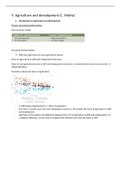
Economic output and share of agriculture:
- X: GDP/capita (development), y: share of agriculture
- The richer a country gets, the more developed a country is, the smaller the share of agriculture in GDP
and employment.
- Light blue at the bottom: the difference between the 2 (% of agriculture in GDP and employment). It’s
a negative difference. So the share in employment declines more than the share in GDP.
, - The same, but than in Sub-Saharan Africa: the share in GDP and employment declines, there is a
negative difference.
2 views on that:
1. Industrial pull (traditional view): Productivity growth in industrial (non-agricultural) sector → formal
wages increase in industrial sector → labor is “pulled” from agricultural sector to industrial sector
2. Agricultural push (opposing view): Productivity growth in agricultural sector → less demand for labor
in agricultural sector (less people are needed) → labor is “pushed” from agricultural sector to
industrial sector
2) People migrate from rural to urban (→ urbanization)
See next lecture!
3) Demographic transition
See next lecture!
, Status que in Africa
Poverty rates in Africa are high:
- Decrease in share of poor: from 54% in 1990 to 41% in 2015
- Increase in number of poor: from 278 million in 1990 to 413 million in 2015
- Poverty is expected to be predominantly an African phenomenon by 2030: from 17% in 1990 to 51% in
2013
The poor often stay poor (chronical poverty), many non-poor fall into poverty, some of the poor move out of
poverty (transitory poverty):
- Many are chronical poor and can’t move out of poverty. Poverty is still a problem in the world,
especially in SSA!
1. Introduction to agriculture and development
Theory: structural transformation
Dual economy model:
Structural transformation:
1) Shift from agricultural to non-agricultural sectors
Share of agriculture in GDP and employment decreases
Share of non-agricultural sector in GDP and employment increases i.e. industrial and service economy rise (→
industrialization)
Economic output and share of agriculture:
- X: GDP/capita (development), y: share of agriculture
- The richer a country gets, the more developed a country is, the smaller the share of agriculture in GDP
and employment.
- Light blue at the bottom: the difference between the 2 (% of agriculture in GDP and employment). It’s
a negative difference. So the share in employment declines more than the share in GDP.
, - The same, but than in Sub-Saharan Africa: the share in GDP and employment declines, there is a
negative difference.
2 views on that:
1. Industrial pull (traditional view): Productivity growth in industrial (non-agricultural) sector → formal
wages increase in industrial sector → labor is “pulled” from agricultural sector to industrial sector
2. Agricultural push (opposing view): Productivity growth in agricultural sector → less demand for labor
in agricultural sector (less people are needed) → labor is “pushed” from agricultural sector to
industrial sector
2) People migrate from rural to urban (→ urbanization)
See next lecture!
3) Demographic transition
See next lecture!
, Status que in Africa
Poverty rates in Africa are high:
- Decrease in share of poor: from 54% in 1990 to 41% in 2015
- Increase in number of poor: from 278 million in 1990 to 413 million in 2015
- Poverty is expected to be predominantly an African phenomenon by 2030: from 17% in 1990 to 51% in
2013
The poor often stay poor (chronical poverty), many non-poor fall into poverty, some of the poor move out of
poverty (transitory poverty):
- Many are chronical poor and can’t move out of poverty. Poverty is still a problem in the world,
especially in SSA!


