

Genetic Drift
Stochasticity: non-deterministic (ie. random), a stochastic system is one with a
system that is determined probabilistically
Transmission of genes between generations – the genotypes inherited by the
offspring can be predicted in a ratio BUT individuals vary in fitness
In a large population – averaging fitness realisations so w cc ~ 1-c
In a small population – random deviations have significant effect, so w cc not always
1-c
Similar situation occurs in the absence of selection
Expectation is there is no change – pt+1 = pt
More or less met in large populations, but potentially large deviations in small
populations (= genetic drift)
Evolution, but not adaptation
Neutral Evolution
Theory highlights the relative importance of drift
and selection
Suggests that if a population carries several
different alleles, there are chances that each allele
is equally good at performing its job – variation is neutral – the possession of any
particular allele does not affect fitness
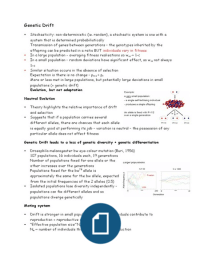
Genetic Drift leads to a loss of genetic diversity + genetic differentiation
Drosophila melanogaster bw eye-colour mutation (Buri, 1956)
107 populations, 16 individuals each, 19 generations
Number of populations fixed for one allele or the
other increases over the generations
Populations fixed for the bw75 allele is
approximately the same for the bw allele, expected
from the initial frequencies of the 2 alleles (0.5)
Isolated populations lose diversity independently –
populations can fix different alleles and so
populations diverge genetically
Mating system
Drift is stronger in small populations or if few individuals contribute to
reproduction = reproductive skew, polygyny (lek)
“Effective population size” Ne
Ne ~ number of individuals that contribute to reproduction
, (not the census number of breeding individuals, but depends on mode of inheritance,
level of inbreeding population, the numbers of males and females, the variance in
reproductive success, changes in population size over time, age structure, any
geographic and genetic structuring of the population
Ne of a real population = size of an idealised population with same drift, in general
Ne gives an approximation of the rate of drift and often valid only asymptotically
(ie. after sufficient time elapsed since start of the process)
Genetic Identity: probabilities that alleles are identical
Describing (the loss of) genetic diversity
Used to predict dynamics of genetic diversity/make inferences about population
structure
How similar are alleles – within individuals/between individuals/between populations
Hierarchical organisation of alleles
- Alleles in the same individual
F: inbreeding
coefficient/consanguinity
- Alleles in different individuals
Θ: coancestry within populations
- Alleles in different individuals
α: coancestry between populations
Genetic variation can be distributed in
the:
Individual level: inbreeding, mating
system
Sub-population level: differentiation, migration/isolation
Population level
Populations are often organised into hierarchal sets with increasing levels of
subdivision (eg. subspecies within species, geographic races within subspecies, local
populations within races) – Variance between groups at any level can then be
estimated
Fixation Indices, FIS (Wright, 1951)
Subscripts indicate that this F statistic
measures the departure of the individual
genotype frequencies within a local population
from random mating expectation
Comparing identity/heterozygosity between levels
Within populations: are individuals more homozygote than expected from identity
between individuals
, The measures of FIS, FST, FIT, are related to amounts of heterozygosity at various
levels of population – all derived from inbreeding coefficient F
FIT is the inbreeding coefficient of an individual (I), relative to total population (T),
FIS is the inbreeding coefficient of an individual (I) relative to subpopulation (S), F ST
is the effect of subpopulations (S) compared to total population (T)
FIS > 0 homozygosity greater than expected, inbreeding
Positive F denotes excess of homozygotes over random-mating expectation
Negative F denotes excess of heterozygotes
Individual
F=θ=1/2, FIS = 0 HW equilibrium
F= 1, θ=1/2, FIS = 1 complete inbreeding
Sub-population
Θ=a, FST population homogenous
a-=0, θ=1, FST =1 complete differentiation
Measuring population structure
Population structure can be observed using
genetic markers such as single nucleotide
polymorphisms (SNPs) or Microsatellites
Applications
a. Human genetic diversity – expansion of human population “out of Africa” (Balloux
and Manica)
Colonisation = repeated “bottlenecks”/”founder
effects”- small group of individuals contribute the
alleles to the whole population (binomial sampling)
Effects of drift accumulate along colonisation
routes (Prugnolle et al., 2005)
Also observed in Helicobacter pylori populations
(Linz et al., 2008)
b. Detecting deviations from neutrality
Major Histocompatibility Complex (MHC): immune defence
Diversity in MHC genes (Qutob et al., 2012)
c. Evolution between dog breeds (Akey et al., 2010)
Which genes are involved in phenotypic traits? 10 breeds, with many SNP
markers along entire genome
Neutral loci: frequency differences due to drift
Selected loci: differences due to drift + selection
Which genes show high frequency differences?
Stochasticity: non-deterministic (ie. random), a stochastic system is one with a
system that is determined probabilistically
Transmission of genes between generations – the genotypes inherited by the
offspring can be predicted in a ratio BUT individuals vary in fitness
In a large population – averaging fitness realisations so w cc ~ 1-c
In a small population – random deviations have significant effect, so w cc not always
1-c
Similar situation occurs in the absence of selection
Expectation is there is no change – pt+1 = pt
More or less met in large populations, but potentially large deviations in small
populations (= genetic drift)
Evolution, but not adaptation
Neutral Evolution
Theory highlights the relative importance of drift
and selection
Suggests that if a population carries several
different alleles, there are chances that each allele
is equally good at performing its job – variation is neutral – the possession of any
particular allele does not affect fitness
Genetic Drift leads to a loss of genetic diversity + genetic differentiation
Drosophila melanogaster bw eye-colour mutation (Buri, 1956)
107 populations, 16 individuals each, 19 generations
Number of populations fixed for one allele or the
other increases over the generations
Populations fixed for the bw75 allele is
approximately the same for the bw allele, expected
from the initial frequencies of the 2 alleles (0.5)
Isolated populations lose diversity independently –
populations can fix different alleles and so
populations diverge genetically
Mating system
Drift is stronger in small populations or if few individuals contribute to
reproduction = reproductive skew, polygyny (lek)
“Effective population size” Ne
Ne ~ number of individuals that contribute to reproduction
, (not the census number of breeding individuals, but depends on mode of inheritance,
level of inbreeding population, the numbers of males and females, the variance in
reproductive success, changes in population size over time, age structure, any
geographic and genetic structuring of the population
Ne of a real population = size of an idealised population with same drift, in general
Ne gives an approximation of the rate of drift and often valid only asymptotically
(ie. after sufficient time elapsed since start of the process)
Genetic Identity: probabilities that alleles are identical
Describing (the loss of) genetic diversity
Used to predict dynamics of genetic diversity/make inferences about population
structure
How similar are alleles – within individuals/between individuals/between populations
Hierarchical organisation of alleles
- Alleles in the same individual
F: inbreeding
coefficient/consanguinity
- Alleles in different individuals
Θ: coancestry within populations
- Alleles in different individuals
α: coancestry between populations
Genetic variation can be distributed in
the:
Individual level: inbreeding, mating
system
Sub-population level: differentiation, migration/isolation
Population level
Populations are often organised into hierarchal sets with increasing levels of
subdivision (eg. subspecies within species, geographic races within subspecies, local
populations within races) – Variance between groups at any level can then be
estimated
Fixation Indices, FIS (Wright, 1951)
Subscripts indicate that this F statistic
measures the departure of the individual
genotype frequencies within a local population
from random mating expectation
Comparing identity/heterozygosity between levels
Within populations: are individuals more homozygote than expected from identity
between individuals
, The measures of FIS, FST, FIT, are related to amounts of heterozygosity at various
levels of population – all derived from inbreeding coefficient F
FIT is the inbreeding coefficient of an individual (I), relative to total population (T),
FIS is the inbreeding coefficient of an individual (I) relative to subpopulation (S), F ST
is the effect of subpopulations (S) compared to total population (T)
FIS > 0 homozygosity greater than expected, inbreeding
Positive F denotes excess of homozygotes over random-mating expectation
Negative F denotes excess of heterozygotes
Individual
F=θ=1/2, FIS = 0 HW equilibrium
F= 1, θ=1/2, FIS = 1 complete inbreeding
Sub-population
Θ=a, FST population homogenous
a-=0, θ=1, FST =1 complete differentiation
Measuring population structure
Population structure can be observed using
genetic markers such as single nucleotide
polymorphisms (SNPs) or Microsatellites
Applications
a. Human genetic diversity – expansion of human population “out of Africa” (Balloux
and Manica)
Colonisation = repeated “bottlenecks”/”founder
effects”- small group of individuals contribute the
alleles to the whole population (binomial sampling)
Effects of drift accumulate along colonisation
routes (Prugnolle et al., 2005)
Also observed in Helicobacter pylori populations
(Linz et al., 2008)
b. Detecting deviations from neutrality
Major Histocompatibility Complex (MHC): immune defence
Diversity in MHC genes (Qutob et al., 2012)
c. Evolution between dog breeds (Akey et al., 2010)
Which genes are involved in phenotypic traits? 10 breeds, with many SNP
markers along entire genome
Neutral loci: frequency differences due to drift
Selected loci: differences due to drift + selection
Which genes show high frequency differences?


