

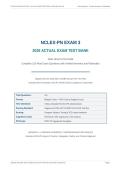
NCLEX-PN EXAM 3 2026 - ACTUAL EXAM TEST BANK | NGN NCLEX-PN 150 Questions - Verified Answers & Rationales
NCLEX-PN EXAM 3
2026 ACTUAL EXAM TEST BANK
NGN NCLEX-PN EXAM
Complete 150 Real Exam Questions with Verified Answers and Rationales
Aligned with the 2026-2027 NCSBN NCLEX-PN Test Plan
Including Next Generation NCLEX (NGN) Clinical Judgment Components
Total Questions: 150
Format: Multiple Choice + NGN Clinical Judgment Cases
Time Allotment: 3 Hours (Standard NCLEX-PN administration)
Passing Standard: Aligned with 2026-2027 NCSBN NCLEX-PN Test Plan
Scoring: Computer Adaptive Testing (CAT) format simulation
Cognitive Levels: 25% Recall | 50% Application | 25% Analysis
PN Scope: LPN/LVN appropriate throughout
GRADED A+ | VERIFIED ANSWERS | COMPREHENSIVE RATIONALES
Includes LPN/LVN Scope of Practice, Delegation, Safety, and Clinical Judgment
Aligned with 2026-2027 NCSBN NCLEX-PN Test Plan with NGN Components Page 1
,NCLEX-PN EXAM 3 2026 - ACTUAL EXAM TEST BANK | NGN NCLEX-PN 150 Questions - Verified Answers & Rationales
EXAM CONTENTS
Section Content Area Questions
1 Safe & Effective Care - Coordinated Care Q1 - Q25
2 Safe & Effective Care - Safety & Infection Control Q26 - Q40
3 Health Promotion and Maintenance Q41 - Q55
4 Psychosocial Integrity Q56 - Q70
5 Basic Care and Comfort Q71 - Q85
6 Pharmacological and Parenteral Therapies Q86 - Q105
7 Reduction of Risk Potential Q106 - Q120
8 Physiological Adaptation Q121 - Q140
9 NGN Clinical Judgment (Case Studies) Q141 - Q150
Cognitive Level Distribution
Recall (25%): Remembering facts, terms, and basic concepts.
Application (50%): Using knowledge in new situations, implementing care.
Analysis (25%): Breaking down information, identifying patterns, making clinical judgments.
Instructions to Candidate
This examination consists of 150 multiple-choice questions and NGN clinical judgment cases. Select the SINGLE
BEST answer for each question. Read each question carefully and consider all options before selecting your answer.
The rationales provided explain why the correct answer is best and why the other options are incorrect, supporting
learning and review.
Aligned with 2026-2027 NCSBN NCLEX-PN Test Plan with NGN Components Page 2
,NCLEX-PN EXAM 3 2026 - ACTUAL EXAM TEST BANK | NGN NCLEX-PN 150 Questions - Verified Answers & Rationales
SECTION 1: Safe and Effective Care Environment - Coordinated Care
Q1-25 | Advocacy, Client Rights, Delegation, Supervision, Assignment, Ethics, Legal Issues, Advance
Directives, HIPAA, Continuity of Care, Interdisciplinary Collaboration, & Case Management
Q1: A licensed practical nurse (LPN) is caring for a client who refuses a prescribed blood
transfusion based on religious beliefs. Which action by the LPN is most appropriate?
A. Notify the provider and document the refusal, then continue to provide supportive care
[CORRECT]
B. Explain that the transfusion is medically necessary and administer it anyway
C. Contact the hospital's legal department before any further action
D. Ask a family member to convince the client to accept the transfusion
Correct Answer: A
Rationale: Competent adult clients have the legal and ethical right to refuse any treatment, including life-saving
interventions, based on autonomy and informed consent principles. The LPN must respect the client's decision,
notify the provider of the refusal, document the refusal with the client's stated reason and the education provided, and
continue to provide supportive care within the PN scope. Option B violates informed consent and constitutes battery.
Option C delays necessary communication and is not the LPN's initial responsibility. Option D violates client
autonomy and confidentiality by involving family without consent.
Q2: An RN delegates care of four clients to an LPN. Which client should the LPN recognize as
inappropriate for assignment within the PN scope of practice?
A. A client 2 days postoperative from an appendectomy requiring wound care and oral analgesics
B. A client with stable chronic heart failure receiving oral furosemide and daily weights
C. A client admitted 4 hours ago with acute gastrointestinal bleeding receiving IV blood products
[CORRECT]
D. A client with a stage 2 pressure injury requiring wet-to-dry dressing changes
Correct Answer: C
Rationale: The client with acute GI bleeding receiving IV blood products is hemodynamically unstable and requires
ongoing assessment and complex interventions outside the LPN scope. LPNs/LVNs should care for clients with
predictable outcomes and stable conditions, performing focused assessments and standardized care. The other three
clients have stable, predictable needs appropriate for PN scope: routine postoperative care, stable chronic disease
management, and established wound care. The RN retains responsibility for unstable clients requiring comprehensive
assessment, frequent re-evaluation, and complex clinical judgment.
Aligned with 2026-2027 NCSBN NCLEX-PN Test Plan with NGN Components Page 3
, NCLEX-PN EXAM 3 2026 - ACTUAL EXAM TEST BANK | NGN NCLEX-PN 150 Questions - Verified Answers & Rationales
Q3: A client is scheduled for surgery and the surgeon has explained the procedure, risks, and
alternatives. The client signs the consent form. The LPN witnesses the signature. Which best
describes the LPN's role in this situation?
A. The LPN is verifying that the client understood the procedure
B. The LPN is confirming that the signature on the form belongs to the client [CORRECT]
C. The LPN is taking responsibility for ensuring the consent is informed
D. The LPN is assuming legal liability for the surgical outcome
Correct Answer: B
Rationale: When an LPN witnesses a consent signature, the LPN is confirming only that the client signed the
document voluntarily and that the signature is authentic. The provider (surgeon) is responsible for explaining the
procedure, risks, benefits, and alternatives and ensuring the consent is truly informed. The LPN is not verifying
comprehension, taking responsibility for informed consent content, or assuming liability for outcomes. If the LPN
observes that the client does not understand or appears coerced, the LPN must notify the provider before the
procedure.
Q4: A client with a documented do-not-resuscitate (DNR) order goes into cardiac arrest. The
family at the bedside demands that the nurse "do everything." Which action should the LPN
take first?
A. Begin cardiopulmonary resuscitation immediately to honor the family's request
B. Call the provider to obtain a telephone order to revoke the DNR
C. Respect the DNR order and provide comfort measures only [CORRECT]
D. Contact the ethics committee for an emergency consultation
Correct Answer: C
Rationale: The DNR order is a medical order that reflects the client's autonomous wishes and must be followed. The
LPN's first action is to respect the documented order and provide comfort measures; initiating CPR would violate the
order and the client's rights. The LPN should then notify the provider, support the family emotionally, and document
the event. While the family's distress is acknowledged, the client's documented directives take legal and ethical
precedence. If the client had revoked the DNR verbally while competent, the order could be reconsidered, but family
override alone is not valid without legal documentation.
Aligned with 2026-2027 NCSBN NCLEX-PN Test Plan with NGN Components Page 4
NCLEX-PN EXAM 3
2026 ACTUAL EXAM TEST BANK
NGN NCLEX-PN EXAM
Complete 150 Real Exam Questions with Verified Answers and Rationales
Aligned with the 2026-2027 NCSBN NCLEX-PN Test Plan
Including Next Generation NCLEX (NGN) Clinical Judgment Components
Total Questions: 150
Format: Multiple Choice + NGN Clinical Judgment Cases
Time Allotment: 3 Hours (Standard NCLEX-PN administration)
Passing Standard: Aligned with 2026-2027 NCSBN NCLEX-PN Test Plan
Scoring: Computer Adaptive Testing (CAT) format simulation
Cognitive Levels: 25% Recall | 50% Application | 25% Analysis
PN Scope: LPN/LVN appropriate throughout
GRADED A+ | VERIFIED ANSWERS | COMPREHENSIVE RATIONALES
Includes LPN/LVN Scope of Practice, Delegation, Safety, and Clinical Judgment
Aligned with 2026-2027 NCSBN NCLEX-PN Test Plan with NGN Components Page 1
,NCLEX-PN EXAM 3 2026 - ACTUAL EXAM TEST BANK | NGN NCLEX-PN 150 Questions - Verified Answers & Rationales
EXAM CONTENTS
Section Content Area Questions
1 Safe & Effective Care - Coordinated Care Q1 - Q25
2 Safe & Effective Care - Safety & Infection Control Q26 - Q40
3 Health Promotion and Maintenance Q41 - Q55
4 Psychosocial Integrity Q56 - Q70
5 Basic Care and Comfort Q71 - Q85
6 Pharmacological and Parenteral Therapies Q86 - Q105
7 Reduction of Risk Potential Q106 - Q120
8 Physiological Adaptation Q121 - Q140
9 NGN Clinical Judgment (Case Studies) Q141 - Q150
Cognitive Level Distribution
Recall (25%): Remembering facts, terms, and basic concepts.
Application (50%): Using knowledge in new situations, implementing care.
Analysis (25%): Breaking down information, identifying patterns, making clinical judgments.
Instructions to Candidate
This examination consists of 150 multiple-choice questions and NGN clinical judgment cases. Select the SINGLE
BEST answer for each question. Read each question carefully and consider all options before selecting your answer.
The rationales provided explain why the correct answer is best and why the other options are incorrect, supporting
learning and review.
Aligned with 2026-2027 NCSBN NCLEX-PN Test Plan with NGN Components Page 2
,NCLEX-PN EXAM 3 2026 - ACTUAL EXAM TEST BANK | NGN NCLEX-PN 150 Questions - Verified Answers & Rationales
SECTION 1: Safe and Effective Care Environment - Coordinated Care
Q1-25 | Advocacy, Client Rights, Delegation, Supervision, Assignment, Ethics, Legal Issues, Advance
Directives, HIPAA, Continuity of Care, Interdisciplinary Collaboration, & Case Management
Q1: A licensed practical nurse (LPN) is caring for a client who refuses a prescribed blood
transfusion based on religious beliefs. Which action by the LPN is most appropriate?
A. Notify the provider and document the refusal, then continue to provide supportive care
[CORRECT]
B. Explain that the transfusion is medically necessary and administer it anyway
C. Contact the hospital's legal department before any further action
D. Ask a family member to convince the client to accept the transfusion
Correct Answer: A
Rationale: Competent adult clients have the legal and ethical right to refuse any treatment, including life-saving
interventions, based on autonomy and informed consent principles. The LPN must respect the client's decision,
notify the provider of the refusal, document the refusal with the client's stated reason and the education provided, and
continue to provide supportive care within the PN scope. Option B violates informed consent and constitutes battery.
Option C delays necessary communication and is not the LPN's initial responsibility. Option D violates client
autonomy and confidentiality by involving family without consent.
Q2: An RN delegates care of four clients to an LPN. Which client should the LPN recognize as
inappropriate for assignment within the PN scope of practice?
A. A client 2 days postoperative from an appendectomy requiring wound care and oral analgesics
B. A client with stable chronic heart failure receiving oral furosemide and daily weights
C. A client admitted 4 hours ago with acute gastrointestinal bleeding receiving IV blood products
[CORRECT]
D. A client with a stage 2 pressure injury requiring wet-to-dry dressing changes
Correct Answer: C
Rationale: The client with acute GI bleeding receiving IV blood products is hemodynamically unstable and requires
ongoing assessment and complex interventions outside the LPN scope. LPNs/LVNs should care for clients with
predictable outcomes and stable conditions, performing focused assessments and standardized care. The other three
clients have stable, predictable needs appropriate for PN scope: routine postoperative care, stable chronic disease
management, and established wound care. The RN retains responsibility for unstable clients requiring comprehensive
assessment, frequent re-evaluation, and complex clinical judgment.
Aligned with 2026-2027 NCSBN NCLEX-PN Test Plan with NGN Components Page 3
, NCLEX-PN EXAM 3 2026 - ACTUAL EXAM TEST BANK | NGN NCLEX-PN 150 Questions - Verified Answers & Rationales
Q3: A client is scheduled for surgery and the surgeon has explained the procedure, risks, and
alternatives. The client signs the consent form. The LPN witnesses the signature. Which best
describes the LPN's role in this situation?
A. The LPN is verifying that the client understood the procedure
B. The LPN is confirming that the signature on the form belongs to the client [CORRECT]
C. The LPN is taking responsibility for ensuring the consent is informed
D. The LPN is assuming legal liability for the surgical outcome
Correct Answer: B
Rationale: When an LPN witnesses a consent signature, the LPN is confirming only that the client signed the
document voluntarily and that the signature is authentic. The provider (surgeon) is responsible for explaining the
procedure, risks, benefits, and alternatives and ensuring the consent is truly informed. The LPN is not verifying
comprehension, taking responsibility for informed consent content, or assuming liability for outcomes. If the LPN
observes that the client does not understand or appears coerced, the LPN must notify the provider before the
procedure.
Q4: A client with a documented do-not-resuscitate (DNR) order goes into cardiac arrest. The
family at the bedside demands that the nurse "do everything." Which action should the LPN
take first?
A. Begin cardiopulmonary resuscitation immediately to honor the family's request
B. Call the provider to obtain a telephone order to revoke the DNR
C. Respect the DNR order and provide comfort measures only [CORRECT]
D. Contact the ethics committee for an emergency consultation
Correct Answer: C
Rationale: The DNR order is a medical order that reflects the client's autonomous wishes and must be followed. The
LPN's first action is to respect the documented order and provide comfort measures; initiating CPR would violate the
order and the client's rights. The LPN should then notify the provider, support the family emotionally, and document
the event. While the family's distress is acknowledged, the client's documented directives take legal and ethical
precedence. If the client had revoked the DNR verbally while competent, the order could be reconsidered, but family
override alone is not valid without legal documentation.
Aligned with 2026-2027 NCSBN NCLEX-PN Test Plan with NGN Components Page 4


