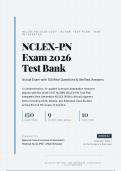
N C L E X- P N 2 0 2 6 – 2 0 2 7 · N C SB N T E ST P L A N · N G N
I N T E G R AT E D
NCLEX-PN
Exam 2026
Test Bank
Actual Exam with 150 Real Questions & Verified Answers
A comprehensive, A+ graded licensure preparation resource
aligned with the 2026–2027 NCSBN NCLEX-PN Test Plan.
Integrates Next Generation NCLEX (NGN) clinical judgment
items including SATA, Bowtie, and Extended Case Studies
across the full PN scope of practice.
150 9 10
QUESTIONS CLIENT NEED A REA S NGN ITEMS
E X A M I N AT I O N GRAD E A+
National Council Licensure Examination 2026–2027 Edition
Practical Nurse (PN) · LPN/LVN Scope Verified Answers & Rationales
NC LEX- P N T ES T BANK · NGN I NT EGR AT ED · C ONFI D ENT I AL
S T UD Y R ES OUR C E
,NCLEX-PN Exam 2026 Test Bank | NGN Integrated 150 Verified Questions & Answers
NCLEX-PN Exam 2026 Test Bank
NGN NCLEX-PN Exam with Complete 150 Real Exam Questions and Correct Verified Answers with
Rationales - Already Graded A+
Exam Title: NCLEX-PN Exam 2026 Test Bank
Edition: 2026-2027 NCSBN NCLEX-PN Test Plan with NGN Components
Total Questions: 150 (Q1-Q140 traditional, Q141-Q150 NGN formats)
Sections: 9 Client Needs categories
NGN Items: 10 questions (SATA, Bowtie, Extended Case Studies)
Cognitive Levels: 20% Recall | 50% Application | 30% Analysis
Answer Key: Verified A+ with detailed rationales for all options
PN Scope: LPN/LVN responsibilities, RN supervision, UAP delegation
Exam Structure: This comprehensive test bank includes 9 sections aligned with the NCSBN NCLEX-PN
Test Plan. Sections 1-8 contain traditional multiple-choice questions with NGN integration. Section 9
contains Next Generation NCLEX (NGN) clinical judgment items including SATA (Select All That Apply),
Bowtie questions (Condition-Interventions-Evaluation format), and Extended Case Studies requiring
application of the Clinical Judgment Measurement Model (CJMM). All rationales include pathophysiology,
nursing interventions, safety considerations, prioritization frameworks, and PN scope of practice
considerations.
How to Use This Exam: For each question, read the stem carefully, consider all options before selecting
an answer, then review the detailed rationale for both correct and incorrect options. For NGN SATA
questions, partial credit is awarded for each correct selection. For Bowtie questions, identify the condition,
select all indicated interventions, and identify evaluation findings that indicate improvement. For Extended
Case Studies, analyze cues, prioritize hypotheses, generate solutions, take action, and evaluate outcomes
using the CJMM framework.
NCLEX-PN 2026 - Grade A+ Verified Page 1
,NCLEX-PN Exam 2026 Test Bank | NGN Integrated 150 Verified Questions & Answers
Table of Contents
Section 1: Safe and Effective Care Environment - Coordinated Care (Q1-Q25) 3
Section 2: Safe and Effective Care Environment - Safety and Infection Control (Q26-Q40) 12
Section 3: Health Promotion and Maintenance (Q41-Q55) 16
Section 4: Psychosocial Integrity (Q56-Q70) 22
Section 5: Basic Care and Comfort (Q71-Q85) 27
Section 6: Pharmacological and Parenteral Therapies (Q86-Q105) 31
Section 7: Reduction of Risk Potential (Q106-Q120) 38
Section 8: Physiological Adaptation (Q121-Q140) 43
Section 9: Next Generation NCLEX (NGN) Clinical Judgment (Q141-Q150) 50
NCLEX-PN 2026 - Grade A+ Verified Page 2
, NCLEX-PN Exam 2026 Test Bank | NGN Integrated 150 Verified Questions & Answers
Section 1: Safe and Effective Care Environment - Coordinated Care (Q1-Q25)
Advocacy, Client Rights, Delegation, Supervision, Assignment, Ethics, Legal Issues, Advance Directives, HIPAA, Continuity of
Care, Interdisciplinary Collaboration, and Case Management within PN scope.
Q1: The LPN/LVN is caring for four clients on a medical-surgical unit. Which client should the LPN
identify as the highest priority to assess first?
A. A 72-year-old client with pneumonia who is scheduled for discharge tomorrow and reports feeling "slightly
tired"
B. A 58-year-old client with heart failure who has new-onset crackles in the lung bases and a 1.5 kg
weight gain since yesterday **[CORRECT]**
C. A 45-year-old postoperative client who is requesting pain medication for incisional pain rated 6/10
D. A 60-year-old client with type 2 diabetes who has a fasting blood glucose of 140 mg/dL
Correct Answer: B
Rationale: Using the ABC (Airway, Breathing, Circulation) priority framework combined with acute-versus-chronic and
urgent-versus-non-urgent criteria, the client with heart failure showing new-onset crackles and weight gain is exhibiting
early signs of fluid volume excess and pulmonary congestion that can rapidly progress to pulmonary edema. The LPN
must assess this client first because respiratory compromise is a life-threatening complication. Within the PN scope, the
LPN should assess, collect data, and report findings to the supervising RN immediately so the care team can intervene
with diuretics, oxygen therapy, or position changes. Discharge planning, pain management, and routine glucose
management are all important but stable in comparison.
Q2: A family member approaches the LPN/LVN at the nurses' station and asks for an update on a client's
condition. Which response by the LPN best demonstrates compliance with HIPAA regulations?
A. "I can share general information because the client has been here for several days."
B. "I cannot share any client information without the client's written permission. Let me check the chart
for authorized contacts." **[CORRECT]**
C. "The client is doing better today. The doctor will be in to talk with you soon."
D. "I can only tell you what the client has authorized. Let me ask the client if they want to share information."
Correct Answer: B
Rationale: HIPAA (Health Insurance Portability and Accountability Act) requires that protected health information
(PHI) be shared only with individuals the client has specifically authorized in writing. The LPN must verify authorization
before disclosing any client information, even to family members. Option A assumes implied consent which is not valid
under HIPAA. Option C violates HIPAA by sharing condition updates without verifying authorization. Option D is
partially correct but still requires the LPN to first verify written authorization in the medical record rather than relying
solely on the client's verbal consent at the time. The LPN must act as a client advocate by protecting privacy while
facilitating communication.
Q3: The LPN/LVN is planning care for the shift and is working with one unlicensed assistive personnel
(UAP). Which task is most appropriate for the LPN to delegate to the UAP?
A. Measuring vital signs on a client who was transferred from the ICU 2 hours ago and remains hemodynamically
unstable
B. Ambulating a client who is 3 days postoperative from a total knee replacement and ambulating with a walker
C. Performing oral care and repositioning a client who is unconscious and on enteral feedings
**[CORRECT]**
D. Reinforcing teaching with a client newly diagnosed with diabetes about foot care
Correct Answer: C
NCLEX-PN 2026 - Grade A+ Verified Page 3
I N T E G R AT E D
NCLEX-PN
Exam 2026
Test Bank
Actual Exam with 150 Real Questions & Verified Answers
A comprehensive, A+ graded licensure preparation resource
aligned with the 2026–2027 NCSBN NCLEX-PN Test Plan.
Integrates Next Generation NCLEX (NGN) clinical judgment
items including SATA, Bowtie, and Extended Case Studies
across the full PN scope of practice.
150 9 10
QUESTIONS CLIENT NEED A REA S NGN ITEMS
E X A M I N AT I O N GRAD E A+
National Council Licensure Examination 2026–2027 Edition
Practical Nurse (PN) · LPN/LVN Scope Verified Answers & Rationales
NC LEX- P N T ES T BANK · NGN I NT EGR AT ED · C ONFI D ENT I AL
S T UD Y R ES OUR C E
,NCLEX-PN Exam 2026 Test Bank | NGN Integrated 150 Verified Questions & Answers
NCLEX-PN Exam 2026 Test Bank
NGN NCLEX-PN Exam with Complete 150 Real Exam Questions and Correct Verified Answers with
Rationales - Already Graded A+
Exam Title: NCLEX-PN Exam 2026 Test Bank
Edition: 2026-2027 NCSBN NCLEX-PN Test Plan with NGN Components
Total Questions: 150 (Q1-Q140 traditional, Q141-Q150 NGN formats)
Sections: 9 Client Needs categories
NGN Items: 10 questions (SATA, Bowtie, Extended Case Studies)
Cognitive Levels: 20% Recall | 50% Application | 30% Analysis
Answer Key: Verified A+ with detailed rationales for all options
PN Scope: LPN/LVN responsibilities, RN supervision, UAP delegation
Exam Structure: This comprehensive test bank includes 9 sections aligned with the NCSBN NCLEX-PN
Test Plan. Sections 1-8 contain traditional multiple-choice questions with NGN integration. Section 9
contains Next Generation NCLEX (NGN) clinical judgment items including SATA (Select All That Apply),
Bowtie questions (Condition-Interventions-Evaluation format), and Extended Case Studies requiring
application of the Clinical Judgment Measurement Model (CJMM). All rationales include pathophysiology,
nursing interventions, safety considerations, prioritization frameworks, and PN scope of practice
considerations.
How to Use This Exam: For each question, read the stem carefully, consider all options before selecting
an answer, then review the detailed rationale for both correct and incorrect options. For NGN SATA
questions, partial credit is awarded for each correct selection. For Bowtie questions, identify the condition,
select all indicated interventions, and identify evaluation findings that indicate improvement. For Extended
Case Studies, analyze cues, prioritize hypotheses, generate solutions, take action, and evaluate outcomes
using the CJMM framework.
NCLEX-PN 2026 - Grade A+ Verified Page 1
,NCLEX-PN Exam 2026 Test Bank | NGN Integrated 150 Verified Questions & Answers
Table of Contents
Section 1: Safe and Effective Care Environment - Coordinated Care (Q1-Q25) 3
Section 2: Safe and Effective Care Environment - Safety and Infection Control (Q26-Q40) 12
Section 3: Health Promotion and Maintenance (Q41-Q55) 16
Section 4: Psychosocial Integrity (Q56-Q70) 22
Section 5: Basic Care and Comfort (Q71-Q85) 27
Section 6: Pharmacological and Parenteral Therapies (Q86-Q105) 31
Section 7: Reduction of Risk Potential (Q106-Q120) 38
Section 8: Physiological Adaptation (Q121-Q140) 43
Section 9: Next Generation NCLEX (NGN) Clinical Judgment (Q141-Q150) 50
NCLEX-PN 2026 - Grade A+ Verified Page 2
, NCLEX-PN Exam 2026 Test Bank | NGN Integrated 150 Verified Questions & Answers
Section 1: Safe and Effective Care Environment - Coordinated Care (Q1-Q25)
Advocacy, Client Rights, Delegation, Supervision, Assignment, Ethics, Legal Issues, Advance Directives, HIPAA, Continuity of
Care, Interdisciplinary Collaboration, and Case Management within PN scope.
Q1: The LPN/LVN is caring for four clients on a medical-surgical unit. Which client should the LPN
identify as the highest priority to assess first?
A. A 72-year-old client with pneumonia who is scheduled for discharge tomorrow and reports feeling "slightly
tired"
B. A 58-year-old client with heart failure who has new-onset crackles in the lung bases and a 1.5 kg
weight gain since yesterday **[CORRECT]**
C. A 45-year-old postoperative client who is requesting pain medication for incisional pain rated 6/10
D. A 60-year-old client with type 2 diabetes who has a fasting blood glucose of 140 mg/dL
Correct Answer: B
Rationale: Using the ABC (Airway, Breathing, Circulation) priority framework combined with acute-versus-chronic and
urgent-versus-non-urgent criteria, the client with heart failure showing new-onset crackles and weight gain is exhibiting
early signs of fluid volume excess and pulmonary congestion that can rapidly progress to pulmonary edema. The LPN
must assess this client first because respiratory compromise is a life-threatening complication. Within the PN scope, the
LPN should assess, collect data, and report findings to the supervising RN immediately so the care team can intervene
with diuretics, oxygen therapy, or position changes. Discharge planning, pain management, and routine glucose
management are all important but stable in comparison.
Q2: A family member approaches the LPN/LVN at the nurses' station and asks for an update on a client's
condition. Which response by the LPN best demonstrates compliance with HIPAA regulations?
A. "I can share general information because the client has been here for several days."
B. "I cannot share any client information without the client's written permission. Let me check the chart
for authorized contacts." **[CORRECT]**
C. "The client is doing better today. The doctor will be in to talk with you soon."
D. "I can only tell you what the client has authorized. Let me ask the client if they want to share information."
Correct Answer: B
Rationale: HIPAA (Health Insurance Portability and Accountability Act) requires that protected health information
(PHI) be shared only with individuals the client has specifically authorized in writing. The LPN must verify authorization
before disclosing any client information, even to family members. Option A assumes implied consent which is not valid
under HIPAA. Option C violates HIPAA by sharing condition updates without verifying authorization. Option D is
partially correct but still requires the LPN to first verify written authorization in the medical record rather than relying
solely on the client's verbal consent at the time. The LPN must act as a client advocate by protecting privacy while
facilitating communication.
Q3: The LPN/LVN is planning care for the shift and is working with one unlicensed assistive personnel
(UAP). Which task is most appropriate for the LPN to delegate to the UAP?
A. Measuring vital signs on a client who was transferred from the ICU 2 hours ago and remains hemodynamically
unstable
B. Ambulating a client who is 3 days postoperative from a total knee replacement and ambulating with a walker
C. Performing oral care and repositioning a client who is unconscious and on enteral feedings
**[CORRECT]**
D. Reinforcing teaching with a client newly diagnosed with diabetes about foot care
Correct Answer: C
NCLEX-PN 2026 - Grade A+ Verified Page 3