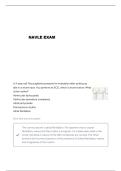
A 3-year old Thoroughbred presents for evaluation after pulling up
late in a recent race. You perform an ECG, which is shown below. What
is the rhythm?
Ventricular tachycardia
Ventricular premature complexes
Atrial tachycardia
Normal sinus rhythm
Atrial fibrillation
Give this one a try later!
The correct answer is atrial fibrillation. The baseline shows coarse
fibrillatory waves and the rhythm is irregular. For a base-apex lead in the
horse, the deep S waves of the QRS complexes are normal. The other
answers are incorrect because of the presence of flutter/fibrillatory waves
and irregularity of the rhythm.
,A 4 -year old domestic short haired cat presents for anorexia and weight loss of 1
week. Physical exam reveals a body condition score of 7/9, jaundice of the skin and
sclera, and dehydration of 4%. Temperature is normal. Bloodwork shows: ALT=303 (25-
97 U/L) GGT=1.8 (0-6 U/L) ALP=1170 (0-45 U/L) bilirubin=3.0 (0-0.1 mg/dl) Radiographs
show an enlarged liver. What is the most important treatment for the cat's likely
diagnosis?
Esophagostomy tube feeding
Oral S-adenosylmethionine for at least 1 month
Parenteral vitamin K injections
Oral clavulanic acid and amoxicillin for 4 weeks
Give this one a try later!
The cat described likely has hepatic lipidosis. Cats that are greater than 2
years of age and obese have the greatest risk for hepatic lipidosis. Often
these cats are indoor-only and have had a recent stress in their life. An
obese cat that is not eating with the above symptoms is most likely to have
hepatic lipidosis.
An ALP elevation that is greater in magnitude than GGT is also suggestive
of hepatic lipidosis. A bile duct obstruction, cholangiohepatitis, lymphoma,
and FIP are other differentials but are less likely with the given information.
A 10-year-old male Pomeranian presents to you with a 3-month history
of wheezing and marked respiratory distress. The owner reports that
he has been coughing sporadically as if trying to clear his throat of a
hairball. The owner is a regular smoker. On your examination, the dog
displays moderate expiratory difficulty. You submit blood work and
take radiographs including inspiratory and expiratory lateral
projections of the dog, which are shown below. Which of the following
are commonly used to treat the likely condition?
Furosemide and prednisone
Amoxicillin, nebulization, and coupage
Meloxicam and fluconazole
,Butorphanol and theophylline
Surgical repair of the defect
Give this one a try later!
The radiographs show dynamic collapse of the intrathoracic trachea,
carina, and mainstem bronchi. There is a marked redundant tracheal
membrane in the cervical region. The left atrium may be slightly enlarged
but there is no evidence of left heart failure. Based on these findings, you
should suspect that tracheal collapse is the cause of the dog's clinical signs.
Treatment options include bronchodilators (i.e. theophylline, terbutaline),
cough suppressants (hydrocodone, butorphanol), weight loss, and
corticosteroids to control inflammation. In severely affected dogs, sedation
may be necessary to break the cough cycle. Dogs should be kept away
from smoke and environmental pollution. About 70% of dogs respond to
medical management. Those that don't are sometimes treated with stents or
tracheal rings, but neither repairs the underlying cartilaginous defect.
Furosemide is not an appropriate treatment as there is no evidence of heart
failure. Nebulization and coupage are used to treat pneumonia, which is
also not present in this case.
A group of dairy calves were fed a home-made grain mix that had a
high percentage of cottonseed (photo shows seed and oil).
Cottonseed is a good source of protein. A few days after being
started on this new grain mix, the calves began having problems
including dyspnea, and weakness, followed by death in several calves.
What is the toxic principle acting here?
Gossypol
Cardiac glycosides
Nicotine
Cyanide
Tannins
Give this one a try later!
, Gossypol is a natural constituent of many types of cotton. It acts as an
insecticide and protects the plant. The polyphenol binds to iron in cell
constituents. It may cause kidney damage, inhibit dehydrogenase enzymes,
and uncouple phosphorylation in the cell. Acute gossypol toxicity in calves
can be severe.
You are called one hot summer day to see a group of horses in New
Mexico which are slobbering and not eating their hay. Three out of 20
horses seem to be visibly affected. On physical exam of the first one,
you find fever of 104 F (40 C) and obvious oral ulcers as shown in the
image, mainly on the tongue. What is your tentative diagnosis?
Foot-and-Mouth disease (FMD)
African Horse Sickness
Glanders
Vesicular stomatitis
Bovine papular stomatitis
Give this one a try later!
VS affects horses, cattle and pigs with similar clinical signs. It is a viral
disease of high morbidity and low mortality that appears about every 7 to
10 years in the Southwestern United States. Yearly outbreaks occur in
southern Mexico and northern South America. Black flies and midges
appear to be the vectors. Affected premises should be quarantined.
A cow is presented with two hind feet that look like this. Which one of
the following choices is the most likely interpretation?
A. Corkscrew claw
B. Normal hoof variation
C. Slipper foot
D. Sandcracks
E. White line disease
Give this one a try later!
late in a recent race. You perform an ECG, which is shown below. What
is the rhythm?
Ventricular tachycardia
Ventricular premature complexes
Atrial tachycardia
Normal sinus rhythm
Atrial fibrillation
Give this one a try later!
The correct answer is atrial fibrillation. The baseline shows coarse
fibrillatory waves and the rhythm is irregular. For a base-apex lead in the
horse, the deep S waves of the QRS complexes are normal. The other
answers are incorrect because of the presence of flutter/fibrillatory waves
and irregularity of the rhythm.
,A 4 -year old domestic short haired cat presents for anorexia and weight loss of 1
week. Physical exam reveals a body condition score of 7/9, jaundice of the skin and
sclera, and dehydration of 4%. Temperature is normal. Bloodwork shows: ALT=303 (25-
97 U/L) GGT=1.8 (0-6 U/L) ALP=1170 (0-45 U/L) bilirubin=3.0 (0-0.1 mg/dl) Radiographs
show an enlarged liver. What is the most important treatment for the cat's likely
diagnosis?
Esophagostomy tube feeding
Oral S-adenosylmethionine for at least 1 month
Parenteral vitamin K injections
Oral clavulanic acid and amoxicillin for 4 weeks
Give this one a try later!
The cat described likely has hepatic lipidosis. Cats that are greater than 2
years of age and obese have the greatest risk for hepatic lipidosis. Often
these cats are indoor-only and have had a recent stress in their life. An
obese cat that is not eating with the above symptoms is most likely to have
hepatic lipidosis.
An ALP elevation that is greater in magnitude than GGT is also suggestive
of hepatic lipidosis. A bile duct obstruction, cholangiohepatitis, lymphoma,
and FIP are other differentials but are less likely with the given information.
A 10-year-old male Pomeranian presents to you with a 3-month history
of wheezing and marked respiratory distress. The owner reports that
he has been coughing sporadically as if trying to clear his throat of a
hairball. The owner is a regular smoker. On your examination, the dog
displays moderate expiratory difficulty. You submit blood work and
take radiographs including inspiratory and expiratory lateral
projections of the dog, which are shown below. Which of the following
are commonly used to treat the likely condition?
Furosemide and prednisone
Amoxicillin, nebulization, and coupage
Meloxicam and fluconazole
,Butorphanol and theophylline
Surgical repair of the defect
Give this one a try later!
The radiographs show dynamic collapse of the intrathoracic trachea,
carina, and mainstem bronchi. There is a marked redundant tracheal
membrane in the cervical region. The left atrium may be slightly enlarged
but there is no evidence of left heart failure. Based on these findings, you
should suspect that tracheal collapse is the cause of the dog's clinical signs.
Treatment options include bronchodilators (i.e. theophylline, terbutaline),
cough suppressants (hydrocodone, butorphanol), weight loss, and
corticosteroids to control inflammation. In severely affected dogs, sedation
may be necessary to break the cough cycle. Dogs should be kept away
from smoke and environmental pollution. About 70% of dogs respond to
medical management. Those that don't are sometimes treated with stents or
tracheal rings, but neither repairs the underlying cartilaginous defect.
Furosemide is not an appropriate treatment as there is no evidence of heart
failure. Nebulization and coupage are used to treat pneumonia, which is
also not present in this case.
A group of dairy calves were fed a home-made grain mix that had a
high percentage of cottonseed (photo shows seed and oil).
Cottonseed is a good source of protein. A few days after being
started on this new grain mix, the calves began having problems
including dyspnea, and weakness, followed by death in several calves.
What is the toxic principle acting here?
Gossypol
Cardiac glycosides
Nicotine
Cyanide
Tannins
Give this one a try later!
, Gossypol is a natural constituent of many types of cotton. It acts as an
insecticide and protects the plant. The polyphenol binds to iron in cell
constituents. It may cause kidney damage, inhibit dehydrogenase enzymes,
and uncouple phosphorylation in the cell. Acute gossypol toxicity in calves
can be severe.
You are called one hot summer day to see a group of horses in New
Mexico which are slobbering and not eating their hay. Three out of 20
horses seem to be visibly affected. On physical exam of the first one,
you find fever of 104 F (40 C) and obvious oral ulcers as shown in the
image, mainly on the tongue. What is your tentative diagnosis?
Foot-and-Mouth disease (FMD)
African Horse Sickness
Glanders
Vesicular stomatitis
Bovine papular stomatitis
Give this one a try later!
VS affects horses, cattle and pigs with similar clinical signs. It is a viral
disease of high morbidity and low mortality that appears about every 7 to
10 years in the Southwestern United States. Yearly outbreaks occur in
southern Mexico and northern South America. Black flies and midges
appear to be the vectors. Affected premises should be quarantined.
A cow is presented with two hind feet that look like this. Which one of
the following choices is the most likely interpretation?
A. Corkscrew claw
B. Normal hoof variation
C. Slipper foot
D. Sandcracks
E. White line disease
Give this one a try later!