

Understanding Human Homeostasis: A Gizmo Lab
Activity Guide
M9L2 Gizmo Lab Activity: Human Homeostasis
Name: Date:
Vocabulary: dehydration, heat stroke, homeostasis, hypothermia, involuntary, thermoregulation,
voluntary
Prior Knowledge Questions (Do these BEFORE using the Gizmo.)
A thermostat is a device that regulates the temperature inside a building.
What does a thermostat do if it gets too cool?
It will try to balance the temperature by making it warmer.
What does a thermostat do if it gets too hot?
It will try to make it cooler.
How do our bodies sometimes act like a thermostat?
Our sweat helps us cool down when we are very hot and when we get very cold. We can get
a fever to heat our bodies up, and then sweat in order to cool down.
Gizmo Warm-up
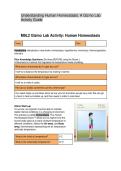
To survive, an organism must be able to maintain
stable internal conditions in a changing environment.
This process is called homeostasis. The Human
Homeostasis Gizmo™ allows you to explore how the
human body stays at a nearly constant temperature in
different conditions. Notice the Air temp. and Body
temp. thermometers representing the air temperature
and body temperature.
What is the initial air temperature? 0C
What is the initial body temperature? 37 C
, Next to each factor listed below, write “increase,” “decrease,” or “same” based on how you
expect that factor to affect body temperature.
Raising air temperature: Decrease Sweating: Decrease
Lowering air temperature: Increase Shivering: Increase
Adding clothing: Increase Exercising: increase
Activity A: Get the Gizmo ready:
Body temperature ● If necessary, click Reset ( ).
Question: What factors increase or decrease body temperature?
Observe: With the Air temp. at 0 °C (32 °F) and Body temp. at 37 °C (99 °F), click Play ( ).
After one simulated hour (does not have to be exact), click Pause ( ).
What is the body temperature after one hour? 35 C
Gather data: Fill in the first line of the data table below. Then, use the same procedure to test
the effect of each of the following factors. Click Reset between each trial. Record the initial and
final body temperatures in the table below. (Leave the last column blank.)
● Set the Exercise level to 70%. (All other settings in default position.)
● Set the Sweat level to 70%.
● Under Body position, select Shivering.
● Next to Clothing, click Add four times to add a sweatshirt, hat, pants, and parka.
Initial body Body temp. Effect of factor on body
Factor
temp. after one hour temperature
Standing still 99 97 decrease
Exercising (70%) 99 100 increase
Sweating (70%) 99 95 decrease
Shivering 99 99 no change
Adding clothing (4x) 99 99 no change
Analyze: To determine the effect of a factor on body temperature, compare the final body
temperature with that factor to the final body temperature while standing still. Based on this
comparison, fill in the last column of the data table above.
Which factor raised body temperature the most? exercising
Why do you think this process raises body temperature?
Activity Guide
M9L2 Gizmo Lab Activity: Human Homeostasis
Name: Date:
Vocabulary: dehydration, heat stroke, homeostasis, hypothermia, involuntary, thermoregulation,
voluntary
Prior Knowledge Questions (Do these BEFORE using the Gizmo.)
A thermostat is a device that regulates the temperature inside a building.
What does a thermostat do if it gets too cool?
It will try to balance the temperature by making it warmer.
What does a thermostat do if it gets too hot?
It will try to make it cooler.
How do our bodies sometimes act like a thermostat?
Our sweat helps us cool down when we are very hot and when we get very cold. We can get
a fever to heat our bodies up, and then sweat in order to cool down.
Gizmo Warm-up
To survive, an organism must be able to maintain
stable internal conditions in a changing environment.
This process is called homeostasis. The Human
Homeostasis Gizmo™ allows you to explore how the
human body stays at a nearly constant temperature in
different conditions. Notice the Air temp. and Body
temp. thermometers representing the air temperature
and body temperature.
What is the initial air temperature? 0C
What is the initial body temperature? 37 C
, Next to each factor listed below, write “increase,” “decrease,” or “same” based on how you
expect that factor to affect body temperature.
Raising air temperature: Decrease Sweating: Decrease
Lowering air temperature: Increase Shivering: Increase
Adding clothing: Increase Exercising: increase
Activity A: Get the Gizmo ready:
Body temperature ● If necessary, click Reset ( ).
Question: What factors increase or decrease body temperature?
Observe: With the Air temp. at 0 °C (32 °F) and Body temp. at 37 °C (99 °F), click Play ( ).
After one simulated hour (does not have to be exact), click Pause ( ).
What is the body temperature after one hour? 35 C
Gather data: Fill in the first line of the data table below. Then, use the same procedure to test
the effect of each of the following factors. Click Reset between each trial. Record the initial and
final body temperatures in the table below. (Leave the last column blank.)
● Set the Exercise level to 70%. (All other settings in default position.)
● Set the Sweat level to 70%.
● Under Body position, select Shivering.
● Next to Clothing, click Add four times to add a sweatshirt, hat, pants, and parka.
Initial body Body temp. Effect of factor on body
Factor
temp. after one hour temperature
Standing still 99 97 decrease
Exercising (70%) 99 100 increase
Sweating (70%) 99 95 decrease
Shivering 99 99 no change
Adding clothing (4x) 99 99 no change
Analyze: To determine the effect of a factor on body temperature, compare the final body
temperature with that factor to the final body temperature while standing still. Based on this
comparison, fill in the last column of the data table above.
Which factor raised body temperature the most? exercising
Why do you think this process raises body temperature?


