ASCP MLS FINAL EXAM STUDY GUIDE TEST.
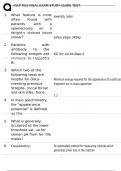
1. What feature is most Howell-Jolly bodies
often found with
patients with a
splenectomy on a
Wright's stained blood
smear? Surface antigen (HbSAg)
2. Patients with
antibody to the
following antigen are ASO titer and Anti-DNase B
immune to Hepatitis
B:
3. Which two of the
following tests are
helpful for docu- Minimum energy required for the appearance of a particula
menting previous fragment ion in mass spectrum
Strepto- coccal throat
and skin infec- tions:
7.2
4. In mass spectrometry,
the "appearance
potential" is defined
as the:
5. What is generally
accepted as the lower
threshold val- ue for
semen pH from fer- tile
males?
6. Coulometry: An automated method for measuring chloride which
generates silver ions in the reaction
1/
42
, ASCP MLS FINAL EXAM STUDY GUIDE TEST.
7. Erythroleukemia: Also known as Acute Myelogenous Leukemia type M6. This
type is
associated with either the presence of both erythroid and myelo
precursors OR strictly erythroid precursors.
8. Myelomonocytic leukemia Is associated with an increase in myeloid and monocytic
cell pre-
cursors, but not red blood cell precursors
2/
42
, ASCP MLS FINAL EXAM STUDY GUIDE TEST.
9. Species that are Lysine Enterobacter aerogenes, Edwardsiella species and most
(+), arginine (=) and Serratia species
ornithine (+):
10. Lysine reaction for all Negative
Cit- robacter:
11. Key identifying negative reactions for the three decarboxylases commonly
characteris- tic for tested ( Lysine, arginine and ornithine)
Pantoa (Enterobac- ter)
agglomerans:
Yersina entercolitica is most likely responsible for septic
12. Which organism is reactions in transfusions of Red Blood Cells. This
MOST likely responsible organism is usually ac- quired by ingestion of
for septic reactions contaminated food and causes mild symp- toms of
associated with Red abdominal pain and diarrhea. Growth of Y. entercolitica is
Blood Cell transfu- enhanced in iron-rich environments such as red cell
sions? components.
13. Gaucher's disease The most common lysosomal storage disease caused by in-
suflcient activity of the lysosomal enzyme
glucocerebrosidase that leads to the deposition of
glucocerebroside in cells of the macrophage-monocyte
system.
14. Diseases associated Chediak-Higashi syndrome (CH), Chronic granulomatous
with dysfunctions of disease (CGD), Myeloperoxidase deficiency (MPO)
polymor- phonuclear
neutrophils (PMNs)
15. Nephrotic Syndrome: Caused by damage to the kidneys, especially the basement
mem-
brane of the glomerulus; which causes abnormal
3/
42
, ASCP MLS FINAL EXAM STUDY GUIDE TEST.
excretion of protein and red blood cells in the urine. Fats
are also present in the urine in most cases. A foamy
appearance of the urine is a key characteristic of this
condition.
4/
42
1. What feature is most Howell-Jolly bodies
often found with
patients with a
splenectomy on a
Wright's stained blood
smear? Surface antigen (HbSAg)
2. Patients with
antibody to the
following antigen are ASO titer and Anti-DNase B
immune to Hepatitis
B:
3. Which two of the
following tests are
helpful for docu- Minimum energy required for the appearance of a particula
menting previous fragment ion in mass spectrum
Strepto- coccal throat
and skin infec- tions:
7.2
4. In mass spectrometry,
the "appearance
potential" is defined
as the:
5. What is generally
accepted as the lower
threshold val- ue for
semen pH from fer- tile
males?
6. Coulometry: An automated method for measuring chloride which
generates silver ions in the reaction
1/
42
, ASCP MLS FINAL EXAM STUDY GUIDE TEST.
7. Erythroleukemia: Also known as Acute Myelogenous Leukemia type M6. This
type is
associated with either the presence of both erythroid and myelo
precursors OR strictly erythroid precursors.
8. Myelomonocytic leukemia Is associated with an increase in myeloid and monocytic
cell pre-
cursors, but not red blood cell precursors
2/
42
, ASCP MLS FINAL EXAM STUDY GUIDE TEST.
9. Species that are Lysine Enterobacter aerogenes, Edwardsiella species and most
(+), arginine (=) and Serratia species
ornithine (+):
10. Lysine reaction for all Negative
Cit- robacter:
11. Key identifying negative reactions for the three decarboxylases commonly
characteris- tic for tested ( Lysine, arginine and ornithine)
Pantoa (Enterobac- ter)
agglomerans:
Yersina entercolitica is most likely responsible for septic
12. Which organism is reactions in transfusions of Red Blood Cells. This
MOST likely responsible organism is usually ac- quired by ingestion of
for septic reactions contaminated food and causes mild symp- toms of
associated with Red abdominal pain and diarrhea. Growth of Y. entercolitica is
Blood Cell transfu- enhanced in iron-rich environments such as red cell
sions? components.
13. Gaucher's disease The most common lysosomal storage disease caused by in-
suflcient activity of the lysosomal enzyme
glucocerebrosidase that leads to the deposition of
glucocerebroside in cells of the macrophage-monocyte
system.
14. Diseases associated Chediak-Higashi syndrome (CH), Chronic granulomatous
with dysfunctions of disease (CGD), Myeloperoxidase deficiency (MPO)
polymor- phonuclear
neutrophils (PMNs)
15. Nephrotic Syndrome: Caused by damage to the kidneys, especially the basement
mem-
brane of the glomerulus; which causes abnormal
3/
42
, ASCP MLS FINAL EXAM STUDY GUIDE TEST.
excretion of protein and red blood cells in the urine. Fats
are also present in the urine in most cases. A foamy
appearance of the urine is a key characteristic of this
condition.
4/
42