Garantie de satisfaction à 100% Disponible immédiatement après paiement En ligne et en PDF Tu n'es attaché à rien 4,6 TrustPilot
logo-home
Notes de cours

Opgeloste EXAMENvragen proefdierkunde I

Vendu
27
Pages
37
Publié le
23-12-2014
Écrit en
2013/2014

Samenvatting van alle lessen van de gastprofessoren en antwoorden op vragen waaruit zeker de examenvragen zullen komen.

Aperçu du contenu

Proefdierkunde I
1. Introduction: the use of laboratory animals
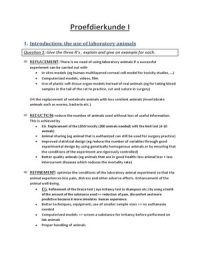
Question 1: Give the three R’s , explain and give an example for each.

 REPLACEMENT: There is no need of using laboratory animals if a successful
experiment can be carried out with
 In vitro models (eg human multilayered corneal cell model for toxicity studies, …)
 Computerized models, videos, film
 Use of plastic soft-tissue organ models instead of real animals (eg for taking blood
samples in the tail of the rat to practice, cut and suture in surgery)

OR the replacement of vertebrate animals with less sentient animals (invertebrate
animals such as worms, bacteria etc.)

 REDUCTION: reduce the number of animals used without loss of useful information.
This is achieved by
 EG. Replacement of the LD50 toxicity (200 animals needed) with the limit test (6-10
animals)
 Animal sharing (eg animal that is euthanized can still be used for surgery practice)
 Improved statistical design (eg reduce the number of variables through good
experimental design by using genetically homogenous animals or by ensuring that
the conditions of the experiment are rigorously controlled)
 Better quality animals (eg animals that are in good health: less animal loss + less
intercurrent diseases which reduces the mortality rate)

 REFINEMENT: optimize the conditions of the laboratory animal experiment so that the
animal experiences less pain, distress and other adverse effects. Enhancement of the
animal well-being.
 EG. Refinement of the Draize test ( eye irritancy test to shampoos etc.) by using a tenth
of the amount of the substance used => reduction of pain, discomfort and more
predictive because it more simulates human experience.
 Better techniques, equipment, use of smaller sample sizes => no euthanasia
needed
 Computerized models => screen a substance for irritancy before performed on
lab animals
 Proper handling of animals

,  Proper housing of animals with all animal needs supplied (space, environmental
enrichment). Eg. New caging allow monkeys to live in groups, reducing the stress
level in these highly social animals.

ICLAS: International Council for Laboratory Animal Science

Aim: enhance international collaboration in the field of laboratory animal science


2. Taxonomy of vertebrates
Taxonomy = Classification into hierarchically nested groups based on shared characteristics and
giving names to those groups

Fylogenie = de studie van de ontstaansgeschiedenis van een groep organismen, hoe de ene groep uit
de andere is ontstaan

Linnaen taxonomy = Classification into groups based on morfologische eigenschappen (polytomous
subdivision + paraphyletic grouping allowed; one ancestor of the taxon can have more descendants
belonging to other taxa)

Cladistics = Classification into groups based on one or more shared characteristics that come from
the group’s last common ancestor (dichotomous subdivision + monophyletic grouping; single
ancestor for all members of the clade )

Question 1: Give the taxonomic classification of the rabbit, mouse, guinea pig,
dog, rhesus monkey and monkey or sheep.

a) RABBIT
Unranked: Glires
Order: Lagomorpha (lagos: hair)
Family: Leporidae (lepus: hair)
Genus: Oryctolagus
Species: Oryctolagus cuniculus

Toepassing: antiserum productie, alternatief rodents, eye irritancy

b) MOUSE
Order: Rodentia
Suborder: Myomorpha (old world rodents: fast breeders, born naked)
Superfamily: Muroidea
Family: Muridae
Subfamily: Murinae
Genus: Mus
Species: Mus musculus

, Toepassing : multipurpose animal model (ease of maintenance and handling, fast reproduction, fully
sequenced genome)

c) GUINEA PIG
Order: Rodentia
Suborder: Hystricomorpha (Hystrix: jaw) (New world rodents: born with hair)
Superfamily: Cavioidea
Family: Caviidae
Subfamily: Caviinae
Genus: cavia
Species: cavia porcellus


Toepassing: vitamin c en foliumzuur dependency, gelijkaardig immuunsysteem

d) Rhesus Monkey
Order: Primates
Suborder: Haplorrhini (haplo rhinos: single nose)
Infraorder: Simiiformes (simius: ape, monkey)
Parvorder: Catarrhini (kata rhinos: downward nose)
Superfamily: Cercopithecoidea
Family: Cercopithecidae (monkey with tail: old world monkeys)
Genus: macaca
Species: macaca mulatta OF macaca fascicularis


e) Chimpanzee
Order: Primates
Suborder: Haplorrhini (haplo rhinos: single nose)
Infraorder: Simiiformes (simius: ape, monkey)
Parvorder: Catarrhini (kata rhinos: downward nose)
Superfamily: Hominidae
Subfamily : Homininae
Genus : pan
Species : pan troglodytes
Species : pan paniscus (bonobo)

f) Varken
Order: Artiodactyla
Suborder: Suina
Family : Suinae
Tribe : suini
Genus : sus
Species: sus scrofa
Subspecies: sus scrofa domestica

Infos sur le Document

Publié le
23 décembre 2014
Nombre de pages
37
Écrit en
2013/2014
Type
Notes de cours
Professeur(s)
K. hermans
Contient
Toutes les classes

Sujets

€10,99
Accéder à l'intégralité du document:

Garantie de satisfaction à 100%
Disponible immédiatement après paiement
En ligne et en PDF
Tu n'es attaché à rien

Reviews from verified buyers

Affichage de tous les 2 avis
8 année de cela

9 année de cela

These are more relevant but lacking some questions. Also mixture of English and Dutch.

3,0

2 revues

5
0
4
0
3
2
2
0
1
0
Avis fiables sur Stuvia

Tous les avis sont réalisés par de vrais utilisateurs de Stuvia après des achats vérifiés.

Faites connaissance avec le vendeur

Seller avatar
Les scores de réputation sont basés sur le nombre de documents qu'un vendeur a vendus contre paiement ainsi que sur les avis qu'il a reçu pour ces documents. Il y a trois niveaux: Bronze, Argent et Or. Plus la réputation est bonne, plus vous pouvez faire confiance sur la qualité du travail des vendeurs.
MichaelM Universiteit Gent
Voir profil
S'abonner Vous devez être connecté afin de suivre les étudiants ou les cours
Vendu
85
Membre depuis
11 année
Nombre de followers
51
Documents
2
Dernière vente
3 année de cela

Ik ben een laatstejaarsstudent Bio-Ingenieur die in academiejaar 2013-2014 twee keuzevakken gevolgd heb aan de faculteit Diergeneeskunde (Proefdierkunde I en II). Voor deze vakken had ik een samenvatting gemaakt met antwoorden op voorbeeld examenvragen die online stonden. Na geslaagd te zijn voor beide vakken besloot ik mijn samenvattingen te verkopen op internet. Hierbij vermeld ik graag dat ik ook open sta om andere samenvattingen te maken van bepaalde vakken indien mij dit gevraagd wordt.

Lire la suite Lire moins
3,3

4 revues

5
1
4
0
3
2
2
1
1
0

Documents populaires

Pourquoi les étudiants choisissent Stuvia

Créé par d'autres étudiants, vérifié par les avis

Une qualité sur laquelle compter : rédigé par des étudiants qui ont réussi et évalué par d'autres qui ont utilisé ce document.

Le document ne convient pas ? Choisis un autre document

Aucun souci ! Tu peux sélectionner directement un autre document qui correspond mieux à ce que tu cherches.

Paye comme tu veux, apprends aussitôt

Aucun abonnement, aucun engagement. Paye selon tes habitudes par carte de crédit et télécharge ton document PDF instantanément.

Student with book image

“Acheté, téléchargé et réussi. C'est aussi simple que ça.”

Alisha Student

Foire aux questions