CHAPTER 34 MEDICATION ADMINISTRATION EXAM WITH CORRECT ANSWERS #8
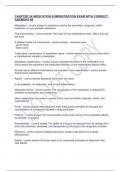
Medication - correct answer A substance used in the prevention, diagnosis, relief, treatment, or cure of health alterations
Pharmacokinetics - correct answer The study of how medications enter, affect, and exit the body
3 different names of medications - correct answer - chemical name
- given name
- trade name
Tradename, brand-name, or proprietary name - correct answer is the name under which
a manufacturer markets a medication
Meditation classification - correct answer Indicates the effect of the medication on a body system the symptoms the medication relieves, or the medications desired effect
At least seven different medications are included in this classification - correct answer Sulfonylurea classification
Aspirin - correct answer Belong to more than one class
Is an analgesic, an antipyretic, and an anti inflammatory
Medication forms - correct answer The composition of the medication is designed to enhance its absorption and metabolism.
Many medications are made in several forms, such as tablets, capsules, elixirs, and suppositories.
Purity - correct answer Manufacturers must meet purity standards for the type and concentration of substances allowed in drug production
Potency - correct answer The concentration of the active drug in the preparation affects its strength, or potency
Bioavailability - correct answer The ability of a drug to be released from its dosage form and to be dissolved, absorbed, and transported by the body to the drugs site of action.
Efficiancy - correct answer Detailed laboratory studies help determine a drugs effectiveness
Safety - correct answer All drugs need to be continually evaluated to determine their side effects Before a new drug can be marketed in Canada, and application for approval must be made to this - correct answer Health protection branch (HPB)
Violations of this are punishable by fines, imprisonment, and loss of your nursing license
or your nursing registration - correct answer Narcotic control act
Pharmacokinetics - correct answer Is the study of how medications into the body, reach their site of action, metabolize, and exit the body.
Absorption - correct answer Refers to the passage of medication molecules into the blood from the medications site of administration.
Orally administered medications - correct answer Must pass through the gastrointestinal, G.I., tracked to be absorbed, the overall rate of absorption is usually slow.
Intravenous, I V injection - correct answer Produces the most rapid absorption because this route to provide immediate access to the systemic circulation
Ability of the medication to dissolve - correct answer depends on its form of preparation
Blood flow to the site of administration - correct answer when the site of administration contains a rich blood supply, the body absorbs medications more rapidly
Body surface area - correct answer When a medication is in contact with a large surface
area, the medication will be absorbed at a faster rate
Lipid solubility of the medication - correct answer Highly lipid soluble medications easily cross the cell membrane and I absorbed quickly
Distribution - correct answer After medication is absorbed by the body, it is distributed to
the tissues and organs and see what specific site of action
Circulation - correct answer After medication enters the bloodstream, it is carried throughout the body's tissues and organs, the speed at which it reaches the site depends on the vascular content of the tissues and organs.
Membrane permeability - correct answer For medication to be distributed it into an Organ it must pass through all the organs tissues and biological membranes.
Protein binding - correct answer Most medications bind to proteins to some extent. The degree to which medications bind to the serum proteins, such as albumin, affect the medications distribution
Medication - correct answer A substance used in the prevention, diagnosis, relief, treatment, or cure of health alterations
Pharmacokinetics - correct answer The study of how medications enter, affect, and exit the body
3 different names of medications - correct answer - chemical name
- given name
- trade name
Tradename, brand-name, or proprietary name - correct answer is the name under which
a manufacturer markets a medication
Meditation classification - correct answer Indicates the effect of the medication on a body system the symptoms the medication relieves, or the medications desired effect
At least seven different medications are included in this classification - correct answer Sulfonylurea classification
Aspirin - correct answer Belong to more than one class
Is an analgesic, an antipyretic, and an anti inflammatory
Medication forms - correct answer The composition of the medication is designed to enhance its absorption and metabolism.
Many medications are made in several forms, such as tablets, capsules, elixirs, and suppositories.
Purity - correct answer Manufacturers must meet purity standards for the type and concentration of substances allowed in drug production
Potency - correct answer The concentration of the active drug in the preparation affects its strength, or potency
Bioavailability - correct answer The ability of a drug to be released from its dosage form and to be dissolved, absorbed, and transported by the body to the drugs site of action.
Efficiancy - correct answer Detailed laboratory studies help determine a drugs effectiveness
Safety - correct answer All drugs need to be continually evaluated to determine their side effects Before a new drug can be marketed in Canada, and application for approval must be made to this - correct answer Health protection branch (HPB)
Violations of this are punishable by fines, imprisonment, and loss of your nursing license
or your nursing registration - correct answer Narcotic control act
Pharmacokinetics - correct answer Is the study of how medications into the body, reach their site of action, metabolize, and exit the body.
Absorption - correct answer Refers to the passage of medication molecules into the blood from the medications site of administration.
Orally administered medications - correct answer Must pass through the gastrointestinal, G.I., tracked to be absorbed, the overall rate of absorption is usually slow.
Intravenous, I V injection - correct answer Produces the most rapid absorption because this route to provide immediate access to the systemic circulation
Ability of the medication to dissolve - correct answer depends on its form of preparation
Blood flow to the site of administration - correct answer when the site of administration contains a rich blood supply, the body absorbs medications more rapidly
Body surface area - correct answer When a medication is in contact with a large surface
area, the medication will be absorbed at a faster rate
Lipid solubility of the medication - correct answer Highly lipid soluble medications easily cross the cell membrane and I absorbed quickly
Distribution - correct answer After medication is absorbed by the body, it is distributed to
the tissues and organs and see what specific site of action
Circulation - correct answer After medication enters the bloodstream, it is carried throughout the body's tissues and organs, the speed at which it reaches the site depends on the vascular content of the tissues and organs.
Membrane permeability - correct answer For medication to be distributed it into an Organ it must pass through all the organs tissues and biological membranes.
Protein binding - correct answer Most medications bind to proteins to some extent. The degree to which medications bind to the serum proteins, such as albumin, affect the medications distribution