Summary Inorganic Chemistry
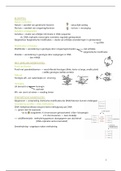
1. Structure of metal complexes
Chapter 1:
Group-state electron configuration: specification of the orbital occupation of an atom in its lowest
energy state
- Pauli exclusion principle: no more than two electrons may occupy a single orbital and, if two
do occupy a single orbital, than their spins must be paired
- Nuclear charge experienced by an electron is reduced because of shielding by other electrons
- s<p<d<f
- Effective nuclear charge: reduced the actual charge of the nucleus
- Shielding: the reduction of the true nuclear charge to the effective nuclear charge by other
electrons
- Penetration: the potential for the presence of an electron inside shells of other electrons
Aufbau principle: a procedure that leads to plausible ground-state configurations
- Hund’s rule: when more than one orbital has the same energy,
electrons occupy separate orbitals and do so with parallel spins
- Spin correlation: the requirement of parallel spins for electrons
that do occupy different orbitals
- Exchange energy: an additional factor that stabilizes
arrangements of electrons with parallel spins
- Closed shell: a shell with its full complement of electrons
- In some cases a lower energy may b e obtained by forming a
half-filled or filled d subshell (there might be an s electron
moving into the d subshell
d5s1 rather than d4s2 , d10s1 rather than d9s2, d10s0 rather than d8s2 (same for f)
Classification of elements:
- Metal: lustrous, malleable, ductile, electrically conducting solid at about room temperature
- Non-metal: gases, liquid or solids that do not conduct electricity appreciably
- Combine:
- Metal – non-metal: compounds that are hard, non-volatile solids
- Non-metal – non-metal: volatile molecular compounds
- Metal-metal: alloys that have most of physical characteristics of metals
- Metalloids: elements that have properties which make it difficult to classify them as metals or
non-metals
Atomic properties: show regular periodic variations with atomic number
a. Atomic and ionic radii
- Atomic radii increase down a group and decreases from left to right
- Highest at bottom left
b. Ionization energy
- Highest at upper right
- Successive ionizations of a species require higher energies
c. Electron affinity
- Highest for elements near fluorine in the periodic table
d. Electronegativity
- The electronegativity of an elements is the power of an atom of the element to attract
electrons when it is part of a compound
- Highest at upper right
1. Structure of metal complexes
Chapter 1:
Group-state electron configuration: specification of the orbital occupation of an atom in its lowest
energy state
- Pauli exclusion principle: no more than two electrons may occupy a single orbital and, if two
do occupy a single orbital, than their spins must be paired
- Nuclear charge experienced by an electron is reduced because of shielding by other electrons
- s<p<d<f
- Effective nuclear charge: reduced the actual charge of the nucleus
- Shielding: the reduction of the true nuclear charge to the effective nuclear charge by other
electrons
- Penetration: the potential for the presence of an electron inside shells of other electrons
Aufbau principle: a procedure that leads to plausible ground-state configurations
- Hund’s rule: when more than one orbital has the same energy,
electrons occupy separate orbitals and do so with parallel spins
- Spin correlation: the requirement of parallel spins for electrons
that do occupy different orbitals
- Exchange energy: an additional factor that stabilizes
arrangements of electrons with parallel spins
- Closed shell: a shell with its full complement of electrons
- In some cases a lower energy may b e obtained by forming a
half-filled or filled d subshell (there might be an s electron
moving into the d subshell
d5s1 rather than d4s2 , d10s1 rather than d9s2, d10s0 rather than d8s2 (same for f)
Classification of elements:
- Metal: lustrous, malleable, ductile, electrically conducting solid at about room temperature
- Non-metal: gases, liquid or solids that do not conduct electricity appreciably
- Combine:
- Metal – non-metal: compounds that are hard, non-volatile solids
- Non-metal – non-metal: volatile molecular compounds
- Metal-metal: alloys that have most of physical characteristics of metals
- Metalloids: elements that have properties which make it difficult to classify them as metals or
non-metals
Atomic properties: show regular periodic variations with atomic number
a. Atomic and ionic radii
- Atomic radii increase down a group and decreases from left to right
- Highest at bottom left
b. Ionization energy
- Highest at upper right
- Successive ionizations of a species require higher energies
c. Electron affinity
- Highest for elements near fluorine in the periodic table
d. Electronegativity
- The electronegativity of an elements is the power of an atom of the element to attract
electrons when it is part of a compound
- Highest at upper right