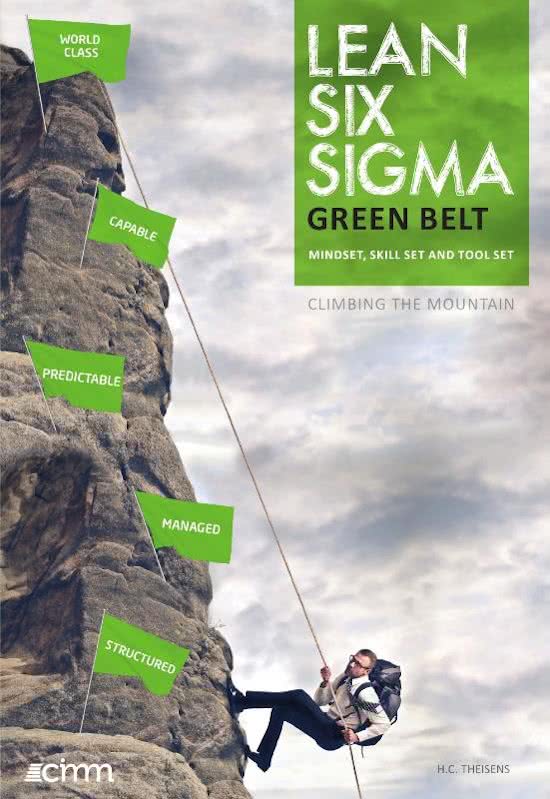
Summary Lean Six Sigma Green Belt Climbing The Mountain
0 Preface
Increasing customer requirements:
Shorter Lead Times Process Improvement (innovation, order & supply chain, customer service)
Increasing Quality Expectations Tighter Quality Control
Price Willingness to pay evolving with Demand and Time in Market
Continuous Improvement Maturity Model (CIMM): best practices of Process Improvement (1), Quality
Management (2) and New Product Development (3), maintained by Lean Six Sigma Academy (LSSA).
Lean manufacturing, focussing on speed and efficiency thru stability and elimination of Waste (Muda).
Kaizen, small improvement steps (organized at the work floor).
Theory of Constraint (ToC).
Total Quality Management (TQM).
Total Productive Maintenance (TPM).
Six Sigma, focusing on improved effectiveness (lead time) and process quality by reducing variation (removal
of errors).
Determine the Operation Excellence Level before starting improvement (up to World Class performance)!
1 World Class Performance
Highest level a company can reach within its sector by developing new products & services that exceed
customer expectation in a very short time-to-market.
Best in world products & services.
Production and delivery processes performing at Operational Excellence
Organisation should continuously improve processes.
Organisation should be Innovative, Agile and have a high ability of Renewal.
1.1 Competitive Strategies
1.1.1 Operational Excellence, Customer Intimacy & Product Leadership
Customer Intimacy:
Focusses on offering a unique product or service to the market.
Thru: personalization of services, customization of products, bundling into a ‘solution’.
Requires: decentralized organisation to change according to customer needs and high flexibility design of
development, delivery and support processes.
Typical companies: construction, IT, development, retail, recreation.
Operational Excellence:
Focusses on delivering to customer expectation, without failures, on time, in a cost-efficient manner.
Thru: ongoing improvement of organisation thru problem solving, teamwork, and leadership.
Requires: centralized leadership, strong organisational
discipline, standardised rule-based operation.
Involves: focus on customer needs, keeping employees
positive and empowered, continuous improvement of
activities.
Typical companies: high-volume and
transaction-oriented, operating in Highest Quality
mature and commoditized market. Lowest Cost
Right Time
Product Leadership:
Focusses on continuously offering superior products to the market.
Allows to achieve premium market prices thanks to customer experience.
Typical companies: automotive, consumer electronics, pharmaceutical, fund management.
Market leaders typically excel in one (few in two) of the three.
, Summary Lean Six Sigma Green Belt Climbing The Mountain
1.1.2 Physical vs Transactional processes
Transactional processes (services) Physical processes (manufacturing)
Stronger need for fast adaptability (customer needs
change more frequently).
Inventory less visible (Work In Progress has the form of
electronic data and correspondence).
Electronic processes may be dispersed on computer Manufacturing processes tend to be more
systems in different locations. centralised in one location.
Maintenance related to systems and data availability. Maintenance related to equipment and tooling.
More waiting time as a consequence of several process-
approval steps and lack of WIP controls and FIFO.
Less data driven, (customer) decisions often based on
opinions rather than facts.
Quality evaluated by subjective metrics like customer Quality evaluated by objective metrics collected
satisfaction and complaints. during processing.
Defects rather invisible and not evident until Product quality varies more between good and
experienced by customer, quality often good or bad. bad.
Data often discrete (e.g. # defects). Some tools (like Data more continuous (with mean or standard
Measurement System Analysis and Design of deviation)
Experiments) more difficult to apply.
People in service organisations tend to have less affinity
with statistical analysis.
Improvement programs are associated with change.
1.2 History of Continuous Improvement
Common goals between TQM, Lean and Six Sigma:
Time Reduction (greater speed)
Operational Cost Reduction (more bottom line impact)
Quality Improvement (less variation)
1.2.1 History TQM, Lean and Six Sigma
History of Quality Management:
Ford: Assembly line technique of mass production – standardization of design and component
standards, inspections of product output by Quality department.
Shewhart: Statistical Quality Control – control chart, Statistical Process Control (SPC), PDCA circle.
Fischer: Foundation of statistical science – Analysis of Variance (ANOVA) and Design of Experiments
(DOE).
Juran: Trilogy (quality planning, control & improvement), Cost of Poor Quality (COPQ), Vital Few vs.
Useful Many, Pareto (80/20).
Deming: SPC, PDCA, Prize for quality.
Imai: Kaizen.
History of Lean Manufacturing:
Started with Henri Ford: Standardised Work (flow production) and interchangeable parts (not able to
provide variety - T-Ford).
Toyota Production System (TPS) – Just-In-Time (JIT) philosophy, Pull concept, Jidoka (addressing high
cost of inventory).
History of Six Sigma:
Foundation by Motorola engineers captured in Six Sigma quality program, finding and resolving defects
by process capability, tolerance, critical-to-quality characteristics, design margins.
Embraced amongst others by General Electric.
2 of 63
, Summary Lean Six Sigma Green Belt Climbing The Mountain
1.3 Philosophy and principles
1.3.1 Value and foundations of and Six Sigma
Lean: approach used to achieve improved efficiency and process velocity through the ‘relentless pursuit of
the elimination of Waste’.
Six Sigma: approach used to achieve improved effectiveness and process quality by reducing variation.
1.3.2 Lean principles
1. Value: Define what is of value to the customer.
2. Value Stream: Identify the value stream and eliminate Waste.
3. Flow: Create a constant flow.
4. Pull: Deliver based on demand.
5. Perfection: Continuously improve the process.
Toyota Production System, the 4 P´s of Lean:
Problem Solving:
Continuous improvement &
learning
People & Partners:
Respect-Challenge-Grow
Process: Eliminate
Waste
Philosophy: Long
term thinking!
The 14 principles:
Philosophy:
1. Base your decisions on long term philosophy, even at the expense of short term financial goals.
Process:
2. Create a process flow to surface problems.
3. Use Pull systems to avoid overproduction.
4. Level out the workload (Heijunka).
5. Stop when there is a quality problem (Jidoka).
6. Standardize tasks for continuous improvement.
7. Use visual control so no problems are hidden.
8. Use only reliable, thoroughly tested technology.
People & Partners:
9. Create leaders who live the philosophy.
10. Respect, develop and challenge your people and teams.
11. Respect, challenge and help your suppliers.
Problem solving:
12. Go see for yourself to thoroughly understand the situation.
13. Make decisions slowly by consensus, thoroughly considering all options, implement decisions rapidly.
14. Become a learning organisation through relentless reflection (Hansei) and Continuous Improvement
(Kaizen).
3 of 63
0 Preface
Increasing customer requirements:
Shorter Lead Times Process Improvement (innovation, order & supply chain, customer service)
Increasing Quality Expectations Tighter Quality Control
Price Willingness to pay evolving with Demand and Time in Market
Continuous Improvement Maturity Model (CIMM): best practices of Process Improvement (1), Quality
Management (2) and New Product Development (3), maintained by Lean Six Sigma Academy (LSSA).
Lean manufacturing, focussing on speed and efficiency thru stability and elimination of Waste (Muda).
Kaizen, small improvement steps (organized at the work floor).
Theory of Constraint (ToC).
Total Quality Management (TQM).
Total Productive Maintenance (TPM).
Six Sigma, focusing on improved effectiveness (lead time) and process quality by reducing variation (removal
of errors).
Determine the Operation Excellence Level before starting improvement (up to World Class performance)!
1 World Class Performance
Highest level a company can reach within its sector by developing new products & services that exceed
customer expectation in a very short time-to-market.
Best in world products & services.
Production and delivery processes performing at Operational Excellence
Organisation should continuously improve processes.
Organisation should be Innovative, Agile and have a high ability of Renewal.
1.1 Competitive Strategies
1.1.1 Operational Excellence, Customer Intimacy & Product Leadership
Customer Intimacy:
Focusses on offering a unique product or service to the market.
Thru: personalization of services, customization of products, bundling into a ‘solution’.
Requires: decentralized organisation to change according to customer needs and high flexibility design of
development, delivery and support processes.
Typical companies: construction, IT, development, retail, recreation.
Operational Excellence:
Focusses on delivering to customer expectation, without failures, on time, in a cost-efficient manner.
Thru: ongoing improvement of organisation thru problem solving, teamwork, and leadership.
Requires: centralized leadership, strong organisational
discipline, standardised rule-based operation.
Involves: focus on customer needs, keeping employees
positive and empowered, continuous improvement of
activities.
Typical companies: high-volume and
transaction-oriented, operating in Highest Quality
mature and commoditized market. Lowest Cost
Right Time
Product Leadership:
Focusses on continuously offering superior products to the market.
Allows to achieve premium market prices thanks to customer experience.
Typical companies: automotive, consumer electronics, pharmaceutical, fund management.
Market leaders typically excel in one (few in two) of the three.
, Summary Lean Six Sigma Green Belt Climbing The Mountain
1.1.2 Physical vs Transactional processes
Transactional processes (services) Physical processes (manufacturing)
Stronger need for fast adaptability (customer needs
change more frequently).
Inventory less visible (Work In Progress has the form of
electronic data and correspondence).
Electronic processes may be dispersed on computer Manufacturing processes tend to be more
systems in different locations. centralised in one location.
Maintenance related to systems and data availability. Maintenance related to equipment and tooling.
More waiting time as a consequence of several process-
approval steps and lack of WIP controls and FIFO.
Less data driven, (customer) decisions often based on
opinions rather than facts.
Quality evaluated by subjective metrics like customer Quality evaluated by objective metrics collected
satisfaction and complaints. during processing.
Defects rather invisible and not evident until Product quality varies more between good and
experienced by customer, quality often good or bad. bad.
Data often discrete (e.g. # defects). Some tools (like Data more continuous (with mean or standard
Measurement System Analysis and Design of deviation)
Experiments) more difficult to apply.
People in service organisations tend to have less affinity
with statistical analysis.
Improvement programs are associated with change.
1.2 History of Continuous Improvement
Common goals between TQM, Lean and Six Sigma:
Time Reduction (greater speed)
Operational Cost Reduction (more bottom line impact)
Quality Improvement (less variation)
1.2.1 History TQM, Lean and Six Sigma
History of Quality Management:
Ford: Assembly line technique of mass production – standardization of design and component
standards, inspections of product output by Quality department.
Shewhart: Statistical Quality Control – control chart, Statistical Process Control (SPC), PDCA circle.
Fischer: Foundation of statistical science – Analysis of Variance (ANOVA) and Design of Experiments
(DOE).
Juran: Trilogy (quality planning, control & improvement), Cost of Poor Quality (COPQ), Vital Few vs.
Useful Many, Pareto (80/20).
Deming: SPC, PDCA, Prize for quality.
Imai: Kaizen.
History of Lean Manufacturing:
Started with Henri Ford: Standardised Work (flow production) and interchangeable parts (not able to
provide variety - T-Ford).
Toyota Production System (TPS) – Just-In-Time (JIT) philosophy, Pull concept, Jidoka (addressing high
cost of inventory).
History of Six Sigma:
Foundation by Motorola engineers captured in Six Sigma quality program, finding and resolving defects
by process capability, tolerance, critical-to-quality characteristics, design margins.
Embraced amongst others by General Electric.
2 of 63
, Summary Lean Six Sigma Green Belt Climbing The Mountain
1.3 Philosophy and principles
1.3.1 Value and foundations of and Six Sigma
Lean: approach used to achieve improved efficiency and process velocity through the ‘relentless pursuit of
the elimination of Waste’.
Six Sigma: approach used to achieve improved effectiveness and process quality by reducing variation.
1.3.2 Lean principles
1. Value: Define what is of value to the customer.
2. Value Stream: Identify the value stream and eliminate Waste.
3. Flow: Create a constant flow.
4. Pull: Deliver based on demand.
5. Perfection: Continuously improve the process.
Toyota Production System, the 4 P´s of Lean:
Problem Solving:
Continuous improvement &
learning
People & Partners:
Respect-Challenge-Grow
Process: Eliminate
Waste
Philosophy: Long
term thinking!
The 14 principles:
Philosophy:
1. Base your decisions on long term philosophy, even at the expense of short term financial goals.
Process:
2. Create a process flow to surface problems.
3. Use Pull systems to avoid overproduction.
4. Level out the workload (Heijunka).
5. Stop when there is a quality problem (Jidoka).
6. Standardize tasks for continuous improvement.
7. Use visual control so no problems are hidden.
8. Use only reliable, thoroughly tested technology.
People & Partners:
9. Create leaders who live the philosophy.
10. Respect, develop and challenge your people and teams.
11. Respect, challenge and help your suppliers.
Problem solving:
12. Go see for yourself to thoroughly understand the situation.
13. Make decisions slowly by consensus, thoroughly considering all options, implement decisions rapidly.
14. Become a learning organisation through relentless reflection (Hansei) and Continuous Improvement
(Kaizen).
3 of 63