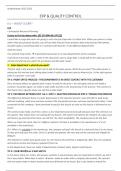
ERP - samenvatting - Businness Processes
ERP Control and Business Processes (Arteveldehogeschool)
,Business processes
1 Introduction: what is ERP p.1-35
1.1 Definition
ERP = Enterprise Resource Planning
= business processes are used to organize and streamline activities.
In the first place we need to make decisions, but on the other hand it’s necessary to communicate
with customers and suppliers, and maybe even more with them than internally.
All those activities only make sense when they add value
- We need to streamline these activities in the best possible way
- The process needs to be robust
Successful companies mainly look at how activities run. The purchase process is more than the
only the purchase department with his purchase process. There are other departments that needs
to be involved in the purchase process to optimize it.
“Examples 1, 2 & 3 book p 12-13”
Two important terms are “process innovation” and “process improvement”. They are 2 separate
dimensions in the change of your process from its current to its new state.
Innovation:
Is a thorough and structural change in the way in which you work.
- Refers to a new technology or new working style
Innovation is expected to lead to improvement and if this is not immediately, then at least at long
term.
Improvement:
Efficiency and effectiveness. By improvement we mean a positive effect with at least one of them
and preferably both.
- Efficiency: use the means to a good end
- More result, same means: use a car for transport to work. For each vacant seat, you
take someone with you. Or you use your car as a multimodal means of transportation: take
a bicycle out of your car and use it for your “last mile”-transport.
- Same result, less means: the example of the car with a start-stop. You save fuel with it.
- Effectivity: improve the result as such to better fit your customer’s expectations. Compare the
result that you produce vs. your customer’s expectation.
1. More efficiency leads to more effectiveness:
An example of this is if you check out in an online store and you have a high payment the
site/ company says you don’t need to pay for the transportation costs.
- Efficiency improvement for the supplier
- Effectively for the customer
The customer will automatically come back and buy more on the site.
2. More efficiency and yet loss of effectiveness
Decreasing the profit margin of the supplier will sometimes lead a chance of customer and
maybe you will lose your supplier.
3. More effectiveness without efficiency change
You do not always need to cut costs or improve product’s efficiency in order to see a rise in
effectiveness.
Examples p16-17.
TCO= Total Costs of Ownership.
, Innovation
Temporarily
Ideal
acceptable
Process works
less efficient or Process
effective then improveme
before nt
Avoid Very good
Use outdated
1.2 Processes techniques
Processes are tailor made for your company.
1. When you go shopping physically the process of becoming the owner of the product is a bit
different then when you would shop online.
a. In the store you take the product, go to the cashier, give her the money and you’re the
owner of the products
b. On an online store, you select your products and put them in your virtual shopping car,
and you buy them. You are now owner of the product, but you didn’t have them. They
need to be shipped to you first.
2. Getting the goods to the customer can be done in different ways but the result will stay the
same. The company can bring the goods to the customer himself or he can outsource it.
1.2.1 Most widely used processes
The sales process wants to structure the interaction with the customer.
- Objective: dissipate orders from customers and deliver and invoice them to earn
money
The purchase process focuses on suppliers
The planning process: Planning department will determine what, how much and when
goods need to be bought and produced.
The production process transforms raw materials into semi-finished and finally a finished
product, ready to deliver to customer.
Sales, purchase & production = operational processes
Logistics, HR, bookkeeping = supporting processes
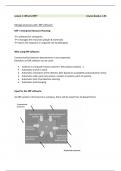
All of the departments become together. They all have a
different job, but all do their different job in one program/
system.
a schedule to help study
Sales - Sales orders
- Customer
information
- Sales prices
Production - Products
- Product structure
HR - Employees
- Salaries
- Hours worked
Purchase - Suppliers
- Prices of parts
Logistics - Input & output
, - Registration(stock
keeping)
Bookkeepi - P&L
ng - Invoice making
Everyone is feeding the system
the system will only work if
everyone inputs the correct
data SOD
1.3 Process configuration
1.3.1 SOD = Segregation of
Duty’s
Not everyone can see
everything (everybody has an
own login and with that login
you receive limited abilities in
the system)
- Different persons per
transaction (everyone
has one duty)
- Documentation
- Physical
- Financial
1.3.2 Master Data
Management
Much information is getting in
the system
Keep control
Master Data Management Team the only that can change all the data can’t do
transactions
- WHY?
o No double entries
o Understand significances of every field
o Correct sequence of entrance
Know exactly how the system works
=> login and only access to the modules you need, no more and no less
A lot of DATA in 1 database
ERP Control and Business Processes (Arteveldehogeschool)
,Business processes
1 Introduction: what is ERP p.1-35
1.1 Definition
ERP = Enterprise Resource Planning
= business processes are used to organize and streamline activities.
In the first place we need to make decisions, but on the other hand it’s necessary to communicate
with customers and suppliers, and maybe even more with them than internally.
All those activities only make sense when they add value
- We need to streamline these activities in the best possible way
- The process needs to be robust
Successful companies mainly look at how activities run. The purchase process is more than the
only the purchase department with his purchase process. There are other departments that needs
to be involved in the purchase process to optimize it.
“Examples 1, 2 & 3 book p 12-13”
Two important terms are “process innovation” and “process improvement”. They are 2 separate
dimensions in the change of your process from its current to its new state.
Innovation:
Is a thorough and structural change in the way in which you work.
- Refers to a new technology or new working style
Innovation is expected to lead to improvement and if this is not immediately, then at least at long
term.
Improvement:
Efficiency and effectiveness. By improvement we mean a positive effect with at least one of them
and preferably both.
- Efficiency: use the means to a good end
- More result, same means: use a car for transport to work. For each vacant seat, you
take someone with you. Or you use your car as a multimodal means of transportation: take
a bicycle out of your car and use it for your “last mile”-transport.
- Same result, less means: the example of the car with a start-stop. You save fuel with it.
- Effectivity: improve the result as such to better fit your customer’s expectations. Compare the
result that you produce vs. your customer’s expectation.
1. More efficiency leads to more effectiveness:
An example of this is if you check out in an online store and you have a high payment the
site/ company says you don’t need to pay for the transportation costs.
- Efficiency improvement for the supplier
- Effectively for the customer
The customer will automatically come back and buy more on the site.
2. More efficiency and yet loss of effectiveness
Decreasing the profit margin of the supplier will sometimes lead a chance of customer and
maybe you will lose your supplier.
3. More effectiveness without efficiency change
You do not always need to cut costs or improve product’s efficiency in order to see a rise in
effectiveness.
Examples p16-17.
TCO= Total Costs of Ownership.
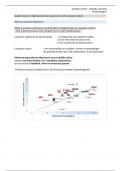
, Innovation
Temporarily
Ideal
acceptable
Process works
less efficient or Process
effective then improveme
before nt
Avoid Very good
Use outdated
1.2 Processes techniques
Processes are tailor made for your company.
1. When you go shopping physically the process of becoming the owner of the product is a bit
different then when you would shop online.
a. In the store you take the product, go to the cashier, give her the money and you’re the
owner of the products
b. On an online store, you select your products and put them in your virtual shopping car,
and you buy them. You are now owner of the product, but you didn’t have them. They
need to be shipped to you first.
2. Getting the goods to the customer can be done in different ways but the result will stay the
same. The company can bring the goods to the customer himself or he can outsource it.
1.2.1 Most widely used processes
The sales process wants to structure the interaction with the customer.
- Objective: dissipate orders from customers and deliver and invoice them to earn
money
The purchase process focuses on suppliers
The planning process: Planning department will determine what, how much and when
goods need to be bought and produced.
The production process transforms raw materials into semi-finished and finally a finished
product, ready to deliver to customer.
Sales, purchase & production = operational processes
Logistics, HR, bookkeeping = supporting processes
All of the departments become together. They all have a
different job, but all do their different job in one program/
system.
a schedule to help study
Sales - Sales orders
- Customer
information
- Sales prices
Production - Products
- Product structure
HR - Employees
- Salaries
- Hours worked
Purchase - Suppliers
- Prices of parts
Logistics - Input & output
, - Registration(stock
keeping)
Bookkeepi - P&L
ng - Invoice making
Everyone is feeding the system
the system will only work if
everyone inputs the correct
data SOD
1.3 Process configuration
1.3.1 SOD = Segregation of
Duty’s
Not everyone can see
everything (everybody has an
own login and with that login
you receive limited abilities in
the system)
- Different persons per
transaction (everyone
has one duty)
- Documentation
- Physical
- Financial
1.3.2 Master Data
Management
Much information is getting in
the system
Keep control
Master Data Management Team the only that can change all the data can’t do
transactions
- WHY?
o No double entries
o Understand significances of every field
o Correct sequence of entrance
Know exactly how the system works
=> login and only access to the modules you need, no more and no less
A lot of DATA in 1 database