Kin Selection
Social Behaviour: set of interactions among individuals of the same species
Wide range of sociality (including parental
care) – relatively asocial (eg. mosquitoes,
polar bears) to highly social organisms that
live together in large groups and cooperate
to conduct many tasks (eg. packs of wolves, schools of fish)
Eusociality: evolution of social behaviour at its most intimate and complex degree –
live in nests
- Only a relatively small fraction of the animals in the colony reproduce, non-
reproductive colony members provide resources, defence, collective care of the
young
- Ants, termites, some wasps, some bees, small number of aphid and thrip species,
2 species of mammal (naked mole rat and Damaraland mole rat), multiple species
of reef-dwelling shrimp
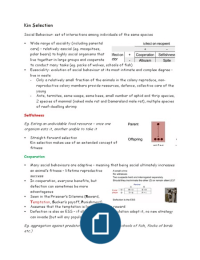
Selfishness
Eg. Eating an undividable food resource – once one
organism eats it, another unable to take it
Straight-forward selection
Kin selection makes use of an extended concept of
fitness
Cooperation
Many social behaviours are adaptive – meaning that being social ultimately increases
an animal’s fitness – lifetime reproductive
success
In cooperation, everyone benefits, but
defection can sometimes be more
advantageous
Seen in the Prisoner’s Dilemma (Reward,
Temptation, Sucker’s payoff, Punishment)
Assumes that the temptation is larger than the reward
Defection is also an ESS – if all individuals in a population adopt it, no new strategy
can invade (but will any population survive?)
Eg. aggregation against predators (herd of wildebeest, schools of fish, flocks of birds
etc.)
, - Herd of wildebeest on a landscape reduces the risk of any single individual being
eaten (the odds of a solitary individual getting attacked is 100% but in groups
this is greatly reduced)
- There may be social costs involved – less land for grazing, but since the costs of
social interaction outweighs the costs (possibility to evolve and maintain social
behaviour – living in groups requires a balance of conflict and cooperation)
- Positive selection for certain alleles takes place indirectly through enhanced
reproduction of the genetic relatives of carriers of the alleles rather than
directly through an increased fitness of the carriers themselves
How does cooperation evolve?
a) Repeated interactions: reciprocity
- Vampire bats returning from unsuccessful foraging will beg to share food from
successful individuals
- In the direct interest of bat to keep all its food to itself – giving up a meal is
altruistic (in ecological and evolutionary terms – other members of this bat’s own
species are its greatest competitors)
- Experiments done by Gerald Wilkinson (1980s) demonstrated that vampire bats
in Costa Rica did not share their meals with all other bats equally
- Bats were far more likely to share blood with bats they were more likely to
encounter
- When a greater opportunity for reciprocity, bats more willing to share food
- Reciprocity enables existence of altruism – in the long term: the benefits of
altruism can outweigh the costs of altruism (example demonstrates altruism
more than just cooperation)
b) Direct (selfish benefits) – inherit breeding territory
Altruism
Behaviour which harms or is disadvantageous to the actor
Not compatible with natural selection
Kin selection (Bill Hamilton, 1964) was postulated in
attempts to account for the evolution of altruism
- Altruism: increases the fitness of other organism
at the expense of one’s own fitness
- Positive selection for certain alleles takes place
indirectly through enhanced reproduction of the genetic relatives of carriers of
the alleles rather than directly
- Fitness is not simply the lifetime reproductive success but the transmission of
genes (direct or indirectly)
- Evolution of a trait depends on the effect on the bearer’s fitness and the
effect on the fitness of others = inclusive fitness
, - Central concept in kin selection = relatives have genes in common – genes that
cause altruistic behaviour can increase in frequency if the increase in the
recipient’s fitness as a result of altruism is sufficiently large to offset the
decrease in the altruist’s own fitness
Hamilton’s Rule and Inclusive Fitness
rb>c
Suppose altruism results in a decrease
in fitness c of the altruist that is
offset by an increase in fitness b in
the recipient
Gene for altruism increases in frequency if the ratio of cost to benefit is small
enough, relative to the genetic relationship between altruist and the recipient (ie.
gene for altruism increases in frequency if c/b < r) – indirect benefits can
outweigh the costs
r is a measure of genetic relationship between altruist X and the recipient Y
defined as 2FXY/ (1+ FX) (FX: inbreeding coefficient of X, FXY: inbreeding coefficient
of hypothetical offspring of X and Y
r is the probability that 2 gametes from X and Y contain alleles that are identical
by descent, FXY relative to the probability that 2 gametes from X contain alleles
that are identical b descent (1+FX)/2
Relatedness
Vampire bats share food not only due to
anticipation of reciprocation – far more likely
to share blood meals with their relatives
Kin selection (effect of relatedness on
altruism) – reflects how copies of an
individual’s genes are passed down through the
survival and reproduction of their relatives
Selection will favour an altruistic act if the
benefit of the act (in terms of indirect fitness) exceeds the cost of the act (in
terms of direct fitness)
When individuals are more closely related, they have a greater relatedness (r) and
altruism is more likely to occur
0 = no relation among individuals, full siblings: 0.5, parent-offspring: 0.5,
grandparent-grandchild: 0.25, cousins: 0.125
Testing Kin selection: Does altruistic behaviour decrease if we reduce relatedness?
Social Behaviour: set of interactions among individuals of the same species
Wide range of sociality (including parental
care) – relatively asocial (eg. mosquitoes,
polar bears) to highly social organisms that
live together in large groups and cooperate
to conduct many tasks (eg. packs of wolves, schools of fish)
Eusociality: evolution of social behaviour at its most intimate and complex degree –
live in nests
- Only a relatively small fraction of the animals in the colony reproduce, non-
reproductive colony members provide resources, defence, collective care of the
young
- Ants, termites, some wasps, some bees, small number of aphid and thrip species,
2 species of mammal (naked mole rat and Damaraland mole rat), multiple species
of reef-dwelling shrimp
Selfishness
Eg. Eating an undividable food resource – once one
organism eats it, another unable to take it
Straight-forward selection
Kin selection makes use of an extended concept of
fitness
Cooperation
Many social behaviours are adaptive – meaning that being social ultimately increases
an animal’s fitness – lifetime reproductive
success
In cooperation, everyone benefits, but
defection can sometimes be more
advantageous
Seen in the Prisoner’s Dilemma (Reward,
Temptation, Sucker’s payoff, Punishment)
Assumes that the temptation is larger than the reward
Defection is also an ESS – if all individuals in a population adopt it, no new strategy
can invade (but will any population survive?)
Eg. aggregation against predators (herd of wildebeest, schools of fish, flocks of birds
etc.)
, - Herd of wildebeest on a landscape reduces the risk of any single individual being
eaten (the odds of a solitary individual getting attacked is 100% but in groups
this is greatly reduced)
- There may be social costs involved – less land for grazing, but since the costs of
social interaction outweighs the costs (possibility to evolve and maintain social
behaviour – living in groups requires a balance of conflict and cooperation)
- Positive selection for certain alleles takes place indirectly through enhanced
reproduction of the genetic relatives of carriers of the alleles rather than
directly through an increased fitness of the carriers themselves
How does cooperation evolve?
a) Repeated interactions: reciprocity
- Vampire bats returning from unsuccessful foraging will beg to share food from
successful individuals
- In the direct interest of bat to keep all its food to itself – giving up a meal is
altruistic (in ecological and evolutionary terms – other members of this bat’s own
species are its greatest competitors)
- Experiments done by Gerald Wilkinson (1980s) demonstrated that vampire bats
in Costa Rica did not share their meals with all other bats equally
- Bats were far more likely to share blood with bats they were more likely to
encounter
- When a greater opportunity for reciprocity, bats more willing to share food
- Reciprocity enables existence of altruism – in the long term: the benefits of
altruism can outweigh the costs of altruism (example demonstrates altruism
more than just cooperation)
b) Direct (selfish benefits) – inherit breeding territory
Altruism
Behaviour which harms or is disadvantageous to the actor
Not compatible with natural selection
Kin selection (Bill Hamilton, 1964) was postulated in
attempts to account for the evolution of altruism
- Altruism: increases the fitness of other organism
at the expense of one’s own fitness
- Positive selection for certain alleles takes place
indirectly through enhanced reproduction of the genetic relatives of carriers of
the alleles rather than directly
- Fitness is not simply the lifetime reproductive success but the transmission of
genes (direct or indirectly)
- Evolution of a trait depends on the effect on the bearer’s fitness and the
effect on the fitness of others = inclusive fitness
, - Central concept in kin selection = relatives have genes in common – genes that
cause altruistic behaviour can increase in frequency if the increase in the
recipient’s fitness as a result of altruism is sufficiently large to offset the
decrease in the altruist’s own fitness
Hamilton’s Rule and Inclusive Fitness
rb>c
Suppose altruism results in a decrease
in fitness c of the altruist that is
offset by an increase in fitness b in
the recipient
Gene for altruism increases in frequency if the ratio of cost to benefit is small
enough, relative to the genetic relationship between altruist and the recipient (ie.
gene for altruism increases in frequency if c/b < r) – indirect benefits can
outweigh the costs
r is a measure of genetic relationship between altruist X and the recipient Y
defined as 2FXY/ (1+ FX) (FX: inbreeding coefficient of X, FXY: inbreeding coefficient
of hypothetical offspring of X and Y
r is the probability that 2 gametes from X and Y contain alleles that are identical
by descent, FXY relative to the probability that 2 gametes from X contain alleles
that are identical b descent (1+FX)/2
Relatedness
Vampire bats share food not only due to
anticipation of reciprocation – far more likely
to share blood meals with their relatives
Kin selection (effect of relatedness on
altruism) – reflects how copies of an
individual’s genes are passed down through the
survival and reproduction of their relatives
Selection will favour an altruistic act if the
benefit of the act (in terms of indirect fitness) exceeds the cost of the act (in
terms of direct fitness)
When individuals are more closely related, they have a greater relatedness (r) and
altruism is more likely to occur
0 = no relation among individuals, full siblings: 0.5, parent-offspring: 0.5,
grandparent-grandchild: 0.25, cousins: 0.125
Testing Kin selection: Does altruistic behaviour decrease if we reduce relatedness?