Garantie de satisfaction à 100% Disponible immédiatement après paiement En ligne et en PDF Tu n'es attaché à rien 4,6 TrustPilot
logo-home
Resume

Summary AQA A Level Biology- Immune Response Processes

Note
-
Vendu
-
Pages
1
Publié le
13-08-2021
Écrit en
2020/2021

Detailed summary of the relevant immune responses (phagocytosis, cell-mediated response and humoral response) required for the new AQA A Level Biology specification.

Établissement
Cours

Aperçu du contenu

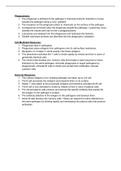
Phagocytosis:
1. The phagocyte is attracted to the pathogen’s chemical products, therefore it moves
towards the pathogen along a conc. gradient
2. The receptors on the phagocyte attach to chemicals on the surface of the pathogen.
3. A phagosome is formed when the phagocyte engulfs the pathogen. Lysosomes move
towards the vesicle and fuse to form a phagolysosome.
4. Lysozymes are released into the phagosome and hydrolyse the bacteria.
5. Soluble hydrolysis products are absorbed into the phagocyte’s cytoplasm.

Cell-Mediated Response:
1. Phagocytes take in pathogens.
2. Phagocytes place antigens from pathogens onto its cell-surface membrane.
3. Receptors on a helper T cell fit exactly onto these antigens.
4. This attachment activates the T cells to divide rapidly by mitosis and form a clone of
genetically identical cells.
5. The cloned cells develop into: memory cells that enable a rapid response to future
infections by the same pathogen; stimulate phagocytes to engulf pathogens by
phagocytosis; stimulate B cells to divide and secrete their antibodies; activate
cytotoxic cells.

Humoral Response:
1. The surface antigens of an invading pathogen are taken up by a B cell.
2. The B cell processes the antigens and presents them on its surface.
3. Helper T cells attach to the processed antigens and therefore activates the B cell.
4. The B cell is now activated to divide by mitosis to form a clone of plasma cells.
5. The cloned plasma cells produce and secrete the specific antibody that exactly fits
the antigen on the pathogen’s surface.
6. The antibody attaches to the antigen on the pathogens and destroys them.
7. Some B cells develop into memory cells. These can respond to future infections by
the same pathogen by dividing rapidly and developing into plasma cells that produce
antibodies.

Livre connecté

École, étude et sujet

Niveau d'études
Editeur
Sujet
Cours

Infos sur le Document

Livre entier ?
Non
Quels chapitres sont résumés ?
Chapter 5- cell recognition and the immune system
Publié le
13 août 2021
Nombre de pages
1
Écrit en
2020/2021
Type
RESUME

Sujets

€9,53
Accéder à l'intégralité du document:

Garantie de satisfaction à 100%
Disponible immédiatement après paiement
En ligne et en PDF
Tu n'es attaché à rien

Faites connaissance avec le vendeur
Seller avatar
anjalibhambra

Faites connaissance avec le vendeur

Seller avatar
anjalibhambra Kings College London
S'abonner Vous devez être connecté afin de suivre les étudiants ou les cours
Vendu
2
Membre depuis
4 année
Nombre de followers
2
Documents
7
Dernière vente
4 année de cela

0,0

0 revues

5
0
4
0
3
0
2
0
1
0

Documents populaires

Récemment consulté par vous

Pourquoi les étudiants choisissent Stuvia

Créé par d'autres étudiants, vérifié par les avis

Une qualité sur laquelle compter : rédigé par des étudiants qui ont réussi et évalué par d'autres qui ont utilisé ce document.

Le document ne convient pas ? Choisis un autre document

Aucun souci ! Tu peux sélectionner directement un autre document qui correspond mieux à ce que tu cherches.

Paye comme tu veux, apprends aussitôt

Aucun abonnement, aucun engagement. Paye selon tes habitudes par carte de crédit et télécharge ton document PDF instantanément.

Student with book image

“Acheté, téléchargé et réussi. C'est aussi simple que ça.”

Alisha Student

Foire aux questions