1
Dr. Martin Psychology Fundamentals C
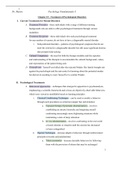
Chapter 15 - Treatment of Psychological Disorders
I. Current Treatments for Mental Disorders
A. Treatment Providers—those individuals with a range of different training
backgrounds who are able to offer psychological treatments through various
modalities
B. Treatment Recipients—those individuals who seek psychological treatment
for any number of reasons; do not have to have a diagnosable mental disorder
i. Subsyndromal disorders—patterns of psychological symptoms that do not
meet the criteria for a diagnosable disorder but still cause significant distress
that prompts help-seeking
C. Cultural Competence—the need for both the therapy modality and the expertise
and understanding of the therapist to accommodate the cultural background, values,
and expectations of the patient being seen
D. Tarasoff case- Tarasoff was killed after she rejected Poddar. Her family brought suit
against the psychologist and the university for knowing about this potential murder
but did not do anything to warn Tarasoff or to confine Poddar.
II. Psychological Treatments
A. Behavioral Approaches—techniques that emerged in opposition to psychoanalysis,
emphasizing a scientific framework and a focus on objectively observable behaviors,
which were viewed as modifiable based on learning principles
i. Classical Conditioning Techniques—can be used to modify a behavior
through such procedures as extinction (unpair fear and stimulus)
a. Exposure therapy (Systematic desensitization)—involves
establishing an anxiety hierarchy and imagining oneself
confronting increasingly more frightening situations while
maintaining a state of deep relaxation
b. In vivo desensitization—involves confronting in the real world
a feared stimulus or situation until the anxiety has decreased
or been extinguished
ii. Operant Techniques—increase adaptive behaviors through reinforcement
principles (rewards and punishments)
a. Token economies—increase desirable behaviors by following
them with the provision of tokens that may be exchanged
1
, for privileges or desired items such as snacks (used in psychiatric
wards)
b. Contingency management—specifies for a person what
consequences will follow particular “good” or “bad” behaviors.
(used in weight loss management, with children with autism)
iii. Modeling Techniques—allow a therapist or appropriate peer to demonstrate
an appropriate behavior so that a person may more quickly acquire the
desired behavior
B. Cognitive-Behavioral Approaches—techniques that integrate principles from
cognitive therapy with behavioral techniques (helps identify what makes you feel
bad, in order to deal with them correctly)
i. Rational Emotive Behavioral Therapy—targets inaccurate, irrational
thoughts that make people feel distressed, highlighting the fact that our
irrational thoughts about events, rather than the events themselves, tend
to make us distressed; Ellis and ABCs
ii. Cognitive Therapy—also the role of inaccurate thoughts
in causing distress (automatic thoughts), and stresses the tendency toward
overly negative cognitions in causing mental disorders; Beck
a. Cognitive restructuring—a cognitive therapy technique that
attempts to change a person’s dysfunctional beliefs or the person’s
habitually negative way of interpreting events; use thought records
to do this
C. Psychodynamic Approaches—treatments that originated in classical psychoanalysis
and assume that insight into unconscious dynamics, particularly those related to early
childhood family experiences, is necessary
D. Humanistic Approaches—techniques that developed in reaction against the
deterministic, negative views of psychoanalysis, and emphasized free will, personal
responsibility, and living fully in the present
i. Client-centered Therapy—emphasized helping the client accept himself
as he is; Rogers
a. Unconditional positive regard—provided to promote self-
acceptance and involved a nonjudgmental, accepting stance
in therapy
b. Empathic understanding—helped the client feel understood by
sensing what it would be like to experience life as the client does
ii. Gestalt Therapy—a form of humanistic therapy that emphasizes self-
2
Dr. Martin Psychology Fundamentals C
Chapter 15 - Treatment of Psychological Disorders
I. Current Treatments for Mental Disorders
A. Treatment Providers—those individuals with a range of different training
backgrounds who are able to offer psychological treatments through various
modalities
B. Treatment Recipients—those individuals who seek psychological treatment
for any number of reasons; do not have to have a diagnosable mental disorder
i. Subsyndromal disorders—patterns of psychological symptoms that do not
meet the criteria for a diagnosable disorder but still cause significant distress
that prompts help-seeking
C. Cultural Competence—the need for both the therapy modality and the expertise
and understanding of the therapist to accommodate the cultural background, values,
and expectations of the patient being seen
D. Tarasoff case- Tarasoff was killed after she rejected Poddar. Her family brought suit
against the psychologist and the university for knowing about this potential murder
but did not do anything to warn Tarasoff or to confine Poddar.
II. Psychological Treatments
A. Behavioral Approaches—techniques that emerged in opposition to psychoanalysis,
emphasizing a scientific framework and a focus on objectively observable behaviors,
which were viewed as modifiable based on learning principles
i. Classical Conditioning Techniques—can be used to modify a behavior
through such procedures as extinction (unpair fear and stimulus)
a. Exposure therapy (Systematic desensitization)—involves
establishing an anxiety hierarchy and imagining oneself
confronting increasingly more frightening situations while
maintaining a state of deep relaxation
b. In vivo desensitization—involves confronting in the real world
a feared stimulus or situation until the anxiety has decreased
or been extinguished
ii. Operant Techniques—increase adaptive behaviors through reinforcement
principles (rewards and punishments)
a. Token economies—increase desirable behaviors by following
them with the provision of tokens that may be exchanged
1
, for privileges or desired items such as snacks (used in psychiatric
wards)
b. Contingency management—specifies for a person what
consequences will follow particular “good” or “bad” behaviors.
(used in weight loss management, with children with autism)
iii. Modeling Techniques—allow a therapist or appropriate peer to demonstrate
an appropriate behavior so that a person may more quickly acquire the
desired behavior
B. Cognitive-Behavioral Approaches—techniques that integrate principles from
cognitive therapy with behavioral techniques (helps identify what makes you feel
bad, in order to deal with them correctly)
i. Rational Emotive Behavioral Therapy—targets inaccurate, irrational
thoughts that make people feel distressed, highlighting the fact that our
irrational thoughts about events, rather than the events themselves, tend
to make us distressed; Ellis and ABCs
ii. Cognitive Therapy—also the role of inaccurate thoughts
in causing distress (automatic thoughts), and stresses the tendency toward
overly negative cognitions in causing mental disorders; Beck
a. Cognitive restructuring—a cognitive therapy technique that
attempts to change a person’s dysfunctional beliefs or the person’s
habitually negative way of interpreting events; use thought records
to do this
C. Psychodynamic Approaches—treatments that originated in classical psychoanalysis
and assume that insight into unconscious dynamics, particularly those related to early
childhood family experiences, is necessary
D. Humanistic Approaches—techniques that developed in reaction against the
deterministic, negative views of psychoanalysis, and emphasized free will, personal
responsibility, and living fully in the present
i. Client-centered Therapy—emphasized helping the client accept himself
as he is; Rogers
a. Unconditional positive regard—provided to promote self-
acceptance and involved a nonjudgmental, accepting stance
in therapy
b. Empathic understanding—helped the client feel understood by
sensing what it would be like to experience life as the client does
ii. Gestalt Therapy—a form of humanistic therapy that emphasizes self-
2