
- Guías de estudio, Notas de estudios & Resúmenes
¿Buscas las mejores guías de estudio, notas de estudio y resúmenes para ? En esta página encontrarás 211 documentos de estudio para .

Examen
Isp 203B Final Comprehensive Study Sheet Questions And Answers Graded A+
NuevoIsp 203B Final Comprehensive Study Sheet Questions And Answers Graded A+
 Favorgrades

Examen
Isp 203B Final Certification Evaluation Full Questions And Solutions Verified Preparation Material
NuevoIsp 203B Final Certification Evaluation Full Questions And Solutions Verified Preparation Material
Favorgrades

Examen
Isp 203B Final Certification Evaluation Complete Questions With Accurate Answers
NuevoIsp 203B Final Certification Evaluation Complete Questions With Accurate Answers
Favorgrades

Examen
Isp 203B Final Actual Test Script Complete Questions With Verified Solutions
NuevoIsp 203B Final Actual Test Script Complete Questions With Verified Solutions
Favorgrades

Examen
Isp 203B Final Actual Test Questions With Complete Solution Premium Review Content
NuevoIsp 203B Final Actual Test Questions With Complete Solution Premium Review Content
Favorgrades

Examen
ISP 203B Volcanoes Chapter 6 Questions and All Correct Answers.
Nuevocascade range volcanoes are active - Answer rule of thumb: if volcano had significant glacial erosion, it had not erupted since end of last ice age and probably wouldn't erupt again sit over subduction zone therefore active Active or extinct - Answer not dormant on geological time scale Mt. St. Helens 1980 - Answer -magma rising, puff of ash, volcano flank landslides so pressure released on team in magma initial lateral blast blast rapidly grows. mudflows - Answe...
 COCOSOLUTIONS

Examen
ISP 203B Natural Hazards Exam 1 Questions and All Correct Answers.
NuevoWhich of the following is a potential consequence of a large asteroid impact? A. Tsunami B. Earthquake C. Wildfire D. All of the Above - Answer D. All of the Above The Scientific Method typically develops in order as follows: A. Question - Observation - Research - Data - Experiment - Hypothesis - Conclusion B. Observation - Question - Research - Hypothesis - Experiment - Data - Conclusion C. Research - Question - Observation - Data - Experiment - Hypothesis - Conclusion D. Hypot...
COCOSOLUTIONS

Examen
ISP 203B Final Review Questions and Already Passed Answers 2025-2026 Updated.
NuevoWhich of the following do NOT typically form volcanoes? A) Divergent B) Hotspot C) Subduction zone D) Transform - Answer D) Transform Where do the largest earthquakes occur? - Answer subduction zones (convergent boundaries) Which part of the earth is more liquid A) Lithosphere B) Asthenosphere - Answer B) Asthenosphere Which type of boundary creates subduction zones? A) Convergent B) Divergent C) Transform - Answer A) Convergent Which type of boundary...
COCOSOLUTIONS

Examen
ISP 203B Exam 3 Study Guide Test Questions with All Actual Answers.
NuevoWild fires are natural. True or false? - Answer True What are the natural purposes of wildfires? - Answer -Naturally thins forests -Leaves larger trees -Promotes diversity in undergrowth -Some species depend on fire to trigger seed opening/germination What do you need to start a wildfire? - Answer The fire triangle 1. Oxygen 2. Heat 3. Fuel What is combustion? - Answer A chemical reaction that results in release of heat and light What are the 3 methods o...
COCOSOLUTIONS

Examen
ISP 203b Exam 3 Questions and All Correct Answers.
NuevoAn ecosystem consists of two components that occur in the same locale. Which of the following are the two components? - Answer Biotic & Abiotic Seven major types of Terrestrial ecosystems exist. The location is usually dependent on two major factors. What are those factors? - Answer Latitude and precipitation The three types of Ocean ecosystems that exist are Shallow, Deep, and Deep Ocean Surface. - Answer True Biotic components are non-living factors of an ecosystem. ...
COCOSOLUTIONS

Examen
ISP 203B Exam 3 Questions and All Correct Answers.
NuevoAn ecosystem consists of two components that occur in the same locale. Which of the following are the two components? - Answer Biotic and abiotic Seven major types of Terrestrial ecosystems exist. The location is usually dependent on two major factors. What are those factors? - Answer Latitude and precipitation The three types of Ocean ecosystems that exist are Shallow, Deep and Deep ocean surface. - Answer True Biotic components are non-living factors of an ecosystem....
COCOSOLUTIONS

Examen
Isp 203B Exam 2 Questions And All Correct Answers.
NuevoVolcanic Mudflows - Answer - Form when ash combines with water primarily on stratovolcanoes, and pours down their flanks at high speeds. Similar to very wet concrete. People are often killed by the boulders carried by the flows. - You can't outrun it - Climb up the valley side for safety. Lahars - Answer - A hot mudflow. Mt. Rainer - Answer - Poses serious mudflow risks for Seattle-Tacoma area. - Stratovolcano. - Every 500 years, on average large mud lows reach 100...
COCOSOLUTIONS

Examen
ISP 203 Exam 4 Questions and All Correct Answers.
NuevoMethane Ch4 - Answer Simplest hydrocarbon, main ingredient in natural gas. Extremely effective absorber of radiation How Petroleum and natural gas was formed - Answer Tiny animals and plants died and were buried on the sea floor. Over millions of years, the remains were buried deeper and deeper. The plant and animal remains turned into oil and gas deposits. Shale - Answer A classic sedimentary rock that is made up of clay-size weathering debris. It typically breaks into t...
COCOSOLUTIONS

Examen
isp 203 b final exam Questions and Answers.
NuevoWhy did such a large number of people die as a result of the 2010 Haiti earthquake compared to other recent large earthquakes such as the 2011 Tohoku Japan earthquake? - Answer Many buildings in Haiti were unreinforced masonary and collapsed during the earthquake. In Figure 1-3 in the book, which three hazards cause the most natural hazard related fatalities? - Answer Winter weather, heat and drought, flood Natural hazards happen completely independently from each other. - Answ...
COCOSOLUTIONS
Examen
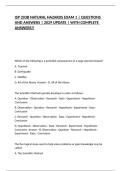
Isp 203B Natural Hazards Exam 1 | Questions And Answers | 2029 Update | With Complete Answers!!
NuevoIsp 203B Natural Hazards Exam 1 | Questions And Answers | 2029 Update | With Complete Answers!!
 EvaTee
Examen
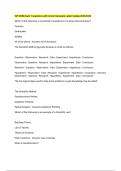
ISP 203B Exam 1 Questions with Correct Answers Latest Update 2025-2026
ISP 203B Exam 1 Questions with Correct Answers Latest Update Which of the following is a potential consequence of a large asteroid impact? Tsunami Earthquake Wildfire All of the above - Answers All of the above The Scientific Method typically develops in order as follows: Question - Observation - Research - Data - Experiment - Hypothesis - Conclusion Observation - Question - Research - Hypothesis - Experiment - Data - Conclusion Research - Question - Observation - Data - Experiment ...
 TutorJosh

Examen
ISP 203B Natural Hazards Exam 1 Solved 100% Correct
ISP 203B Natural Hazards Exam 1 Solved 100% Correct
 CLOUNDLite
Lote
Isp203 B Exam Pack With Complete Solutions
ISP-203B Exam II Questions And Answers 2 Exam (elaborations) ISP 203B-Exam 2 Questions With Solutions 3 Exam (elaborations) ISP 203B- EXAM 1 Questions With Solutions 4 Exam (elaborations) ISP 203B Questions With Solutions 5 Exam (elaborations) ISP 203B EXAM 2 Questions With Solutions
StuviaTutors
Examen
ISP 203B Exam 1 Questions With Solutions
ISP 203B Exam 1 Questions With Solutions Which of the following is a mineral? a. Granite b. Marble c. Diamond d. Shale Diamond In which types of rocks do you find fossils? a. Sedimentary rocks (e.g. sandstone) b. Igneous rocks (e.g. basalt) c. Metamorphic rocks (e.g. marble) Sedimentary rocks (e.g. sandstone)
StuviaTutors
Examen
ISP 203B Exam 1 Study Guide Questions With Solutions
ISP 203B Exam 1 Study Guide Questions With Solutions Where is MSU's Banded Iron Formation located? Natural Science The two most important concepts in this class are: Risk & Disaster Which of these is an example of a Scientific Theory? Plate tectonics Which phrase best describes a Natural Hazard? A natural process or event that represents a potential threat to humans Which of the following does not determine how disastrous a natural hazard may become? Temperature
StuviaTutors