
- Guías de estudio, Notas de estudios & Resúmenes
¿Buscas las mejores guías de estudio, notas de estudio y resúmenes para ? En esta página encontrarás 87 documentos de estudio para .
Examen
Econ 103 Exam 2 Questions & Answers
NuevoEcon 103 Exam 2 Questions & Answers
 GEEKA
GEEKA
Examen
Econ 103 Final Boudreaux Questions & Answers
NuevoEcon 103 Final Boudreaux Questions & Answers
GEEKA
Examen
Econ 103 Exam 1 Questions & Answers
NuevoEcon 103 Exam 1 Questions & Answers
GEEKA
Otro
Econ 103 Final Exam - Chapman Isu Study Guide
NuevoEcon 103 Final Exam - Chapman Isu Study Guide
GEEKA
Examen
Econ 103 Gmu Exam 1 Boudreaux
NuevoEcon 103 Gmu Exam 1 Boudreaux
GEEKA
Examen
Econ 103 Lc3 Questions And Answers
NuevoEcon 103 Lc3 Questions And Answers
GEEKA
Examen
Umass Econ 103 Exam 1 Questions With Correct Answers Latest Update 2025/2026
NuevoUMASS ECON 103 EXAM 1 QUESTIONS WITH CORRECT ANSWERS LATEST UPDATE 2025/2026 How to obtain things needed to live and thrive - Answers The economic problem Study of the aggregate economy, focusing on economic growth and factors like unemployment, prices, production, and banks - Answers Macro economics Study of how individuals make choices as consumers, workers, business owners, and family members - Answers Micro economics Studies the way the economy is and how it works - Answers Positive econ...
 joshuawesonga22
Examen
Econ 103 Exam 2 Actual Questions And Answers
NuevoECON 103 EXAM 2 ACTUAL QUESTIONS AND ANSWERS The elasticity of supply is defined as the ________ change in quantity supplied divided by the _______ change in price. - CORRECT ANSWERpercentage; percentage
STANGRADES
Examen
Econ 103 Gmu Exam 1 Boudreaux 2025 Questions And Answers
Which of the following is among the reasons identified by Adam smith for why the division of labor increases an economy's total output? a) specialized workers are happier than are non specialized workers b) specialized workers each work on tasks for which they each have a comparative advantage c)specialized workers follow instructions better than do non specialized workers d) specialization of workers is more likely to encourage the development of machinery to perform specialized tasks ...
 Fyndlay
Lote
ECON Questions with Detailed Verified Answers (100% Correct Answers) /Already Graded A+
ECON Questions with Detailed Verified Answers (100% Correct Answers) /Already Graded A+
 Passit
Examen
Econ 103 GMU Final Exam Questions and Answers Already Passed
Econ 103 GMU Final Exam Questions and Answers Already Passed Which of the following is among the reasons identified by Adam Smith for why the division of labor increases an economy's total output? - Answers Specialization of workers is more likely to encourage the development of machinery to perform specialized tasks. Which of the following WILL NOT cause the market demand for reading lamps to increase? (assume that reading lamps are a normal good) - Answers A decrease in consumers' inc...
TutorJosh
Examen
ECON 103 Final questions well answered already passed
ECON 103 Final questions well answered already passed
 BravelRadon
Examen
ECON 103 Principles of Microeconomics Practice Multiple Choice Questions and Answers Complete and Rated A
ECON 103 Principles of Microeconomics Practice Multiple Choice Questions and Answers Complete and Rated A
 saraciousstuvia

Examen
Sfu Econ 103 Sample Midterm 1 Questions And Answers Complete 2024 Prep Simon Fraser University
SFU ECON 103 SAMPLE MIDTERM 1 QUESTIONS AND ANSWERS COMPLETE 2024 PREP SIMON FRASER UNIVERSITY Sample Midterm 1 Answers Unless told otherwise, assume throughout that demand curves slope downwards and supply curves slope upwards. 1. Which of the following statements about opportunity cost is TRUE? I. Opportunity cost is equal to implicit costs plus explicit costs. II. Opportunity cost only measures direct monetary costs. III. Opportunity cost accounts for alternative uses of resou...
 smartzone
Examen
ECON 103 GMU exam 1 Boudreaux Questions and Verified Answers | Passed | A+
Which of the following is among the reasons identified by Adam smith for why the division of labor increases an economy's total output? a) specialized workers are happier than are non specialized workers b) specialized workers each work on tasks for which they each have a comparative advantage c)specialized workers follow instructions better than do non specialized workers d) specialization of workers is more likely to encourage the development of machinery to perform specialized tas...
Passit
Examen
ECON 103 KEY Exam Questions and CORRECT Answers
Four factors of Production Land, labor, capital, & entrepreneurship; the four groups of resources that are used to make all goods/services Macroeconomics Study of the performance of the national and global economics Opportunity Cost Highest value alternative that must be given up to get something How are rational choices typically made? Costs vs. benefits Scarcity Wanting more goods/services than can be afforded Comparative Advantage When a producer can produce a good at a lower opportuni...
 STANFORDGRADESS
Examen
ECON 103 UPDATED Test Questions and CORRECT Answers
EconomicsStudy of allocation of scarce resourse Factors of productionLand Labor Capital Human capital Production PossibilityAll possible combination of the maximum amounts of two goods that can be produced by an economy, given fixed and unchanging resources and technology. Choices of points on PPC•Custom(tradition) •Plan(government decides) •Market Growth of curve•Division of labor
STANFORDGRADESS
Examen
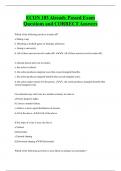
ECON 103 Already Passed Exam Questions and CORRECT Answers
Which of the following involves a trade-off? a.Taking a nap b. Watching a football game on Saturday afternoon c. Going to university d. All of these answers involve trade-offs. d. All of these answers involve trade-offs. A rational person does not act unless a. the action is ethical. b. the action produces marginal costs that exceed marginal benefits. c. the action produces marginal benefits that exceed marginal costs. d. the action makes money for the person. c. the action produces mar...
STANFORDGRADESS
Examen
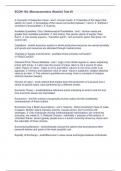
ECON 103: Microeconomics (Rustici) Test #1
ECON 103: Microeconomics (Rustici) Test #1
 performer
Examen
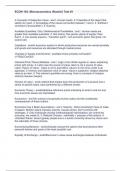
ECON 103: Microeconomics (Rustici) Test #1
ECON 103: Microeconomics (Rustici) Test #1ECON 103: Microeconomics (Rustici) Test #1ECON 103: Microeconomics (Rustici) Test #1ECON 103: Microeconomics (Rustici) Test #1ECON 103: Microeconomics (Rustici) Test #1ECON 103: Microeconomics (Rustici) Test #1ECON 103: Microeconomics (Rustici) Test #1ECON 103: Microeconomics (Rustici) Test #1ECON 103: Microeconomics (Rustici) Test #1ECON 103: Microeconomics (Rustici) Test #1
 Docwinnie