
- Guías de estudio, Notas de estudios & Resúmenes
¿Buscas las mejores guías de estudio, notas de estudio y resúmenes para ? En esta página encontrarás 27 documentos de estudio para .
Examen
Diabetes [DKA/HHS Final Exam Questions] with Correct Answers 2025
Diabetes [DKA/HHS Final Exam Questions] with Correct Answers 2025
 AcademicACHIEVER
Examen
Diabetes [DKA/HHS Final Exam Questions] with Correct Answers 2025
PopularDiabetes [DKA/HHS Final Exam Questions] with Correct Answers 2025
 Stuviahero01
Lote
Diabetes (DKA, HHS, IV Insulin, Type II Teaching) – Comprehensive Study Guide with Key Terms, Definitions, Practice Questions, and Detailed Summaries for Exam Preparation
Nuevo1 Exam (elaborations) Diabetes (DKA / HHS) Exam 4 Comprehensive Study Guide – Key Terms, Definitions, Practice Questions, and Detailed Summaries 2 Exam (elaborations) Diabetes (DKA, HHS, IV Insulin, Type II Teaching) – Comprehensive Study Guide with Key Terms, Definitions, Practice Questions, and Detailed Summaries for Exam Preparation 3 Exam (el
 VerifiedStudyGuides
Examen
Diabetes (DKA/HHS) – Final Exam Comprehensive Study Guide with Key Terms, Definitions, Practice Questions, and Detailed Summaries
NuevoThis comprehensive study guide covers all essential concepts related to Diabetes, Diabetic Ketoacidosis (DKA), and Hyperosmolar Hyperglycemic State (HHS). It includes key terms, clear definitions, detailed topic summaries, and practice questions designed to reinforce understanding and prepare students for final exams. The material integrates multiple chapters and topics, ensuring complete coverage for exam readiness and clinical application.
VerifiedStudyGuides
Examen
Diabetes [Dka/Hhs Latest Updated 2025/2026 Exam With Complete Questions (Most Frequently Tested) And Sure Verified Solutions 100% Graded At A+ Score!! Sure Guaranteed Pass!!
Diabetes [DKA/HHS LATEST UPDATED 2025/2026 Exam WITH COMPLETE Questions (MOST FREQUENTLY TESTED) AND SURE VERIFIED SOLUTIONS 100% GRADED AT A+ SCORE!! SURE GUARANTEED PASS!! A patient with diabetes in the critical care unit is at risk for developing diabetic ketoacidosis (DKA) secondary to A. excess insulin administration. B. inadequate food intake. C. physiologic and psychologic stress. D. increased release of antidiuretic hormone (ADH). - ANSWER ANS C physiologic and psychologi...
 Exchequer
Examen
Diabetes [Dka/Hhs Final Exam Questions] 2025 Brand New Actual Exam With Answers.
Diabetes [Dka/Hhs Final Exam Questions] 2025 Brand New Actual Exam With Answers.
 Savvynurse
Lote
Diabetes DKA/HHS Package Deal Questions and Answers with Verified Solutions Updated 2025/2026
Diabetes DKA/HHS Package Deal Questions and Answers with Verified Solutions Updated 2025/2026
AcademicACHIEVER
Examen
Diabetes [DKA/HHS Final Exam Questions]
Diabetes [DKA/HHS Final Exam Questions] 1. A patient with diabetes in the critical care unit is at risk for developing diabetic ketoacidosis (DKA) secondary to A. excess insulin administration. B. inadequate food intake. C. physiologic and psychologic stress. D. increased release of antidiuretic hormone (ADH). ANS C physiologic and psychologic stress. Major neurologic and endocrine changes occur when an individual is confronted with physiologic stress caused by any critical illness, s...
 FirstClassHonor
Examen
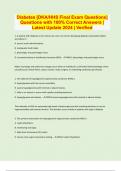
Diabetes [DKA/HHS Final Exam Questions] Questions with 100% Correct Answers | Latest Update 2024 | Verified
Diabetes [DKA/HHS Final Exam Questions] Questions with 100% Correct Answers | Latest Update 2024 | Verified 1. A patient with diabetes in the critical care unit is at risk for developing diabetic ketoacidosis (DKA) secondary to A. excess insulin administration. B. inadequate food intake. C. physiologic and psychologic stress. D. increased release of antidiuretic hormone (ADH). - ANS C physiologic and psychologic stress. Major neurologic and endocrine changes occur when an individual is con...
Parie
Examen
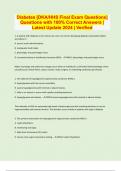
Diabetes [DKA/HHS Final Exam Questions] Questions with 100% Correct Answers | Latest Update 2024 | Verified
1. A patient with diabetes in the critical care unit is at risk for developing diabetic ketoacidosis (DKA) secondary to A. excess insulin administration. B. inadequate food intake. C. physiologic and psychologic stress. D. increased release of antidiuretic hormone (ADH). - ANS C physiologic and psychologic stress. Major neurologic and endocrine changes occur when an individual is confronted with physiologic stress caused by any critical illness, sepsis, trauma, major surgery, or underlyin...
brightonbrezie12
Examen
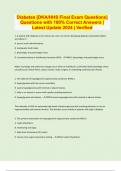
Diabetes [DKA/HHS Final Exam Questions] Questions with 100% Correct Answers | Latest Update 2024 | Verified
1. A patient with diabetes in the critical care unit is at risk for developing diabetic ketoacidosis (DKA) secondary to A. excess insulin administration. B. inadequate food intake. C. physiologic and psychologic stress. D. increased release of antidiuretic hormone (ADH). - ANS C physiologic and psychologic stress. Major neurologic and endocrine changes occur when an individual is confronted with physiologic stress caused by any critical illness, sepsis, trauma, major surgery, or underlyin...
brightonbrezie12
Examen
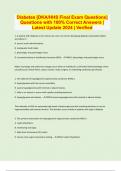
Diabetes [DKA/HHS Final Exam Questions] Questions with 100% Correct Answers | Latest Update 2024 | Verified
1. A patient with diabetes in the critical care unit is at risk for developing diabetic ketoacidosis (DKA) secondary to A. excess insulin administration. B. inadequate food intake. C. physiologic and psychologic stress. D. increased release of antidiuretic hormone (ADH). - ANS C physiologic and psychologic stress. Major neurologic and endocrine changes occur when an individual is confronted with physiologic stress caused by any critical illness, sepsis, trauma, major surgery, or underly...
 DrJon
Examen
Diabetes [DKA/HHS Final Exam Questions] Questions with 100% Correct Answers | Latest Update 2024 | Verified
1. A patient with diabetes in the critical care unit is at risk for developing diabetic ketoacidosis (DKA) secondary to A. excess insulin administration. B. inadequate food intake. C. physiologic and psychologic stress. D. increased release of antidiuretic hormone (ADH). - ANS C physiologic and psychologic stress. Major neurologic and endocrine changes occur when an individual is confronted with physiologic stress caused by any critical illness, sepsis, trauma, major surgery, or underly...
DrJon
Examen
Diabetes [DKA/HHS Final Exam Questions] Questions with 100% Correct Answers | Latest Update 2024 | Verified
1. A patient with diabetes in the critical care unit is at risk for developing diabetic ketoacidosis (DKA) secondary to A. excess insulin administration. B. inadequate food intake. C. physiologic and psychologic stress. D. increased release of antidiuretic hormone (ADH). - ANS C physiologic and psychologic stress. Major neurologic and endocrine changes occur when an individual is confronted with physiologic stress caused by any critical illness, sepsis, trauma, major surgery, or underly...
 StudyLoom01
Examen
Diabetes [DKA/HHS Final Exam Questions] Questions with 100% Correct Answers | Latest Update 2024 | Verified
1. A patient with diabetes in the critical care unit is at risk for developing diabetic ketoacidosis (DKA) secondary to A. excess insulin administration. B. inadequate food intake. C. physiologic and psychologic stress. D. increased release of antidiuretic hormone (ADH). - ANS C physiologic and psychologic stress. Major neurologic and endocrine changes occur when an individual is confronted with physiologic stress caused by any critical illness, sepsis, trauma, major surgery, or underly...
StudyLoom01
Lote
Diabetes Mellitus (HHNS and DKA) Bundled Exams with Complete Solution | Updated & Verified | Guaranteed Success
Diabetes Mellitus (HHNS and DKA) Bundled Exams with Complete Solution | Updated & Verified | Guaranteed Success
 JOSHCLAY
Examen
Diabetes [DKA/HHS Final Exam Questions Answers | Latest Update 2024 | Verified | A+ Graded
Diabetes [DKA/HHS Final Exam Questions Answers | Latest Update 2024 | Verified | A+ Graded 1. A patient with diabetes in the critical care unit is at risk for developing diabetic ketoacidosis (DKA) secondary to A. excess insulin administration. B. inadequate food intake. C. physiologic and psychologic stress. D. increased release of antidiuretic hormone (ADH). - ANS C physiologic and psychologic stress. Major neurologic and endocrine changes occur when an individual is confronted with ...
JOSHCLAY
Lote
Canadian Diabetes Educator Exam | Bundle
All Updated Canadian Diabetes Educator Exam | Bundle
 STUVEX
Examen
Diabetes [DKA/HHS Final Exam Questions] updated 2023/24
Diabetes [DKA/HHS Final Exam Questions] updated 2023/24
STUVEX
Examen
Diabetes [DKA/HHS Final Exam Questions] Questions with 100% Correct Answers | Latest Update 2024 | Verified
Diabetes [DKA/HHS Final Exam Questions] Questions with 100% Correct Answers | Latest Update 2024 | Verified 1. A patient with diabetes in the critical care unit is at risk for developing diabetic ketoacidosis (DKA) secondary to A. excess insulin administration. B. inadequate food intake. C. physiologic and psychologic stress. D. increased release of antidiuretic hormone (ADH). - ANS C physiologic and psychologic stress. Major neurologic and endocrine changes occur when an individual is ...
 Brainbarter