
- Guías de estudio, Notas de estudios & Resúmenes
¿Buscas las mejores guías de estudio, notas de estudio y resúmenes para ? En esta página encontrarás 23 documentos de estudio para .

Examen
Chem 420 UPDATED Test Questions and CORRECT Answers
Noise types1) Johnson * 2) Shot * 3) Flicker * 4) Popcorn 5) Environmental * 6) Microphonic Johnson NoiseRandom motions of charge carriers (electrons or holes) that accompany thermal motions of solid lattice of atoms. (Dependant on frequency) Can be reduced by narrowing the bandwidth, lowering the electrical resistance and lowering the temperature of instrument components. Shot NoiseNoise from electrons jumping across junctions as in photocells & vacuum tubes. (Independant on frequ...
 STANFORDGRADESS

Examen
Chem 420 Exam Questions With Verified Solutions
PopularChem 420 Exam Questions With Verified Solutions Contain a carbonyl group that consist of carbon-oxygen double bond with two groups of atoms attached to the carbon at angles 120. - answerAldehydes and ketones Aldehyde - answerthe carbonyl group is bonded to at least one hydrogen atom Ketones - answerThe carbonyl group is bonded to two alkyl group or aromatic rings. Naming aldehydes - answerreplace -e with -al Naming ketones - answerreplace -e with -one Common names for aldehydes - answerm...
 TheStar

Examen
CHEM 420 EXAM 3 Questions with Answers.
Give a general description of chromatography, highlighting the different phases, interactions, and purpose of this technique? - A separation/purification technique that separates analytes based on their non-covalent interactions. Mobile phase dissolves analyte while an immiscible stationary phase interacts with the analyte. The interactions retard the movement of the analyte relative to the mobile phase causing different elution times and zones. What is the difference between GC, LC, and SFC...
 Josejosy

Examen
Chem 420 Exam Questions With Verified Solutions
Chem 420 Exam Questions With Verified Solutions Contain a carbonyl group that consist of carbon-oxygen double bond with two groups of atoms attached to the carbon at angles 120. - answerAldehydes and ketones Aldehyde - answerthe carbonyl group is bonded to at least one hydrogen atom Ketones - answerThe carbonyl group is bonded to two alkyl group or aromatic rings. Naming aldehydes - answerreplace -e with -al Naming ketones - answerreplace -e with -one Common names for aldehydes - answerm...
 sirjoel

Examen
Chem 420 Final Exam Questions And Answers (Verified And Updated)
Chem 420 Final Exam Questions And Answers (Verified And Updated) Analog Signals - answermagnitude of voltage, current, charge or power, continuous in both amplitude and time Time-domain signals - answertime relationship of signal fluctuations, frequency pulse width, phase Digital Information - answerdata encoded in discrete levels, a simplification for transmission and storage of info which can be re-combined with accuracy and precision Signal-to-Noise Ratio - answerS/N, the measure of t...
sirjoel

Examen
Chem 420 Exam Questions And Answers (Verified And Updated)
Chem 420 Exam Questions And Answers (Verified And Updated) Three types of electrical domains? - answerAnalog Signals - magnitude of voltage, current, charge, or power; continuous in both amplitude and time Time-domain Signals - time relationship of signal fluctuations; frequency, pulse width, phase Digital Info - Data encoded in discrete levels; great accuracy and precision Where does noise come from? (2 types) - answerChemical noise: temperature, pressure, humidity, fumes, etc Instrumen...
sirjoel

Examen
Chem 420 Exam Questions With Verified Solutions
Chem 420 Exam Questions With Verified Solutions Contain a carbonyl group that consist of carbon-oxygen double bond with two groups of atoms attached to the carbon at angles 120. - answerAldehydes and ketones Aldehyde - answerthe carbonyl group is bonded to at least one hydrogen atom Ketones - answerThe carbonyl group is bonded to two alkyl group or aromatic rings. Naming aldehydes - answerreplace -e with -al Naming ketones - answerreplace -e with -one Common names for aldehydes - answerm...
 Brainbarter
Examen
Chem 420 Final Exam Questions And Answers (Verified And Updated)
Chem 420 Final Exam Questions And Answers (Verified And Updated) Analog Signals - answermagnitude of voltage, current, charge or power, continuous in both amplitude and time Time-domain signals - answertime relationship of signal fluctuations, frequency pulse width, phase Digital Information - answerdata encoded in discrete levels, a simplification for transmission and storage of info which can be re-combined with accuracy and precision Signal-to-Noise Ratio - answerS/N, the measure of t...
Brainbarter
Examen
Chem 420 Exam Questions And Answers (Verified And Updated)
Chem 420 Exam Questions And Answers (Verified And Updated) Three types of electrical domains? - answerAnalog Signals - magnitude of voltage, current, charge, or power; continuous in both amplitude and time Time-domain Signals - time relationship of signal fluctuations; frequency, pulse width, phase Digital Info - Data encoded in discrete levels; great accuracy and precision Where does noise come from? (2 types) - answerChemical noise: temperature, pressure, humidity, fumes, etc Instrumen...
Brainbarter

Examen
Chem 420 UPDATED Test Questions and CORRECT Answers
Noise types1) Johnson * 2) Shot * 3) Flicker * 4) Popcorn 5) Environmental * 6) Microphonic Johnson NoiseRandom motions of charge carriers (electrons or holes) that accompany thermal motions of solid lattice of atoms. (Dependant on frequency) Can be reduced by narrowing the bandwidth, lowering the electrical resistance and lowering the temperature of instrument components. Shot NoiseNoise from electrons jumping across junctions as in photocells & vacuum tubes. (Independant on frequ...
 WIZGrades
Examen
Chem 420 TOP Exam Questions and CORRECT Answers
Three types of electrical domains?Analog Signals - magnitude of voltage, current, charge, or power; continuous in both amplitude and time Time-domain Signals - time relationship of signal fluctuations; frequency, pulse width, phase Digital Info - Data encoded in discrete levels; great accuracy and precision Where does noise come from? (2 types)Chemical noise: temperature, pressure, humidity, fumes, etc Instrumental noise: thermal (johnson), shot, flicker, environmental, popcorn, microp...
WIZGrades

Examen
Chem 420 Already Passed Exam Questions and CORRECT Answers
Analog Signalsmagnitude of voltage, current, charge or power, continuous in both amplitude and time Time-domain signalstime relationship of signal fluctuations, frequency pulse width, phase Digital Informationdata encoded in discrete levels, a simplification for transmission and storage of info which can be re-combined with accuracy and precision Signal-to-Noise RatioS/N, the measure of the quality of an instrument measurement, high value of S/N is easier to distinguish analyte signal...
WIZGrades
Examen
Chem 420 Exam Questions With Verified Solutions
Chem 420 Exam Questions With Verified Solutions Contain a carbonyl group that consist of carbon-oxygen double bond with two groups of atoms attached to the carbon at angles 120. - answerAldehydes and ketones Aldehyde - answerthe carbonyl group is bonded to at least one hydrogen atom Ketones - answerThe carbonyl group is bonded to two alkyl group or aromatic rings. Naming aldehydes - answerreplace -e with -al Naming ketones - answerreplace -e with -one Common names for aldehydes - answerm...
 Fyndlay
Examen
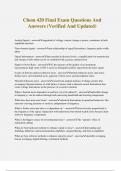
Chem 420 Final Exam Questions And Answers (Verified And Updated)
Chem 420 Final Exam Questions And Answers (Verified And Updated) Analog Signals - answermagnitude of voltage, current, charge or power, continuous in both amplitude and time Time-domain signals - answertime relationship of signal fluctuations, frequency pulse width, phase Digital Information - answerdata encoded in discrete levels, a simplification for transmission and storage of info which can be re-combined with accuracy and precision Signal-to-Noise Ratio - answerS/N, the measure of t...
Fyndlay
Examen
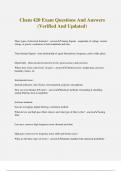
Chem 420 Exam Questions And Answers (Verified And Updated)
Chem 420 Exam Questions And Answers (Verified And Updated) Three types of electrical domains? - answerAnalog Signals - magnitude of voltage, current, charge, or power; continuous in both amplitude and time Time-domain Signals - time relationship of signal fluctuations; frequency, pulse width, phase Digital Info - Data encoded in discrete levels; great accuracy and precision Where does noise come from? (2 types) - answerChemical noise: temperature, pressure, humidity, fumes, etc Instrumen...
Fyndlay
Examen
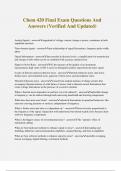
Chem 420 Final Exam Questions And Answers (Verified And Updated)
Chem 420 Final Exam Questions And Answers (Verified And Updated) Analog Signals - answermagnitude of voltage, current, charge or power, continuous in both amplitude and time Time-domain signals - answertime relationship of signal fluctuations, frequency pulse width, phase Digital Information - answerdata encoded in discrete levels, a simplification for transmission and storage of info which can be re-combined with accuracy and precision Signal-to-Noise Ratio - answerS/N, the measure of t...
TheStar
Examen
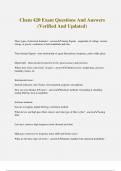
Chem 420 Final Exam Questions And Answers (Verified And Updated)
Chem 420 Exam Questions And Answers (Verified And Updated) Three types of electrical domains? - answerAnalog Signals - magnitude of voltage, current, charge, or power; continuous in both amplitude and time Time-domain Signals - time relationship of signal fluctuations; frequency, pulse width, phase Digital Info - Data encoded in discrete levels; great accuracy and precision Where does noise come from? (2 types) - answerChemical noise: temperature, pressure, humidity, fumes, etc Instrumen...
TheStar

Examen
Chem 420 TOP Exam Questions and CORRECT Answers
Three types of electrical domains?Analog Signals - magnitude of voltage, current, charge, or power; continuous in both amplitude and time Time-domain Signals - time relationship of signal fluctuations; frequency, pulse width, phase Digital Info - Data encoded in discrete levels; great accuracy and precision Where does noise come from? (2 types)Chemical noise: temperature, pressure, humidity, fumes, etc Instrumental noise: thermal (johnson), shot, flicker, environmental, popcorn, microp...
STANFORDGRADESS

Examen
Chem 420 Already Passed Exam Questions and CORRECT Answers
Analog Signalsmagnitude of voltage, current, charge or power, continuous in both amplitude and time Time-domain signalstime relationship of signal fluctuations, frequency pulse width, phase Digital Informationdata encoded in discrete levels, a simplification for transmission and storage of info which can be re-combined with accuracy and precision Signal-to-Noise RatioS/N, the measure of the quality of an instrument measurement, high value of S/N is easier to distinguish analyte signal...
STANFORDGRADESS

Examen
CHEM 420 Exam 4 Study Guide 13, 14, and 15 Latest Update 2023/2024
CHEM 420 Exam 4 Study Guide 13, 14, and 15 Latest Update 2023/2024
 Onlineexam