
- Guías de estudio, Notas de estudios & Resúmenes
¿Buscas las mejores guías de estudio, notas de estudio y resúmenes para ? En esta página encontrarás 8 documentos de estudio para .
Examen
Complete Solutions Breast Surgery
COMPLETE SOLUTIONS BREAST SURGERY BREAST 1. After intraductal papilloma, unilateral bloody nipple discharge from one duct orifice is most commonly caused by which of the following pathologic conditions? A. Paget's disease of the nipple. B. Intraductal carcinoma. C. Inflammatory carcinoma. D. Subareolar mastitis. Answer: B 2. Which of the following conditions is associated with increased risk of breast cancer? A. Fibrocystic mastopathy. B. Severe hyperplasia. C. Aty...
 QUICKEXAMINER
Examen
Complete solutions BREAST surgery Latest Update 2023 Questions and Answers 100% Correct Download to Get A
PopularComplete solutions BREAST surgery Latest Update 2023 Questions and Answers 100% Correct Download to Get A
 ConvenientLearning

Notas de lectura
Mastering Breast Surgery: In-Depth Notes from Renowned Dr. Laura Esserman on Anatomy, Mastectomy, Oncology, and Reconstructive Techniques
NuevoImmerse yourself in this extensive 205-page compilation of lecture notes from acclaimed U.S. breast surgical oncologist Dr. Laura Esserman, ideal for medical students, residents, and practitioners delving into the intricacies of breast surgery. Beginning with foundational anatomy—detailing the breast's extent from the second to sixth ribs, lateral sternal border to anterior axillary line, and extensions to the clavicle, lower ribs, and latissimus dorsi—the notes emphasize surgical relevan...
 Elitestudyvault

Examen
Complete Solutions Breast Surgery
COMPLETE SOLUTIONS BREAST SURGERY BREAST 1. After intraductal papilloma, unilateral bloody nipple discharge from one duct orifice is most commonly caused by which of the following pathologic conditions? A. Paget's disease of the nipple. B. Intraductal carcinoma. C. Inflammatory carcinoma. D. Subareolar mastitis. Answer: B 2. Which of the following conditions is associated with increased risk of breast cancer? A. Fibrocystic mastopathy. B. Severe hyperplasia. C. Aty...
 MYSOLUTIONS
Examen
Complete Solutions Breast Surgery
COMPLETE SOLUTIONS BREAST SURGERY BREAST 1. After intraductal papilloma, unilateral bloody nipple discharge from one duct orifice is most commonly caused by which of the following pathologic conditions? A. Paget's disease of the nipple. B. Intraductal carcinoma. C. Inflammatory carcinoma. D. Subareolar mastitis. Answer: B 2. Which of the following conditions is associated with increased risk of breast cancer? A. Fibrocystic mastopathy. B. Severe hyperplasia. C. Aty...
 TheInstructor
Examen
Complete Solutions Breast Surgery
COMPLETE SOLUTIONS BREAST SURGERY BREAST 1. After intraductal papilloma, unilateral bloody nipple discharge from one duct orifice is most commonly caused by which of the following pathologic conditions? A. Paget's disease of the nipple. B. Intraductal carcinoma. C. Inflammatory carcinoma. D. Subareolar mastitis. Answer: B 2. Which of the following conditions is associated with increased risk of breast cancer? A. Fibrocystic mastopathy. B. Severe hyperplasia. C. Aty...
 MedTestPro
Examen
Complete Solutions Breast Surgery
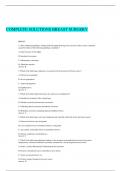
COMPLETE SOLUTIONS BREAST SURGERY BREAST 1. After intraductal papilloma, unilateral bloody nipple discharge from one duct orifice is most commonly caused by which of the following pathologic conditions? A. Paget's disease of the nipple. B. Intraductal carcinoma. C. Inflammatory carcinoma. D. Subareolar mastitis. Answer: B 2. Which of the following conditions is associated with increased risk of breast cancer? A. Fibrocystic mastopathy. B. Severe hyperplasia. C. Aty...
TheInstructor
Examen
Complete Solutions Breast Surgery
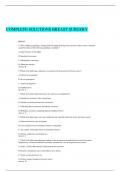
COMPLETE SOLUTIONS BREAST SURGERY BREAST 1. After intraductal papilloma, unilateral bloody nipple discharge from one duct orifice is most commonly caused by which of the following pathologic conditions? A. Paget's disease of the nipple. B. Intraductal carcinoma. C. Inflammatory carcinoma. D. Subareolar mastitis. Answer: B 2. Which of the following conditions is associated with increased risk of breast cancer? A. Fibrocystic...
 BESTEXAMINER01