
- Guías de estudio, Notas de estudios & Resúmenes
¿Buscas las mejores guías de estudio, notas de estudio y resúmenes para ? En esta página encontrarás 52 documentos de estudio para .
Examen
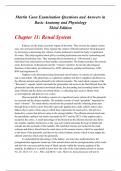
Chapter 11: Renal System Martin Caon Examination Questions and Answers in Basic Anatomy and Physiology Third Edition
Martin Caon Examination Questions and Answers in Basic Anatomy and Physiology Third Edition Chapter 11: Renal System 11.1 Renal Anatomy 1. What is the name for the entry point to the kidney for nerves, blood vessels, ureters and lymphatics? a. Calyx b. Hilus c. Pelvis d. Pyramid Answer is B: Hilum is the name of the point of attachment between an organ and its supply services. 2. Where are all of the glomeruli of the kidney located? a. In the medulla b. In the columns c. In t...
 ExamsRevision

Examen
Chapter 12: Cardiovascular System Martin Caon Examination Questions and Answers in Basic Anatomy and Physiology Third Edition
Martin Caon Examination Questions and Answers in Basic Anatomy and Physiology Third Edition Chapter 12: Cardiovascular System 12.1 Blood 1. To which of the following would the term “white cell” NOT be applied? a. Erythrocyte b. Leucocyte c. Lymphocyte d. Monocyte Answer is A: An erythrocyte is a red blood cell. 2. In the haemostasis process, what forms as a result of the extrinsic and intrinsic pathways? a. Fibrin b. Thrombin c. A platelet plug d. Prothrombinase Answer...
ExamsRevision
Examen
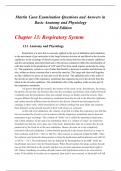
Chapter 13: Respiratory System Martin Caon Examination Questions and Answers in Basic Anatomy and Physiology Third Edition
Martin Caon Examination Questions and Answers in Basic Anatomy and Physiology Third Edition Chapter 13: Respiratory System 13.1 Anatomy and Physiology 1. Which of the following statements could be applied to “external respiration”? a. Exchange of gases between alveolar air and the blood in pulmonary capillaries b. Exchange of dissolved gases between blood in tissue capillaries and the body tissues c. The production of CO2 from organic molecules in the cells by using O2 d. The in...
ExamsRevision

Examen
Chapter 9: Gastrointestinal System Martin Caon Examination Questions and Answers in Basic Anatomy and Physiology Third Edition
Martin Caon Examination Questions and Answers in Basic Anatomy and Physiology Third Edition Chapter 9: Gastrointestinal System 9.1 Anatomy and Function 1. Which type of cell produces hydrochloric acid? a. Zymogenic cells b. Parietal cells c. Chief cells d. Enteroendocrine cells Answer is B: The parietal cells of gastric glands produce hydrochloric acid. (Zymogenic cells are the same as chief cells, and they produce pepsinogen.) 2. What is the role of gastrin in the digestive ...
ExamsRevision

Examen
Chapter 10: Endocrine System Martin Caon Examination Questions and Answers in Basic Anatomy and Physiology Third Edition
Martin Caon Examination Questions and Answers in Basic Anatomy and Physiology Third Edition Chapter 10: Endocrine System 10.1 Endocrine System and Hormones in General 1. Which statement below about hormones is true? a. Hormones are enzymes that catalyse reactions. b. Hormones are released into the blood circulation. c. Hormones affect all cells of the body. d. Hormones are released by neurones at synapses. Answer is B: Hormones are circulating messengers that are transported in blood...
ExamsRevision

Examen
Chapter 8: Muscular System Martin Caon Examination Questions and Answers in Basic Anatomy and Physiology Third Edition
Martin Caon Examination Questions and Answers in Basic Anatomy and Physiology Third Edition Chapter 8: Muscular System 8.1 Muscle Naming 1. Which muscle naming criteria are used to name the quadriceps femoris? a. Muscle action and location b. The origin and insertion c. Location and direction of muscle fibres d. Location and number of origins Answer is D: Femoris refers to location on the femur, quadriceps refers to four origins. 2. Which of the following muscles is named accor...
ExamsRevision
Examen
Basic Anatomy and Physiology questions and answers latest top score.
Basic Anatomy and Physiology questions and answers latest top score.
 stuvaai

Examen
Chapter 4: Chemistry for Physiology Martin Caon Examination Questions and Answers in Basic Anatomy and Physiology Third Edition
Martin Caon Examination Questions and Answers in Basic Anatomy and Physiology Third Edition Chapter 4: Chemistry for Physiology 4.1 Atoms and Molecules 1. The chemical formula C6H12O6 contains much information. However, what information is NOT provided by the formula? a. The number of atoms in a molecule b. The name of the substance c. The elements that make up the substance d. Whether the substance is covalent or ionic Answer is B: The name may be guessed at, but it is possible for...
ExamsRevision

Examen
Chapter 5: Integumentary System Martin Caon Examination Questions and Answers in Basic Anatomy and Physiology Third Edition
Martin Caon Examination Questions and Answers in Basic Anatomy and Physiology Third Edition Chapter 5: Integumentary System 5.1 Layers of the skin 1. What is the name given to the most superficial layer of the integument? a. Stratum corneum b. Papillary dermal layer c. Stratum lucidum d. Superficial fascia Answer is A: The stratum corneum is the horny (i.e. keratinised), dead covering to the epidermis. Choice D is another name for the hypodermis. 2. Which layer of the integumen...
ExamsRevision
Examen
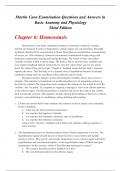
Chapter 6: Homeostasis Martin Caon Examination Questions and Answers in Basic Anatomy and Physiology Third Edition
Martin Caon Examination Questions and Answers in Basic Anatomy and Physiology Third Edition Chapter 6: Homeostasis 1. Choose one answer below that completes the sentence so that it makes a true statement. Positive feedback: a. Is the way the body maintains homeostasis b. Is a response that opposes a stimulus c. Is a response that maintains a dynamic state of equilibrium d. Is a response that enhances a stimulus Answer is D: “Positive” feedback will reinforce the stimulus, making it...
ExamsRevision
Examen
Chapter 7: Skeletal System Martin Caon Examination Questions and Answers in Basic Anatomy and Physiology Third Edition
Martin Caon Examination Questions and Answers in Basic Anatomy and Physiology Third Edition Chapter 7: Skeletal System 7.1 Bones 1. Which of the following is NOT a bone of the axial skeleton? a. Deltoid b. Ethmoid c. Sphenoid d. Hyoid Answer is A: The “deltoid” bone does not exist. Choice D, the hyoid does not articulate with any bone, but being in the neck is considered part of the axial skeleton. 2. Which of the following is a function of the skeletal system? a. Haemopoi...
ExamsRevision

Examen
Chapter 3: Measurement, Errors, Data and Unit Conversion Martin Caon Examination Questions and Answers in Basic Anatomy and Physiology Third Edition
Martin Caon Examination Questions and Answers in Basic Anatomy and Physiology Third Edition Chapter 3: Measurement, Errors, Data and Unit Conversion 3.1 Measurement and Errors 1. Say that someone’s body temperature is measured by four different devices and the resulting four measurements are given below. Which reading has an absolute error of ±0.05 °C? a. 38 °C b. 37.8 °C c. 37.85 °C d. 37.855 °C Answer is B: Absolute error is plus or minus half the smallest scale interval....
ExamsRevision

Examen
Chapter 2: Cells and Tissues test bank Martin Caon Examination Questions and Answers in Basic Anatomy and Physiology Third Edition
Martin Caon Examination Questions and Answers in Basic Anatomy and Physiology Third Edition Chapter 2: Cells and Tissues 2.1 Cell and Membrane Structure Cells are composed of their cytoplasm, which includes the cytosol and organelles, the nucleus and the surrounding plasma membrane. You should know that the plasma membrane is a double layer of phospholipid molecules and that these molecules have a hydrophilic end and a hydrophobic end. The plasma membrane contains proteins including t...
ExamsRevision

Examen
Chapter 1: Organisation of the Body Test Bank Martin Caon Examination Questions and Answers in Basic Anatomy and Physiology Third Edition
Martin Caon Examination Questions and Answers in Basic Anatomy and Physiology Third Edition Chapter 1: Organisation of the Body A large part of beginning the study of anatomy and physiology is learning the specialised words that are used. This new terminology may seem daunting, but the challenge lies in its unfamiliarity rather than its difficulty of comprehension. You must expect to encounter a lot of new words and be prepared to learn them over the course of your study. Most of the words...
ExamsRevision

Examen
Basic anatomy and physiology Questions and Answers (2023/2024) (Verified Answers)
Basic anatomy and physiology Questions and Answers (2023/2024) (Verified Answers)
TIPSCORE

Examen
Basic anatomy and physiology Questions and Answers (2023/2024) (Verified Answers)
Basic anatomy and physiology Questions and Answers (2023/2024) (Verified Answers)
TIPSCORE
Examen
TEST BANK FOR Examination Questions and Answers in Basic Anatomy and Physiology Updated Version 2023
TEST BANK FOR Examination Questions and Answers in Basic Anatomy and Physiology Updated Version 2023
 Tutordiligent

Examen
Basic Anatomy and Physiology questions and answers latest top score.
Basic Anatomy and Physiology questions and answers latest top score. Define anatomy - correct study of the structure of the human body Define physiology - correct science that deals with the function of the living organism Describe the anatomic position - correct ing erect with feet together -facing the observer -arms at the sides with the palms forward mid-sagittal/ median - correct es the body into equal right and left proportions transverse - correct ...
 Lectsadh

Examen
Examination Questions and Answers in Basic Anatomy and Physiology 2400 Multiple Choice Questions 2nd Edition Martin Caon
Examination Questions and Answers in Basic Anatomy and Physiology 2400 Multiple Choice Questions 2nd Edition Martin Caon Examination Questions and Answers inology 2400 Multiple Choice Questions Second Examination Questions and Answers in Basic Anatomy and Physiology 2400 Multiple Choice Questions 2nd Edition Martin Caon TABLE OF Chapter 1 Organisation of the Body 1. Which of the listed terms is described by: “All the chemical processes that take place in the organelles and cytoplasm the cells ...
 testsolution

Lote
Anatomy and Physiology | Bundled Exams with complete solution | everything you need
Anatomy and Physiology | Bundled Exams with complete solution | everything you need
 Brainarium